
ZoomInfo’s GTM.AI connector ranked first among 11 go-to-market providers in Anthropic’s connector directory throughout a nine-week independent study, according to a new benchmark from Send. For revenue teams experimenting with Claude and other AI assistants, the result is a visibility win for ZoomInfo’s pitch: live, permissioned business data is becoming a core input to agent-driven account research.
Send’s The State of GTM Connectors tracked the directory’s public popularity score every minute from July through September 2025, collecting more than 100,000 snapshots. ZoomInfo led every weekly measurement with a normalized index of 100.0, though the top providers were separated by only about two points—an important caveat for anyone treating a directory ranking as a definitive usage league table.
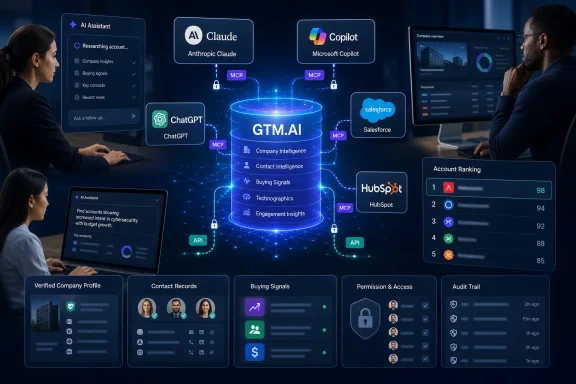
ZoomInfo said its Claude connector is powered by GTM.AI, its API and Model Context Protocol-based context layer. The company positions it as a route for Claude to retrieve verified company, contact, technographic, and buying-signal data while preserving customer entitlements rather than relying on exported lists.
The Send study measures a public popularity signal, not the accuracy of returned records, commercial adoption, or revenue generated through the connector. That distinction matters because connector rankings can show discovery and installation interest without revealing how frequently a service is used in production or whether its answers improve sales outcomes.
Anthropic’s own documentation describes connectors as a way for Claude to access connected applications and services under the user’s existing permissions. The company also warns that enabling a connector can allow Claude to access—or potentially modify—data according to those permissions. For IT teams, the operational question is therefore less about a leaderboard position and more about the connector’s scopes, auditability, retention terms, and controls around sensitive customer data.
The company previously said its Claude integration allows ZoomInfo customers to connect their entitlements through a native directory connector, including in Claude.ai and Claude Code. In practical terms, a user can ask an assistant to map an account’s buying committee or research a target company without first exporting a spreadsheet into a prompt.
That convenience also expands the governance burden. Administrators should verify that connector authorization maps cleanly to least-privilege roles, that CRM and data-provider permissions are consistently enforced, and that agent actions cannot turn a broad research request into uncontrolled list building or data extraction.
For Windows-centric enterprises adopting Microsoft Copilot alongside Claude or ChatGPT, the more meaningful milestone will be whether one governed data layer can actually deliver consistent permissions and traceability across all of those tools.
ZoomInfo said its Claude connector is powered by GTM.AI, its API and Model Context Protocol-based context layer. The company positions it as a route for Claude to retrieve verified company, contact, technographic, and buying-signal data while preserving customer entitlements rather than relying on exported lists.
 A directory score is not a data-quality audit
The Send study measures a public popularity signal, not the accuracy of returned records, commercial adoption, or revenue generated through the connector. That distinction matters because connector rankings can show discovery and installation interest without revealing how frequently a service is used in production or whether its answers improve sales outcomes.Anthropic’s own documentation describes connectors as a way for Claude to access connected applications and services under the user’s existing permissions. The company also warns that enabling a connector can allow Claude to access—or potentially modify—data according to those permissions. For IT teams, the operational question is therefore less about a leaderboard position and more about the connector’s scopes, auditability, retention terms, and controls around sensitive customer data.
The Microsoft Copilot overlap is the enterprise angle
ZoomInfo says the same GTM.AI layer supports integrations spanning Claude, ChatGPT, Microsoft Copilot, Salesforce Agentforce, and HubSpot Breeze. That multi-assistant approach could appeal to organizations where sales and marketing staff use different AI surfaces but security teams want one source for identity, permissions, and data lineage.The company previously said its Claude integration allows ZoomInfo customers to connect their entitlements through a native directory connector, including in Claude.ai and Claude Code. In practical terms, a user can ask an assistant to map an account’s buying committee or research a target company without first exporting a spreadsheet into a prompt.
That convenience also expands the governance burden. Administrators should verify that connector authorization maps cleanly to least-privilege roles, that CRM and data-provider permissions are consistently enforced, and that agent actions cannot turn a broad research request into uncontrolled list building or data extraction.
Popularity helps, but controls decide deployment
ZoomInfo’s first-place showing gives GTM.AI a useful marketing proof point as connector directories become a new distribution channel for enterprise data services. It does not settle the harder questions around data freshness, access boundaries, and whether a specific organization’s AI workflows should receive contact and account intelligence at all.For Windows-centric enterprises adopting Microsoft Copilot alongside Claude or ChatGPT, the more meaningful milestone will be whether one governed data layer can actually deliver consistent permissions and traceability across all of those tools.
References
- Primary source: FinancialContent
Published: 2026-07-31T19:08:00+00:00

Independent Research Ranks ZoomInfo the #1 GTM Connector in Anthropic's Directory | FinancialContent
ZoomInfo (NASDAQ: GTM), the all-in-one AI GTM platform, ranked as the number one go-to-market connector in Anthropic's connector directory in a new independent benchmark from Send. The study, "The State of GTM Connectors," tracked eleven GTM providers over nine consecutive weeks...
www.financialcontent.com
- Related coverage: support.claude.com
Anthropic Software Directory Policy | Claude Help Center
support.claude.com