

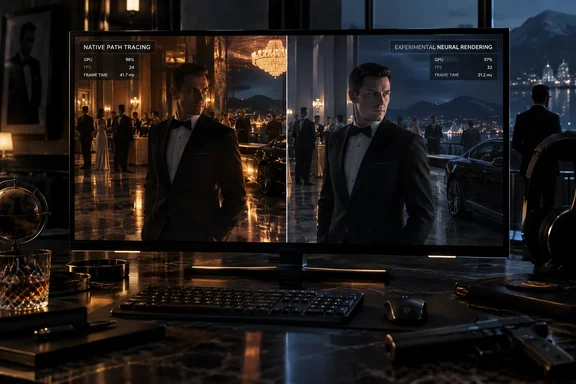
The headline result is less that DLSS 5 looks good than that it cannot repair what rasterized lighting never calculated. DSOGaming’s comparisons find that the mod can improve the apparent detail and material response of characters, but it does not recreate the coherent reflections, shadows, indirect illumination, and scene-wide light behavior produced by IO Interactive’s native path-tracing mode.
That distinction is the important one for anyone deciding where to spend their performance budget: DLSS 5 processes the image the game has already rendered; path tracing changes how the game calculates light in the first place. At current performance levels, the practical choice on all but the fastest GeForce hardware remains the official path-tracing option, DLSS 4.5 Ray Reconstruction, and conventional upscaling or frame generation—not a second, experimental generative-rendering pass.
A free path-tracing update with a steep GPU requirement
IO Interactive released path tracing for the Windows version of 007 First Light on September 15 as a free update for GeForce RTX systems. The studio says its Glacier engine uses RTX Global Illumination, RTX Path Tracing, Opacity Micro-Maps, and DLSS 4.5 Ray Reconstruction to render direct lighting, bounced light, shadows, and reflections through a unified lighting model.
The feature is additive rather than a replacement for the game’s existing rasterized renderer. Players whose PCs do not meet the requirement can continue using the standard graphics path, while eligible RTX users enable Path Tracing in the game’s graphics settings. IO Interactive has also said the option will not appear at all when the system misses its minimum hardware threshold.
The official performance targets make clear how demanding the new rendering mode is. IO Interactive’s published requirements position an RTX 5070 with a Core i5-13500 or Ryzen 5 7600 and 16GB of RAM as the entry point for 1080p, 60 FPS, Path Tracing Medium. Its stated 1440p, 60 FPS target at the same preset moves up to an RTX 5080. For 4K Path Tracing High, the company lists an RTX 5090, 32GB of RAM, and a faster Core i5-13600K or Ryzen 7 7700X-class processor.
Those specifications concern the official rendering stack, which uses DLSS 4.5 Ray Reconstruction and can use Frame Generation. They should not be read as a recommendation for DLSS 5. NVIDIA’s official material did not list 007 First Light among the announced DLSS 5 titles, and IO Interactive’s path-tracing announcement names DLSS 4.5 Ray Reconstruction, not DLSS 5, as its supported AI component.
What the DLSS 5 comparison actually tested
DSOGaming’s September 16 test did not add an official NVIDIA feature toggle to the game. It used version 0.6 of the community-made DLSS eXtended Loader, or DXL, on Windows 10 with a Ryzen 9 7950X3D, 32GB of DDR5-6000 memory, an RTX 5080, and GeForce driver 616.92. The tester selected the loader’s standard default profile and left its performance-oriented settings alone.
That methodology matters. DXL is designed to apply NVIDIA’s neural-rendering technology to compatible games through an external utility. Its own documentation says compatibility differs by game, while its performance controls include reducing the neural-rendering resolution, lowering optical-flow quality, and changing the number of sequential neural-rendering layers. It is not an in-engine DLSS 5 integration built, profiled, or validated by IO Interactive.
The loader can use a game’s native motion-vector data where that route is supported, which is preferable to estimating movement from the finished image. Yet the process still adds a substantial workload after the game has rendered its frame. DXL’s documentation directly warns that lowering its render scale saves GPU time, while repeated “true” neural-rendering layers increase GPU time and memory use. DSOGaming tested at the default quality-oriented configuration, so its result is useful as an image-quality showcase but does not establish the best attainable performance setting.
More importantly, the test uses “DLSS 5” as shorthand for an external neural-rendering modification. That should not be conflated with a native game implementation. NVIDIA describes DLSS 5 as a renderer-grounded system that consumes the current rendered frame, motion vectors, temporal state, and artistic controls. In a full integration, developers can also control intensity, color grading, and masking within the game pipeline. 007 First Light currently has none of that official DLSS 5 support.
Better character rendering does not equal path-traced lighting
In DSOGaming’s screenshots, the most visible DLSS 5 gains appear around people: skin, faces, fabrics, and other materials look more refined than the rasterized baseline. That aligns with NVIDIA’s own description of DLSS 5, which says the model can synthesize details associated with hair, translucent skin, fabric, and light-material interactions.
But visual plausibility at the pixel level has limits. A rasterized scene can lack a reflection because the reflection data was not traced, miss indirect illumination because the light never bounced through the environment, or use a screen-space approximation that fails when an object goes off-screen. An external post-render neural pass can alter the appearance of those pixels, but it cannot ask Glacier’s renderer to trace a new path from a light source, through a window, onto a floor, and into a reflected surface.
IO Interactive’s description of its own path-tracing implementation explains why the distinction is so apparent in the comparison shots. The studio has replaced discrete lighting approximations with one light-transport pass intended to handle shadows, direct light, indirect bounce, and reflections together. It also says the system adapts which lights receive rays based on what contributes to the image, a significant advantage in locations full of practical lights and reflective surfaces.
DSOGaming’s conclusion—that path tracing remains superior to DLSS 5 when a player must choose one—follows from that difference in inputs. DLSS 5 can make a rasterized frame look richer, particularly in close-ups, but the rasterized renderer still supplies the spatial and lighting facts. A generative output cannot reliably stand in for scene data that was not rendered.
Two tests, same warning
DSOGaming is not the only outlet to find that an external DLSS 5 layer carries a punishing performance cost in 007 First Light. GameGPU reported a separate September 15 test on an RTX 5090 at 4K with the official DLSS 4.5 Performance preset and path tracing already enabled. Using a different external tool, it recorded 47–76 FPS across its test scenes before the DLSS 5 pass, then 18–25 FPS after enabling it.
The exact numbers should not be combined with DSOGaming’s figures. The two outlets used different GPUs, scenes, utilities, and configurations. GameGPU’s external NeuralScreen setup is not DXL, and DSOGaming’s RTX 5080 test used its own default loader profile. Neither is a substitute for controlled, native-versus-native benchmarking.
The broad result is corroborated, however: two independent experiments using two different external approaches found that adding DLSS 5 to 007 First Light can turn high-end RTX hardware into a sub-30-FPS experience. In GameGPU’s case, the RTX 5090 test also reported 99 percent GPU utilization, 18GB or more of allocated VRAM, and dramatically higher board power under the modified pipeline.
That undercuts the tempting assumption that DLSS 5 is another DLSS-style performance feature. NVIDIA is positioning it as a generative-rendering stage intended to improve final image appearance, not as a zero-cost upscaler. The model’s inference has a real compute budget, and a mod that bolts it onto a finished game frame has little opportunity to share data, schedule work efficiently, or avoid redundant processing.
The sensible settings path for RTX owners
For 007 First Light players with an RTX 5070 or RTX 5080, the evidence points to a straightforward approach: use the official path-tracing mode at a realistic resolution and preset, retain the game’s DLSS 4.5 Ray Reconstruction path, and consider Frame Generation where its latency and image behavior suit the game. This is the route IO Interactive designed and published hardware targets for.
An RTX 5080 owner chasing 4K should not expect the DXL default profile plus Path Tracing High to be viable based on DSOGaming’s 20–28 FPS result. Lowering the mod’s render scale may regain some performance, but it weakens the visual advantage that justified the experiment. DSOGaming found 1080p with DLSS Quality was the configuration that got the combined mode beyond roughly 40 FPS, with a 50 percent render scale at 1440p as another compromise.
Players who want to try DXL should also keep troubleshooting simple. Record a repeatable scene with the mod disabled, enable only its master neural-rendering effect first, change one setting at a time, and compare both image quality and frame pacing rather than watching only the average FPS counter. Keep a clean way to launch the unmodified game; an external tool can break after a game update, driver revision, overlay change, or anti-cheat adjustment.
For now, 007 First Light is evidence of both what DLSS 5 can add visually and why developer integration still matters. IO Interactive’s September 15 update gives Windows PC players a fully supported path-tracing renderer with a clear hardware floor. The modded DLSS 5 comparisons show an intriguing extra layer—but on an RTX 5080, it costs so much that the clearest practical outcome is to enable the official path tracing first and leave the experimental neural pass off.
Update: Injector comparison reports cleaner DLSS 5 detail at 4K (September 23, 2026)
NeoTeo reports that a separate experimental injector comparison found DLSS 5 could improve fine-detail stability versus the game’s stock DLSS 4.5 profile under 4K, maximum settings, and full path tracing. The test reportedly used an RTX 5090 and compared the two image paths under the same stated conditions.
According to NeoTeo, the injected setup produced clearer small details on vehicle bodywork, grilles, and a watch dial, while reducing subpixel flicker and dynamic ghosting. The report did not publish a frame-rate verdict, so it does not counter the earlier performance findings from external DLSS 5 tests.
This reinforces the distinction between image quality and practicality. The injector may offer visible reconstruction benefits in selected scenes, but it remains an unofficial, externally applied pipeline rather than IO Interactive’s supported DLSS 4.5 implementation.
References
- 007 First Light – Path Tracing vs DLSS 5 Comparisons DSOGaming · 2026-09-16T11:05:00+00:00