

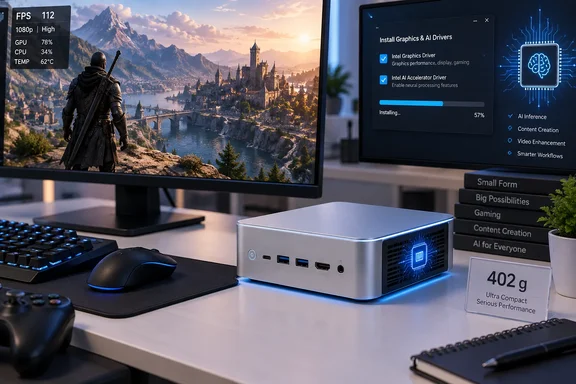
The review is the only hands-on report available so far. The benchmark figures below are the reviewer's own measurements, and nobody has reproduced them independently. The hardware specifications are backed by AceMagic's product listing, Intel's processor specifications and several launch reports from August.
The AceMagic FOCUX F2A puts Panther Lake in a 402-gram box
AceMagic announced the new F2A in late August. It shares only a name with the earlier 2024 F2A. According to androidtvbox.eu, the company rebuilt the machine inside and out: a new silver chassis replaces the old black-and-glass design, and buyers now choose between Intel's Panther Lake Core Ultra X7 358H, reaching up to 180 TOPS of total AI performance, or an AMD Ryzen AI9 HX 470 at up to 86 TOPS. Retro Handhelds reviewed the Intel version, and everything in this article applies only to that configuration.
The Core Ultra X7 358H is a 16-core chip built on Intel's 18A process, combining four Performance cores, eight Efficient cores, and four Low-Power Efficient cores, boosting to 4.8GHz. Intel's own specification sheet adds 18 MB of cache, a 25 W base power and an 80 W maximum turbo power. For graphics, the F2A relies on an integrated Arc B390 GPU, based on the Xe3 architecture. It includes 12 Xe-cores and supports modern standards like AV1 encoding and decoding, ray tracing, and XeSS upscaling.
AceMagic sets its own power limits below Intel's processor ceiling. The review lists a 65 W maximum design power, 54 W sustained and a 25 W low-power mode, fed by a 19 V / 6.32 A DC adapter with a 5.5 × 2.1 mm barrel plug. That 65 W figure describes the whole system, while Intel's 80 W is a processor specification. They don't contradict each other: AceMagic simply chose a lower power budget for this chassis than the chip allows. The review does not test whether a different power mode changes performance.
Connectivity is generous for the size. On the front, a 40Gbps USB4 Type-C port, which Acemagic says supports external GPU (eGPU) expansion for those who need more graphics power than the integrated chips can provide, alongside two USB 3.2 Gen 2 Type-A ports, and a 3.5mm audio jack. The rear panel houses an HDMI 2.1 TMDS port, a DisplayPort, dual 2.5Gbps Ethernet jacks, two USB 3.2 Gen 1 Type-A ports, and a secondary 20Gbps USB-C port that supports 100W power delivery input and DP 1.4. The mini PC can drive up to four displays simultaneously, including an 8K monitor through DisplayPort 2.1. The review rates HDMI at 4K/60 Hz and DisplayPort at 8K/60 Hz. Wireless is Wi-Fi 7 and Bluetooth 5.4.
Soldered 32 GB and Expandable Storage Define the F2A's Upgrade Path
The most important spec for a long-term buyer isn't in the review's headline. Gizmochina reports that inside the 128 x 128 x 37 mm case, the F2A comes with 32GB of soldered LPDDR5X memory and a 1TB NVMe SSD. The review lists the memory as "LPDDR5" at 7500 MT/s. AceMagic's materials say LPDDR5X-7500, so the review's label looks like shorthand for the same memory, not a different part.
Whichever label you use, the memory can't be upgraded. For local AI work, where model size is limited by available memory, 32 GB is a fixed ceiling for the life of the machine. One launch report, from XiaomiToday, claims the F2A can be configured with up to 64GB of LPDDR5X memory. The other launch coverage, AceMagic's own listing and the reviewed unit all describe 32 GB, so buyers should assume 32 GB unless a retailer clearly lists something else.
Storage is where you can expand. AceMagic's product page lists 1× M.2 2280 NVMe PCIe 4.0×4 SSD (1TB pre-installed) 2× M.2 2280 NVMe slots (1× PCIe 4.0×4, 1× PCIe 5.0×4) Up to 2TB per slot, maximum total 4TB. The listing's wording doesn't make clear whether the pre-installed drive sits in one of those two slots. Either way, the 4 TB total and the PCIe 5.0 slot give more storage headroom than most boxes this size.
Arc B390 Gaming Results Put the F2A Past the Budget Mini-PC Tier
Gaming is where the F2A clearly moves beyond its cheaper siblings. The same reviewer tested the AceMagic K5, a Wildcat Lake machine, in August and called gaming on it an afterthought. With the Arc B390, the reviewer calls the F2A "a fairly capable gaming machine."
These are the reviewer's numbers. In 3DMark, the F2A scored 38,869 in Night Raid (GPU score 59,654), 10,938 in Fire Strike (GPU score 13,112) and 4,176 in Steel Nomad Light. The review also lists a 278.8% gain in the Mesh Shaders feature test and 49.0% in Sampler Feedback, but it doesn't say what those gains are measured against, so treat them as descriptive only.
The game tests are more useful. In Rise of the Tomb Raider's built-in benchmark, the reviewer says medium/low settings held a steady 60 fps with no stutters. They then raised the settings to 1080p High with 4× SSAA, tessellation, screen-space reflections and triple-buffered VSync, which is a deliberately heavy load:
| Benchmark scene (1080p High, 4× SSAA) | Avg fps | Min fps | Max fps |
|---|---|---|---|
| Mountain Peak | 49.92 | 29.58 | 64.74 |
| Syria | 34.34 | 26.64 | 41.48 |
| Geothermal Valley | 35.15 | 25.38 | 46.42 |
| Overall | 40.13 | — | — |
SSAA renders the image at a higher internal resolution and scales it down, which is expensive on any GPU. Those High-preset numbers show what the chip can do at its limit. They don't show typical play: dropping SSAA would be the obvious first change for anyone actually playing. In Forza Horizon 6 at the 1080p Low preset, the review reports 58 fps on average, a 100% GPU-limited result, zero stutters and 63.7 ms average latency.
The reviewer's own summary is realistic. The F2A delivered "decent numbers" but doesn't replace a discrete RTX 4070-class card, and they note that cheaper machines offer similar gaming performance. For an eGPU through the front USB4 port, AceMagic claims support, but the review didn't test it.
Geekbench Puts the X7 358H Well Ahead of AceMagic's Older Flagship
For CPU performance, the review compares Geekbench scores across three AceMagic machines the reviewer has tested:
| System | Single-core | Multi-core | Reviewer's price context |
|---|---|---|---|
| FOCUX F2A (Core Ultra X7 358H) | 2,431 | 13,369 | ~$1,140 |
| AceMagic M1 (Core i9-13900HK) | 2,545 | 8,976 | ~$700 |
| AceMagic K5 (Wildcat Lake) | 2,283 | 7,637 | ~$400 |
The pattern is clear. Single-core speed barely changes, and the older i9-13900HK actually edges ahead. The F2A's multi-core score, though, is about 49% higher than the M1's and roughly 75% higher than the K5's. For compiling code, virtual machines, batch media work and other multi-threaded Windows jobs, that's the gain you're paying for. For lightly threaded office work, the F2A won't feel much faster than the M1.
The F2A's NPU Stayed Idle Until Intel Drivers Were Installed
The review's biggest practical finding concerns setup, not speed. The reviewer reports that the F2A arrived with a standard OEM Windows 11 Pro install and, as far as they could tell, no NPU drivers. Before they downloaded Intel's drivers, the GPU was the only AI accelerator available to the OpenVINO-based Geekbench AI tests. The reviewer also recommends updating the GPU driver.
After the drivers were installed, the NPU results were striking:
| Backend | Single precision | Half precision | Quantized |
|---|---|---|---|
| NPU (OpenVINO) | 3,122 | 39,345 | 60,711 |
| GPU (DirectML) | 8,564 | 14,985 | 5,646 |
| CPU (ONNX) | 3,360 | 1,358 | 6,241 |
These results show a split, not a clean win. The NPU led by a wide margin in half-precision and quantized workloads, the lower-precision formats that local inference usually relies on. The GPU was well ahead at single precision. Keep in mind that the three backends ran through different software stacks (OpenVINO, DirectML and ONNX), and the review doesn't give per-workload methodology. The scores show relative strength by precision on this unit, not general application speed.
The "180 TOPS" figure needs the same care. As Guru3D points out, ACEMAGIC quotes as much as 180 TOPS of combined platform AI performance. That total incorporates different processing blocks and should not be compared directly with NPU-only ratings. Applications must explicitly use the CPU, GPU or NPU supported by their software frameworks. Intel's specification lists the NPU at 50 TOPS (INT8) and the Arc B390 at 122 TOPS. It also lists OpenVINO, Windows ML, WebNN and ONNX Runtime as the frameworks the NPU supports. In practice, an application only uses the NPU if it's built on one of those paths and the driver is present, which is exactly what the reviewer ran into.
The reviewer's complaint also comes with history. With the K5 six weeks earlier, they couldn't initialize the Wildcat Lake NPU until Intel released a driver update near the end of testing. They say Panther Lake driver support is "significantly more mature." In both cases, the fix came from Intel rather than from anything AceMagic shipped. The reviewer's minimum request is a printed insert telling buyers to get current drivers from Intel. The review covers a single unit, so it's not certain every retail F2A ships the same way, but buyers should check for themselves.
Pricing Discrepancies Muddy the FOCUX F2A's Value Case
Price is where the F2A's case is weakest, and even the price itself isn't settled. The review gives a $1,299.99 MSRP and an Amazon price of $1,104.99 after a 15% coupon, while its Geekbench table uses about $1,140. At launch, Gizmochina reported that it is priced at $1,099 during the preorder period, down from the stated $1,699 regular price, with shipping set to begin on August 31. So the "regular" figures range from $1,299.99 to $1,699, while actual selling prices seem to stay close to $1,100.
The reviewer puts the F2A alongside the Mac mini M4 and entry-level workstations. For another Panther Lake point of reference, TechPowerUp's coverage refers to a $1,800 M2 Pro Mini PC With Intel Arc B390 iGPU and 32 GB RAM from Minisforum. Guru3D describes the F2A as substantially smaller than the previously covered MINISFORUM M2 Pro based on the same processor. Nobody has compared the two directly, but at around $1,100 the F2A is the cheaper way into this chip.
What this means for you
The F2A is a sensible buy for a small group: people who already run local AI workloads through OpenVINO, Windows ML or ONNX Runtime, want Panther Lake now, and are comfortable handling drivers themselves. The reviewer reaches the same conclusion. Anyone mainly after 1080p gaming or a compact office PC can get similar gaming performance for less, and anyone whose AI plans are vague is paying for hardware they may never use. Enterprise buyers should note that Intel's specification lists Intel Standard Manageability but not vPro-class Active Management Technology on this chip.
- Buy it at around $1,100, not $1,299.99 or $1,699. Launch preorders and Amazon coupons have both hit that level.
- Treat 32 GB as permanent. The LPDDR5X memory is soldered, so if you expect to run larger local models, this isn't the machine for you.
- Once it arrives, install Intel's current NPU driver and update the Arc graphics driver before judging AI performance. Then confirm your AI tool actually detects the NPU.
- Read "180 TOPS" as a combined CPU+GPU+NPU platform figure. The NPU alone is rated at 50 TOPS, and each application uses only the engine its framework targets.
- Expect roughly 40 fps on average at demanding 1080p High settings with SSAA, and about 60 fps at medium/low presets, based on the reviewer's Rise of the Tomb Raider and Forza Horizon 6 runs.
- Use the PCIe 5.0 M.2 slot and USB4 port for growth. Storage goes up to 4 TB, and AceMagic says the front USB4 port supports an eGPU, though no review has tested that.
The FOCUX F2A shows that a 400-gram Windows box can now handle modern games at 1080p and run a real NPU next to a strong 16-core CPU. That hardware is only useful if the software is there. AceMagic has made the chassis, ports and storage options right, but it still ships Windows without the driver that makes the AI hardware work. Until retail units come with Intel's NPU stack installed, or at least a note telling buyers to get it, the F2A suits enthusiasts who were going to install drivers anyway, bought as close to $1,100 as they can find it.