

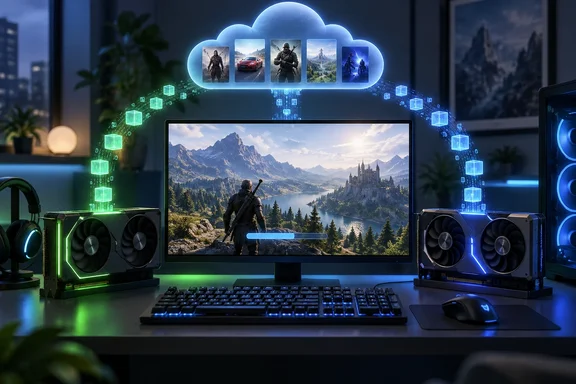
That matters because GeForce cards are a large share of Windows gaming PCs. They were also the most obvious gap while ASD stayed an AMD-only feature on the desktop. The announcement is real, but as of this writing it describes a plan. The fine print covers dates, drivers and which games actually support it, and one early hands-on test already shows the feature failing where it was supposed to work.
What Advanced Shader Delivery actually does
On a PC, a DirectX 12 game has to turn its shaders into instructions your specific GPU and driver can run. That compile step is usually done by your CPU, either:
- as a progress bar the first time you launch a game, which can take several minutes, or
- during play, which causes the familiar hitches and stutter when a new effect appears on screen.
ASD moves that work off your PC. Microsoft's DirectX team says that by delivering precompiled shaders with the game download, ASD cuts the shader work a player's CPU has to do at startup. Games launch faster and stutter less from runtime compilation. A console never has this problem because every unit has the same hardware. Windows PCs come in thousands of GPU and driver combinations, so precompiled shaders have to be built and matched for each one.
VideoCardz notes that ASD works differently from NVIDIA's existing Auto Shader Compilation feature: NVIDIA's feature can rebuild DirectX 12 shaders after a driver update, while Microsoft's ASD system distributes GPU-specific precompiled shaders together with the game download. Microsoft's own post doesn't compare the two. Based on how they're described, they look like complementary tools: one is the driver tidying up after an update, the other is the storefront shipping shaders ready to use.
To be clear, ASD isn't a frame-rate boost. It doesn't make your GPU render faster. It cuts down the waiting and the stutter caused by compiling shaders, which is a different problem from raw performance.
Section summary: ASD ships game- and hardware-specific compiled shaders through the store, so your CPU doesn't have to build them. The payoff is shorter first launches and less compile-related stutter, not higher FPS.
The hardware list, vendor by vendor
Microsoft's October 1 post splits support into what works now and what arrives "later this month." Here's how it breaks down:
| Vendor | Supported hardware | Minimum driver | Status |
|---|---|---|---|
| AMD | RDNA 1, RDNA 2, RDNA 3, RDNA 3.5, RDNA 4 | Adrenalin 26.6.1 or higher | Available |
| Qualcomm | Snapdragon X2 Series | 2026.08.3 or higher | Available |
| Intel | Arc B570, Arc B580, Core Ultra Series 2, Core Ultra Series 3 | Not yet published | Later in October |
| NVIDIA | All RTX GPUs and RTX Spark | Not yet published | Later in October |
The operating system floor for every vendor is Windows 11 24H2 or newer. Windows 10 is out, and so is any Windows 11 machine still on an older feature update.
A few points are worth stressing:
- No NVIDIA or Intel driver numbers yet. AMD RDNA 1 through RDNA 4 and Qualcomm Snapdragon X2 are already listed with minimum driver versions, but Microsoft has not yet listed driver requirements for Intel or NVIDIA. If someone tells you a specific GeForce driver turns ASD on, they're guessing until Microsoft or NVIDIA says so.
- "All RTX" is broad, but nobody has published a generation-by-generation table. Taken literally, the wording should cover GeForce RTX cards going back to the first RTX generation. Microsoft hasn't published a compatibility matrix, though, and GTX-branded cards aren't on the list.
- Intel's support is narrower. OC3D notes that Intel support is limited to the Arc B-series discrete cards (B570 and B580) plus the integrated graphics in Core Ultra Series 2 and Series 3 processors. Older Arc A-series cards aren't named.
The NVIDIA wording is also a step up from earlier messaging. Microsoft's GDC 2026 post quoted NVIDIA's Henry Lin saying that "to eliminate the shader-related stutters and load times that have plagued gamers for years, NVIDIA is working closely with Microsoft on launching Advanced Shader Delivery for GeForce RTX consumers later this year." VideoCardz points out that at GDC, NVIDIA didn't confirm which RTX generations would be included, while Microsoft's new wording now explicitly says "All RTX GPUs."
Section summary: AMD and Snapdragon X2 users with current drivers qualify now. Intel and NVIDIA users should expect support later in October. No driver minimums have been published for either, and Windows 11 24H2 or newer is required for everyone.
Gears of War: E-Day is the first big test
Microsoft is launching the expansion alongside early access for Gears of War: E-Day, which it built ASD support into with The Coalition. Microsoft says first-launch shader compilation with ASD takes "a few seconds," compared with several minutes on a typical PC without it, which it describes as roughly a 95% reduction. Those are Microsoft's numbers. The post doesn't give the test hardware or how the measurement was taken.
Microsoft also says E-Day will be the first game to support ASD across the expanded device ecosystem. Call of Duty: Modern Warfare 4 and other unannounced titles are on the way, with no dates given.
This is where things get complicated. TechPowerUp's own testing found that ASD didn't work in E-Day. The site said the NVIDIA result was expected, since the supporting GeForce drivers aren't due until after launch. On AMD, though, the game's reviewer's guide listed driver 26.7.1 or newer as the requirement. TechPowerUp tested on Adrenalin 26.9.2 and still sat through the full 15-minute compile.
Two takeaways:
- The reviewer's guide (26.7.1) and Microsoft's public requirements (26.6.1) give different AMD minimums. That's minor, but it shows the requirements are still settling.
- Meeting the published hardware and driver requirements didn't guarantee the feature worked in at least one documented case. Whether the cause was the storefront, the specific driver build, or a missing precompiled database for that hardware isn't public. Fifteen minutes is a long time to wait for a feature that promises a few seconds.
Section summary: E-Day is meant to showcase ASD, but TechPowerUp's AMD test shows it can still fail on paper-qualifying hardware. Check for yourself rather than assuming it works.
How to check whether ASD is working on your PC
Microsoft's guidance for E-Day is short, but you can act on it:
- Confirm Windows 11 24H2 or newer. Open Settings > System > About and check the Windows specifications section.
- Update your graphics driver. Microsoft recommends keeping drivers current for the best ASD experience. AMD users need Adrenalin 26.6.1 or later, and Snapdragon X2 users need 2026.08.3 or later. NVIDIA and Intel users should watch for driver release notes that mention ASD later this month.
- Install the Xbox PC app before you download the game. Microsoft specifically says to install the Xbox PC app before downloading E-Day to get ASD. The precompiled shaders come through that store pipeline.
- Look for the confirmation message. When ASD is working, the game's launch window shows "Precompiled shaders installed."
- If you see a long compile bar instead, ASD isn't active for your setup. Check your driver version first. If you already downloaded the game before your driver gained support, a reinstall might help pull the shader package, but that's an educated guess, not documented Microsoft guidance.
There's no Windows setting that forces ASD on for games that don't support it. Each title has to be built for it.
Why developers matter as much as drivers
ASD isn't something Windows applies to every game automatically. Microsoft's developer documentation describes studios collecting state object databases (SODBs) and uploading them to game storefronts so shaders can be precompiled for their title. The compiler plugins from each GPU maker are installed with supported drivers or available directly from the vendors.
ASD works only when three things line up:
- The game: the developer has to collect and submit its shader data.
- The storefront: currently the Xbox PC app, which serves the right precompiled package.
- The vendor: AMD, Intel, NVIDIA or Qualcomm has to supply a compiler and driver that match.
When WindowsForum covered the AMD-only preview earlier this year, we noted that ASD "is not just an API switch; it needs offline compiler integration, validation, and a matching device-and-driver matrix that can be trusted not to make things worse." NVIDIA joining fills the biggest gap in that matrix. The obvious remaining limit is that it's tied to Microsoft's store. Steam, Epic and other launchers aren't part of this announcement. Valve has its own shader pre-caching system on Linux and Steam Deck, which shows the industry knows the problem but hasn't settled on one fix.
How we got here
ASD first appeared in August 2025 for the ROG Xbox Ally handhelds, where the hardware is fixed and the problem is easy to manage. Microsoft added ASD support to Agility SDK 1.618 that September, showed new developer tooling at GDC 2026 in March, and opened a public preview on AMD RDNA hardware in May. A June 11 update moved it beyond Xbox Insiders to general availability in the Xbox PC app and extended support across AMD's whole RDNA line. October is the first time all four major Windows GPU vendors are on the list at once.
The bottom line
On paper, this is one of the more useful Windows gaming features Microsoft has shipped in a while. Long compile waits and shader stutter are real, frustrating problems. Bringing every RTX card into the program, alongside Intel's Battlemage and Core Ultra graphics, means most Windows 11 gamers could benefit, at least in supported games bought through the Xbox PC app.
For now, a few caveats:
- NVIDIA and Intel support is scheduled for later in October, not live. No exact date has been given.
- No driver minimums have been published for those two vendors.
- Only a few games support it so far. E-Day is first, Modern Warfare 4 is promised, and the rest are unannounced.
- The 95% figure is Microsoft's own claim. TechPowerUp's hands-on test shows it can still fail.
If you're playing E-Day, look for the "Precompiled shaders installed" message on the launch screen. If you see a fifteen-minute progress bar instead, ASD isn't working on your setup yet.
Update: Additional details (October 2, 2026)
Neowin notes that Microsoft’s Learn documentation also describes lower local power use as a potential ASD benefit, since less shader compilation is performed on the player’s PC. That remains a design goal rather than a measured battery-life claim for every game or device.
The documentation further breaks the developer workflow into three steps: creating a State Object Database (SODB), compiling and testing it as a Precompiled Shader Database (PSDB) locally, then deploying the SODB to a supported storefront. That reinforces that compatible hardware and drivers alone cannot activate ASD; the game publisher must complete the shader-data pipeline before the store can deliver a matching precompiled package.
References
- Windows 11 Advanced Shader Delivery: AMD and Snapdragon X2 Support Arrives, Intel and NVIDIA Next neowin.net
- Microsoft Advanced Shader Delivery is coming to "All RTX GPUs" - OC3D OC3D · 2026-10-02T10:17:46+00:00
- Microsoft's Advanced Shader Delivery Arrives to NVIDIA GeForce RTX GPUs Later This Month - TechPowerUp TechPowerUp · 2026-10-02T09:29:56+00:00