

Aftershock's Cherry Bloom Uses Heat, Not RGB, as Its Showpiece
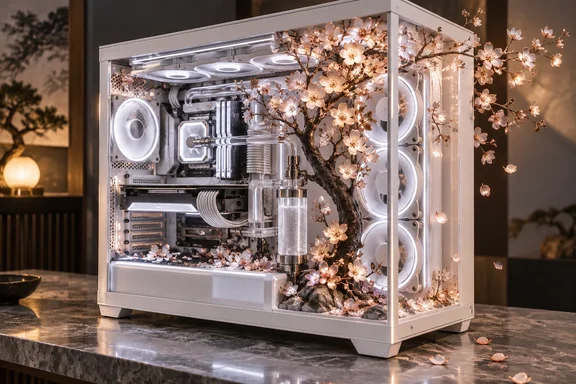
The core of the build is a model cherry tree inside the case. The Cherry Bloom contains 70 handcrafted cherry blossoms that physically open as the hardware heats up during gaming. The flowers are made from a temperature-reactive titanium alloy and are individually formed and hand-painted. There are no motors controlling them and the effect is not produced by RGB lighting. The petals gradually open as the system warms and close again as it cools. That is how VideoCardz described it, and VideoCardz was the outlet TechRadar credits with first spotting the machine.
Tom's Hardware reported the same mechanism separately: there are no motors to break; the blooming blossoms are completely 'powered' by the heat generated from the high-end components in the PC. Aftershock's own showcase page puts it more simply: as your PC warms during gaming, the blossoms bloom. As the system cools down, the tree returns to rest.
Aftershock calls it the "world-first blooming Gaming PC." That is the company's own marketing. Nobody has published a survey of earlier case mods that could confirm or disprove it. What reviewers do agree on is that it looks new. Tom's Hardware wrote that "We've never seen anything like the Cherry Bloom PC from Aftershock PC in Australia".
Several outlets also point out that this is a real product. According to Tom's Hardware, the PC — heat-reactive blossoms included — is actually commercially available, and isn't a one-off custom mod. You can buy one from Aftershock PC right now.
The Titanium Blossoms Show Load; They Don't Measure Temperature
Aftershock hasn't published much detail about how the flowers work. Its presentation shows the tree resting at 18°C, with all the flowers closed. It hasn't said what temperature makes them start to open or open fully. It also hasn't said whether they respond to air inside the case, heat from the coolant loop or from a particular component, or what the alloy actually is.
The Tech Revolutionist, a Singapore-based outlet, noticed the same gap. It reported that Aftershock says the effect uses the PC's heat without compromising thermal regulation, although it has not supplied independent temperature measurements or detailed the mechanism that translates heat into movement.
That gap limits one idea that has come up in coverage. TechRadar wondered whether the concept could replace a digital temperature display as a clearer warning when a machine hits a heat threshold. It's a nice thought, but the Cherry Bloom as sold can't do that job. With no stated opening temperature, calibration or response time, the petals give you a rough, delayed sign that the system is working hard. They can't tell you whether your GPU is running hot. Anyone who needs real thermal data should keep using software monitoring on this machine, just as on any other.
The cooling system itself is ordinary liquid cooling. The Tech Revolutionist describes it as a custom liquid loop with dual 360mm radiators, a D5 pump and reservoir, rigid acrylic tubing and eight chassis fans. Its point is that the concept gives waste heat a visual role while the separate liquid-cooling system continues carrying heat away from the processor and graphics card. In other words, the tree reacts to heat the system is already producing. It doesn't cool anything.
Inside the AU$19,995 Build: RTX 5080, Ryzen 7 9800X3D and a Custom Loop
Aftershock's Australian sales listing names the parts. Powered by an AMD Ryzen 7 9800X3D, ZOTAC GAMING GeForce RTX 5080 SOLID OC White, 64GB DDR5 memory, a fast 2TB Gen4 NVMe SSD, and a 1300W platinum power supply, CHERRY BLOOM is built for serious 4K gaming performance, the company says. The graphics card comes from the partnership behind the project: Aftershock says the RTX 5080 was supplied in partnership with ZOTAC, the graphics engine behind the build.
The full specification from the listing:
| Component | Cherry Bloom configuration |
|---|---|
| CPU | AMD Ryzen 7 9800X3D, 8 cores / 16 threads, up to 5.2GHz |
| GPU | Zotac GeForce RTX 5080 SOLID OC White, 16GB |
| Memory | 64GB Kingston Fury Beast RGB DDR5-6000 CL36 (2 × 32GB) |
| Storage | 2TB Lexar NQ790 PCIe Gen4 NVMe SSD |
| Motherboard | Gigabyte X870E Aorus PRO X3D ICE Wi-Fi 7 |
| Cooling | Custom open-loop liquid cooling |
| Power supply | InWin 1300W 80+ Platinum, modular, PCIe 5.0 |
| Fans | Two Aftershock Chrome RGB 120mm white, six Chrome RGB 120mm reverse |
| OS | Windows 11 Professional, activated |
Tom's Hardware reported the same core parts, and also listed a 2TB Lexar NQ790 PCIe 4.0 SSD, a custom open-loop liquid cooling setup, eight Aftershock Chrome RGB fans, and Windows 11 Professional. Aftershock's listing includes a three-year warranty covering parts, labour and return shipping, plus lifetime technical support. Those are the seller's terms. Nobody has reported on how well that support actually works.
On price, the listing shows AU$19,995 with next-business-day dispatch and same-day pickup from Aftershock's warehouse. It also advertises AU$400 cashback if you pay through Hello Clever and verify a mobile number. You still pay the full AU$19,995 at checkout. US-dollar conversions of roughly $14,000 have appeared in TechRadar, VideoCardz and Tom's Hardware. The only fixed figure is the Australian-dollar price, and the conversion will move with exchange rates.
Aftershock also publishes estimated frame rates at "High" settings, and says results vary by map, scene or level. At 4K it claims 46–72 FPS in Fortnite, 100–148 FPS in Microsoft Flight Simulator 2020 and 108–162 FPS in Grand Theft Auto V. These are the vendor's own numbers, not independent benchmarks. The wide gaps between games are a reason not to treat them as a promise of 4K performance in general.
NOVACORE or APNX V2: Aftershock's Own Pages Disagree on the Case
Aftershock's own material doesn't agree on which case the tree sits in. The showcase page says the CHERRY BLOOM PC is built in the NOVACORE, giving the entire design a stunning 270° seamless glass view. The company's launch post on X also says "Built inside NOVACORE." The detailed specification on the sales listing, however, names an APNX V2 White.
Independent outlets went with the APNX name. Tom's Hardware reported that the chassis used for the Cherry Bloom is the "V2" by Taiwan's Advanced Performance Nexus, better known as APNX, with wrap-around glass on three sides. TechSpot also says this all takes place inside an APNX V2 White case that offers a 270-degree view of the inside. One likely reading is that NOVACORE is Aftershock's own name for its build of the APNX V2. That is an inference, though, and the company hasn't confirmed it.
The same kind of mismatch shows up in the processor description. The showcase page describes a Ryzen 9 9950X3D-class chip, while the listing's title, specification table and product description all name the Ryzen 7 9800X3D. For anyone buying, the listing is the page that matters. Every independent outlet that printed specs reported the 9800X3D.
Early coverage also differs on availability. The Tech Revolutionist gave a Singapore-dollar valuation of S$18,000 and an Australian launch date of 18 September 2026. It also said AFTERSHOCK has not provided a retail configuration, production quantity or purchasing details. The live Australian listing with a price and dispatch terms has since overtaken that last point. Production quantity still hasn't been disclosed. Nothing reported so far shows the Cherry Bloom on sale outside Australia.
The RTX 5090 Question and the Price of a Sculpture
The strongest criticism is about value. TechRadar noted that the price doesn't get you Nvidia's flagship card, and called the missing RTX 5090 disappointing "whichever way you dice it." To show the scale of the premium, TechRadar pointed to Aftershock's standard Creator Max system. It says that system pairs an RTX 5090 with an Intel Core Ultra 9 285K and 64GB of RAM for AU$11,695, about AU$8,300 less than the Cherry Bloom. No other outlet has repeated that comparison, and prices change often.
TechSpot was blunter, and connected the price to the wider parts market. It noted that the consumer PC industry is in a crisis, with some component prices more than double or even triple what they were before AI came along. Its answer to whether anyone should spend that much was short: "You shouldn't, but if for some reason you do, you'll have some very pretty metal flowers inside the case to look at".
Aftershock doesn't really claim the hardware is good value. It sells the machine as a display piece. The showcase page calls it "a PC designed to be watched, not just used." By that standard the hardware list is strong enough. A 9800X3D with an RTX 5080 and a custom loop is a serious 4K gaming system. The question is whether roughly two in every five dollars going to hand-made art makes sense to you.
What this means for you
Only a very small group of buyers should consider this machine: Australian customers who want a showpiece PC and would pay a large premium for a heat-reactive sculpture made by hand. If you care most about gaming performance per dollar, Aftershock's own range reportedly includes an RTX 5090 system for much less. If you're looking for ideas for your own case, the concept is the interesting part. There is no published parts list or method for recreating the blossoms.
- The Cherry Bloom costs AU$19,995 in Australia, and nothing reported shows it on sale anywhere else.
- The retail build is a Ryzen 7 9800X3D, Zotac RTX 5080 SOLID OC White, 64GB DDR5-6000, a 2TB Gen4 SSD, a 1300W Platinum PSU and Windows 11 Pro. It does not have an RTX 5090.
- The 70 blossoms open and close through a titanium alloy that reacts to heat, with no motors or electrics. They don't give any calibrated temperature reading, so keep monitoring temperatures in software.
- Aftershock's pages disagree on the case (NOVACORE versus APNX V2 White) and the processor class. The sales listing, and independent reporting, point to the APNX V2 and the Ryzen 7 9800X3D.
- The frame-rate figures Aftershock publishes are its own estimates, not independent tests. Before paying, check the current price, the cashback terms and stock on Aftershock's listing.
The Cherry Bloom shows that the heat from a gaming PC can be put on display instead of hidden. The flowers are driven purely by the machine's own heat, and so far that holds up in every outlet that has covered it. What this version doesn't answer is whether the idea can come down in price. TechRadar suggested a scaled-down model with fewer blossoms. Until Aftershock or another builder sells a cheaper version, or publishes the alloy's opening temperatures so the effect means something as a gauge, the Cherry Bloom remains an expensive art piece that happens to run games well.
References
- World-first 'blooming gaming PC' is one of the most striking designs ever TechRadar · 2026-09-23T14:53:21+00:00
- $14,000 gaming PC features 70 handcrafted titanium cherry blossoms which unfurl as temperatures rise — Zotac-designed RTX 5080 system features impressive sculpture and an eye-watering price tag to match | Tom's Hardware tomshardware.com
- AFTERSHOCK PC - Custom Gaming Computers, PCs & Laptops aftershockpc.com.au