

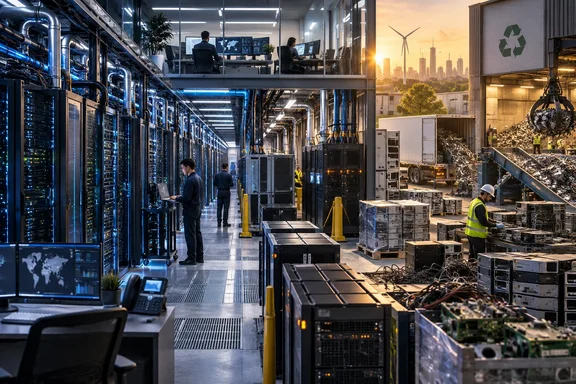
The report, The Coming AI Waste Wave, projects that AI-related equipment retirements could total 395 million to 617 million metric tons from 2025 through 2050. That is the basis for the striking “23 million shipping containers” comparison reported by The Verge and independently covered by The Guardian. For Windows administrators and enterprise IT teams, the useful warning is less the container metaphor than the operational premise: an AI buildout changes the hardware estate well beyond GPUs, and end-of-life planning is being treated as an afterthought.
BAN is right to point out that racks of accelerators are only one part of an AI facility. High-density AI deployments also require switches, storage, power-distribution systems, UPS hardware, liquid-cooling equipment, cabling, and backup infrastructure. A server refresh plan that accounts only for the compute nodes will miss both a large material stream and a large cost center.
But the report’s headline estimate combines two fundamentally different kinds of waste. Its direct data-center model is a useful attempt to count more hardware than earlier studies did. Its much larger AI Waste Contagion estimate — hardware outside the data center that BAN expects AI requirements to render obsolete earlier — is a scenario rather than an observed disposal stream. That distinction should govern how the figures are read.
The 40-to-60-times claim is not a like-for-like comparison
BAN says its 2030 estimate is 40 to 60 times higher than the most widely cited academic estimate from Alex de Vries-Gao, published in Resources, Conservation and Recycling earlier this year. The academic paper estimates annual AI-server e-waste at roughly 131,000 to 225,000 metric tons by 2030. BAN’s report puts total AI-driven retirements at 8.6 million to 13.1 million metric tons in that same year.
The arithmetic works, but the comparison is broader than the headline makes clear.
In BAN’s own table, direct data-center infrastructure accounts for 2.8 million metric tons annually in 2030. The remaining 5.8 million to 10.3 million tons comes from the report’s conservative and aggressive “contagion” scenarios. In other words, BAN reaches the 40-to-60-times figure by comparing its full data-center-plus-device-replacement model with an academic study designed to count AI servers.
Even restricting the comparison to equipment inside data centers, BAN’s estimate remains substantially larger than the academic work. That is the important finding. It does not require folding in every consumer PC, enterprise endpoint, edge appliance, and telecom upgrade potentially influenced by AI adoption.
BAN’s direct infrastructure model counts five categories: accelerators and server racks; networking equipment; power supply and distribution; storage and backup; and cooling systems. The report estimates that each gigawatt of installed data-center capacity represents roughly 70,000 metric tons of physical equipment across those categories. Earlier AI e-waste work generally concentrated on servers and accelerators because those components can be more directly tied to AI compute demand.
The broader scope is defensible as a planning exercise. A liquid-cooled GPU cluster does not exist independently of the power and thermal systems needed to keep it running. Still, counting cooling plants and electrical distribution equipment means the resulting number is a data-center infrastructure retirement estimate, not simply an AI-chip waste estimate.
The most consequential projection rests on assumptions, not disposal records
BAN’s 2050 projection deserves even more care. McKinsey has forecast global data-center capacity demand of 171 GW to 219 GW by 2030, with AI-ready capacity accounting for much of the increase. That is a forecast through 2030, not evidence that the world will build more than a terawatt of capacity by mid-century.
BAN extends the model to 1,093 GW of data-center capacity in 2050 using an 8.8 percent annual growth assumption. It then applies assumed replacement cycles to each equipment category: 2.5 years for accelerators, servers, and racks; 3.5 years for networking; five years for backup power and cooling; and eight years for power distribution.
Those assumptions are not trivial. BAN’s own sensitivity testing shows that changing the combined inputs — equipment life, capacity growth, and mass per gigawatt — produces a direct data-center e-waste estimate ranging from 3.8 million to 35.5 million metric tons per year in 2050. The baseline is 15.5 million tons.
That wide range does not invalidate the analysis. It shows precisely why the report should be used as a warning about procurement and disposal systems rather than a precise forecast of future landfill tonnage.
The contagion category is more speculative still. BAN openly says little data exists to quantify hardware retired earlier because AI software or AI-capable hardware requirements encourage upgrades. It cites AI PCs and other accelerated-computing trends as potential triggers. Yet it assigns that category 16.2 million to 30.7 million metric tons of annual waste by 2050 — more than its estimate for direct data-center infrastructure.
There is a genuine concern here for Windows organizations. New local-AI features can create a practical divide between machines that merely run Windows and machines that meet the performance, memory, and NPU requirements for newer on-device workloads. But a device that lacks an NPU is not automatically scrap, and an endpoint upgrade does not automatically become e-waste. It may remain useful in a lower-demand role, be redeployed, sold, refurbished, donated, or dismantled for parts.
BAN’s report is a white paper, not a peer-reviewed lifecycle assessment. It says researchers including de Vries-Gao reviewed it before publication. That review adds value, but it does not turn its long-range assumptions into measured outcomes.
Data-center refreshes create a security problem before they create a recycling problem
For enterprise administrators, the first immediate risk from accelerated hardware turnover is often not environmental accounting. It is data-bearing equipment leaving controlled custody.
AI clusters concentrate storage devices, network appliances, management controllers, and server components that may hold credentials, telemetry, model data, customer information, or remnants of workloads. A decommissioned GPU server is not simply a chassis with expensive accelerators. Its SSDs, BMC configuration, NIC settings, logs, and attached storage pathways all require a documented disposition process.
The IT asset disposition plan therefore needs to be part of AI infrastructure procurement rather than a cleanup task at the end of a three-year lease or refresh cycle. Organizations should require their suppliers, colocation partners, and disposal vendors to document:
- Every retired server, storage device, switch, UPS unit, and rack component should be inventoried by serial number or another durable asset identifier before it moves off site.
- Data-bearing components should have a recorded sanitization or destruction outcome, including the method used and the organization that performed it.
- Contracts should distinguish reuse, refurbishment, materials recovery, and disposal instead of treating “recycled” as a sufficient final status.
- Downstream processors should be identified, because a recycler’s first handoff is not necessarily the equipment’s final destination.
- Hardware refresh decisions should include a reuse assessment for servers, switches, power equipment, and cooling components that remain technically serviceable.
The e-Stewards standard, operated by BAN’s associated certification program, is one example of a framework that requires chain-of-custody and downstream-vendor controls. It is not the only way to run an asset-disposition program, but its emphasis on tracking and data security addresses the part of the AI hardware cycle that can create a breach long before material reaches a recycling facility.
Hyperscalers have circularity programs, but public metrics remain hard to compare
The report’s timing is awkward for Microsoft because it cites the cloud industry’s longstanding “cattle versus pets” approach: treating individual servers as interchangeable units to be replaced rather than repaired in place. The phrase originated in cloud operations, not as a literal instruction to discard hardware, but rapid AI refresh cycles can make the material consequence more literal.
Microsoft has publicly reported substantial progress in handling retired cloud hardware. In April 2025, the company said it had achieved a 90.9 percent reuse-and-recycling rate for servers and components in 2024 and had reused more than 3.2 million components through its Circular Centers. Microsoft says those facilities sort decommissioned hardware for internal reuse, other supply chains, training programs, refurbishment, and recycling.
That is evidence that large-scale reuse systems can exist alongside hyperscale growth. It also highlights a reporting gap. A combined reuse-and-recycling percentage does not reveal how much hardware was reused as functioning equipment, how much was broken down for material recovery, how much was processed by type, or how much ultimately required disposal. Nor is Microsoft’s rate directly comparable to BAN’s projected global tonnage.
The missing measurement is industry-wide: public, category-level reporting on what leaves data centers, how long it operated, whether it was reused, and where it went. AI providers are eager to publish new capacity, GPU counts, power commitments, and model benchmarks. Their hardware retirement data remains far harder to find.
The next AI buildout metric should be retirement, not just capacity
The United Nations’ Global E-waste Monitor reported that the world generated 62 million metric tons of e-waste in 2022 and formally collected and recycled 22.3 percent of it. That baseline makes BAN’s concern credible even where its future projections are uncertain: the world already has a weak recovery system before the largest AI facilities reach their first major replacement cycles.
The actionable lesson is simple. Every AI capacity announcement should prompt a matching question about retirement capacity: what equipment will be replaced, after how many years, who owns it at end of life, which components can be reused, and what verifiable chain of custody applies to the rest.
Without those answers, the industry’s AI infrastructure story remains incomplete. A new gigawatt of compute is also a future inventory of servers, switches, batteries, cooling equipment, drives, cables, and power hardware that somebody will have to securely recover, reuse, or dispose of.
References
- The AI data center e-waste problem is huge — and getting bigger The Verge · 2026-09-16T20:40:46+00:00