

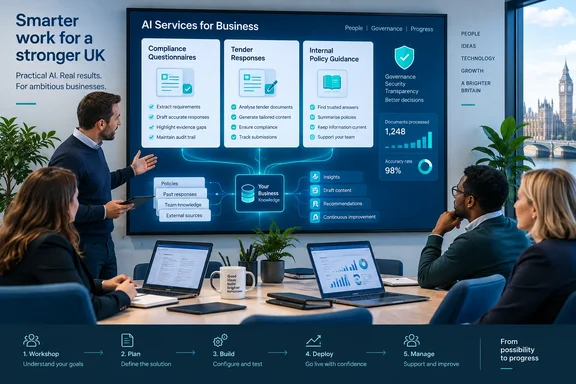
Air IT’s launch post is dated September 17, 2026, while the Edinburgh Chamber of Commerce published its announcement on September 21 using “today” language. Coverage by IT Europa on September 17 and PCR on September 18 also places the announcement before the Chamber’s publication date. The offering is therefore an already-announced services launch, rather than a new Microsoft product release on September 21.
What the new services provide
The package combines four elements: AI Accelerator workshops, the agent marketplace, bespoke agent development and AI Managed Services. Air IT calls the business problem it is addressing the “AI Decision Gap”—its term for pressure to invest in AI without clear priorities or agreed measures of success. This is the company’s framing, rather than a quantified research finding.
The Accelerator starts with discovery and an AI Envisioning Day involving business leaders. Air IT says it assesses potential uses and produces a prioritised roadmap, covering areas such as productivity, automation, data readiness and governance. The Chamber announcement describes that roadmap as identifying what to do now, next and later, alongside how results will be measured.
For a buyer, the useful distinction is between that planning engagement and an implementation. A roadmap identifies and sequences opportunities; deploying an agent is a separate part of the offering. Businesses should establish which deliverables their engagement includes rather than assuming a workshop also supplies a production-ready system.
Which agents are available—and which are planned
Air IT’s September 17 announcement identifies three available agents and two forthcoming additions. Their stated functions are vendor descriptions, not independently measured performance results.
| Agent | Announced status | Stated purpose |
|---|---|---|
| Compliance Agent | Available at launch | Assist with customer, supplier and assurance questionnaires using approved business evidence. |
| Tender Response Agent | Available at launch | Produce first-draft tender responses using approved content, case studies and organisational knowledge. |
| Air Policy Agent | Available at launch | Help employees find internal policy guidance. |
| Website Engagement Agent | Coming soon | Answer website visitors’ questions and guide their enquiries. |
| Recruitment Screening Agent | Coming soon | Assess CVs against predefined criteria to support shortlisting. |
The two response-writing agents address related but distinct workflows. The Compliance Agent is described around evidence-based questionnaire completion; the Tender Response Agent focuses on drafting bids from existing organisational material. The Policy Agent instead addresses employees’ access to internal guidance. Those differences help narrow a buying decision to a particular task rather than a general ambition to “use AI.”
Air IT says marketplace agents can be customised or used as foundations for bespoke solutions. The Chamber announcement further says they can be configured around an organisation’s information, processes and governance requirements before deployment within its Microsoft environment.
“Ready-to-deploy” still involves organisation-specific configuration. The documented approach depends on selecting the relevant business information and requirements. The launch material does not establish a universal Microsoft subscription requirement or identify the underlying Microsoft platform for every agent, so deployment within a Microsoft environment should not be read as proof that an existing Copilot subscription covers the whole service.
Ongoing support has a defined boundary
Air IT’s AI Managed Services description includes bespoke Microsoft agent development, data preparation and integration, and managed agent support. The support component explicitly covers Air IT-developed agents and their supporting AI components, with break-fix assistance, monitoring and operational oversight.
That boundary matters for businesses already running agents from other suppliers: the published description does not establish that those systems are included. It also distinguishes maintaining a deployed solution from preparing its knowledge sources—both are offered, but they address different operational needs.
The announcement does not publish pricing or a licence breakdown. Before approving a project, a useful procurement check is to separate the planning engagement, configuration or development work, Microsoft licensing and ongoing support charges. That is a purchasing implication of the service structure, not a published Air IT pricing model.
Customer examples show projects taking shape, not measured returns
In the announcement published by the Edinburgh Chamber, Air IT says Colchester Global Investors completed an Accelerator engagement and is progressing an agent for requests for proposals, or RFPs, and due-diligence questionnaires, or DDQs. The intended benefit is less repetitive response preparation and easier access to approved information.
Air IT’s own launch post describes a separate early-stage project at RH Commercial Vehicles: a warranty-support agent intended to use previous successful claims and manufacturer guidance to improve submissions and identify missing information. The customer explicitly describes the work as being in its early stages. Neither account establishes measured productivity gains or financial returns.
For an SME evaluating the offering, these examples support a focused starting point: a recurring document or information-access task with identifiable source material. A sensible acceptance criterion would measure the time needed to produce an approved response—including checking and corrections—rather than simply how quickly an agent generates a draft. The available evidence supports evaluating these services against a defined workflow; it does not yet support a forecast of how much time or money a particular business will save.
Update: Air IT cites internal automation metrics behind the SME AI launch (September 24, 2026)
ChannelLife’s September 24 report adds new detail on the company’s own AI and automation use before the services launch. According to the outlet, Air IT says it has spent three years testing automation and AI internally, now running millions of automated actions monthly and saving an estimated 2,000 to 2,500 staff hours each month.
Air IT also reportedly said automated self-service use has risen 350% year on year. These are company-reported internal operating figures, not independently audited measures, and they do not demonstrate equivalent savings for customers adopting the new services.
The additional context helps explain why Air IT is positioning its offering around defined business problems, governance and implementation support rather than access to general-purpose AI tools alone. Buyers should still treat the figures as background to Air IT’s approach, not as a forecast of results from the Accelerator, marketplace agents or bespoke deployments.
Update: Additional details (October 2, 2026)
IT Brief reports that Air IT describes its internal trial programme as “Customer Zero,” saying it tested AI and automation in its own operations before offering similar services to customers. The report repeats the company’s estimates of 2,000 to 2,500 staff hours saved monthly and a 350% year-on-year increase in automated self-service use, while adding that Air IT supports more than 2,000 organisations from nine UK regional offices.
The report also includes customer feedback from Denton, which said the AI Accelerator helped turn broad AI discussions into prioritised practical next steps. Air IT cited research claiming 70% of small businesses are confident using generative AI and 48% use it regularly; it also referenced UK government research saying one in six firms has deliberately deployed an AI technology for a defined business purpose. These cited figures provide market context but do not measure outcomes from Air IT’s services.
References
- Air IT launches AI services for SMEs lacking plans ChannelLife UK · 2026-09-24T07:15:00+00:00
- Air IT Group launches new suite of AI services to close the SME AI decision gap - Edinburgh Chamber of Commerce Edinburgh Chamber of Commerce · 2026-09-21T11:11:29+00:00
- Air IT launches AI services to close SME decision gap IT Brief UK · 2026-10-02T08:15:00+00:00