

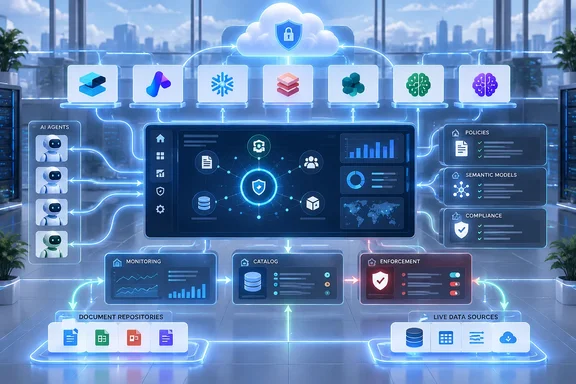
The announcement, made by Alation at its revAlation conference in Chicago on September 17, covers six products: expanded AI Governance, Ontologies, Intelligent Feeds, Console, Governed Collections and Semantic Model Mastering. Two of them—AI Governance enhancements and Semantic Model Mastering—are available now, Alation says. The other four are early-access products, which is the critical operational detail beneath the broad launch language.
Alation’s core claim is that enterprise AI failures usually stem from missing context and weak data controls rather than the foundation model itself. Grant Thornton’s 2026 AI Impact Survey supports the concern rather than the vendor’s product conclusion: 78% of 950 surveyed senior leaders said they lacked strong confidence they could pass an independent AI-governance audit within 90 days. The survey found a wide gap between organizations running integrated AI programs and those still piloting them, but it does not validate any one vendor’s approach.
For Windows and enterprise administrators, this is best understood as a governance overlay, not a replacement for Microsoft’s built-in controls.
Six components, but only two are generally available
Alation is shipping its AI Governance and Semantic Model Mastering updates immediately. AI Governance adds what the company calls agent lineage tracing and six native connectors: Amazon Bedrock, Amazon SageMaker, Databricks MLflow, Microsoft Copilot Studio, Microsoft Foundry and Snowflake Cortex.
The goal is to create a cross-platform registry that links an agent to the data it consumes, the policies associated with that data and its quality status. Alation calls it the first registry to continuously connect an agent’s compliance posture to the live policy and quality state of underlying data. That “first” claim has not been independently substantiated, and the announcement does not disclose the technical limits that determine whether it holds up in a production deployment: the exact metadata collected from each platform, refresh intervals, how permission changes are detected, or whether runtime tool calls are fully recorded.
Those omissions matter. A registry that imports deployment metadata once a day can help with documentation, but it does not establish real-time enforcement. A system that tracks only agent configuration can show who built an agent and which connectors it has, while missing the more important question after an incident: what information was actually retrieved, transformed and acted upon in a particular run.
Alation has not said which of those levels its Microsoft connectors cover. Enterprises should treat the connector announcement as evidence of planned platform integration, not proof that every Copilot Studio or Foundry execution path is automatically auditable end to end.
The other four components are early access:
- Ontologies is intended to encode business entities, relationships, constraints and process logic in a machine-readable form.
- Governed Collections turns unstructured documents from sources including SharePoint, Amazon S3 and Confluence into governed catalog objects.
- Intelligent Feeds distributes governed metrics and explanations to business teams rather than requiring them to search a catalog.
- Console provides a natural-language entry point that routes requests to the relevant part of AIOS.
Early access is useful for design partners, but it carries a different operational status from a generally available control plane. Microsoft administrators with audit or regulatory obligations should not write a policy that assumes Console, Governed Collections, Ontologies or Intelligent Feeds will be available across their tenant until Alation publishes support, licensing, geographic-residency and service-level details.
Microsoft already has an agent control plane
Alation enters a Microsoft environment that has gained its own centralized governance structure. Microsoft’s current Copilot Studio documentation says Agent 365 can serve as a central control plane for observing, governing and securing Copilot Studio agents. Copilot Studio agents can automatically appear in the Agent 365 registry, where administrators can see ownership, deployment state, requested permissions, connector usage and associated policy status.
Microsoft’s registry is materially useful for the basic inventory problem. It can show that an agent exists, who owns it, what connectors it requests and whether it can be blocked, reassigned or removed. Microsoft also says its registry can include agents from Copilot Studio, pro-code sources and non-Microsoft platforms, while Power Platform inventory remains environment-specific.
Copilot Studio has additional controls that are separate from a third-party catalog. Microsoft documents Power Platform data policies for knowledge sources, actions, connectors, HTTP requests, publishing channels and triggers. Its Purview integration supplies audit records, data classification, sensitivity labels, data loss prevention, eDiscovery and retention capabilities for Copilot Studio interactions. Agent 365 also adds identity- and access-governance hooks through Microsoft Entra.
That means a company adopting Alation should resist an easy but risky conclusion: that installing a cross-platform governance catalog eliminates the need to configure Purview, Power Platform data policies, Entra controls and Microsoft’s own Agent 365 registry. It does not.
Alation’s potential value lies elsewhere. Microsoft’s tools can enforce and observe controls inside the Microsoft tenant. Alation is trying to bring in the business context that often lives outside of Microsoft: a governed definition of “active customer,” a finance-approved revenue measure, a relationship between a compliance procedure and the data used to execute it, or a lineage path that crosses Snowflake, Databricks and a Copilot Studio agent.
That can be useful, particularly where a company has grown through multiple data stacks. It is also a different job from identity enforcement, DLP or incident investigation.
The SharePoint promise has a boundary
Governed Collections will draw attention from Microsoft 365 customers because it is designed to catalog documents from SharePoint, including policies, standard operating procedures and business glossaries. Alation says agents can reference those governed documents and use the current version when the underlying content changes, rather than relying on a stale copy embedded in an application workflow.
The design addresses a genuine problem. Teams routinely attach a PDF policy or copied guidance to an agent prompt, then fail to update the agent when the approved source changes. A governed reference model can reduce that drift—provided the implementation preserves source permissions, document versioning, retention obligations and sensitivity labels.
Microsoft already applies some relevant controls at the service layer. For Copilot Studio agents using SharePoint knowledge sources, Purview sensitivity labels and access controls can prevent users from receiving material they would not otherwise be allowed to access. Microsoft also records prompts, responses and references to accessed Microsoft 365 files in its audit tooling, subject to the applicable configuration and licensing.
What Alation has not explained is how Governed Collections will interact with those Microsoft-native protections. The company did not specify whether a SharePoint document’s sensitivity label, conditional access restrictions, records-management status or permissions are synchronized into AIOS; whether its catalog can prevent an agent from using a document; or whether it merely displays governance metadata for an existing connection.
Those are not minor implementation questions. A catalog that says a policy document is approved is valuable. A system that can guarantee every agent respects the document’s access and retention controls is a much larger—and harder—claim.
Semantic models are the most concrete opportunity
Semantic Model Mastering may be the most immediately practical part of the release. Alation says it can ingest semantic models from Snowflake and Databricks, enrich and govern definitions in AIOS, then synchronize those definitions back to the source platforms.
This addresses an expensive form of enterprise inconsistency: one analytics group defines an active customer as someone who made a purchase in 12 months, another uses six months, and an agent offers a confident answer without explaining which definition it used. The data may be technically correct in each platform, but the business answer is unreliable because the semantic layer is fragmented.
For organizations that use Microsoft Copilot Studio or Foundry agents on top of data managed in Snowflake and Databricks, a central semantic workflow could prevent developers from manually re-creating metrics and definitions in agent instructions. It could also provide auditors with a better starting point than a collection of prompts and wiki pages.
But again, Alation’s release leaves key mechanics unexplained. It does not identify which Snowflake and Databricks semantic-model formats are supported, whether synchronization is one-way or bidirectional, how conflicts are resolved, or whether changes require human approval before propagating. Until those details are published, administrators should avoid treating the feature as an authoritative source of truth by default.
The deployment question is governance, not procurement
Alation says all six products are included under its all-inclusive pricing model and require no new contracts for existing customers. That removes one purchasing obstacle, but it does not remove deployment work. A cross-platform agent inventory is only trustworthy if agent owners, service identities, connector permissions, data classifications and policy mappings are maintained as operating controls rather than imported as a one-time catalog project.
The sensible first use case is narrow: select a small number of high-value Copilot Studio or Foundry agents that retrieve data from Snowflake, Databricks or SharePoint; compare Alation’s lineage and policy record with what Agent 365, Purview and the Power Platform admin center report; then identify any gaps in ownership, source access, metric definitions or audit coverage.
If the records diverge, the organization has found something useful before expanding the deployment. If they match, the business must still decide which system is authoritative for enforcement and which is authoritative for semantic context.
Alation has made a credible case that an agent inventory without data meaning is incomplete. But the company has not yet shown that its new layer can replace the controls Microsoft administrators already rely on—or that all six products are ready for production. For now, AI Governance and Semantic Model Mastering are the pieces to evaluate, while the early-access tools remain a roadmap conversation rather than a compliance control.
References
- Alation Expands AIOS With Six Products For AI Governance, Enterprise Context And Agent Management Pulse 2.0 · 2026-09-17T13:30:58+00:00