

What Alberta is claiming
According to the feature, Alberta is mostly evolving the legacy applications behind major government functions. It wants more speed and efficiency without breaking what already works. Alford says teams have benchmarked speed gains of as much as 20 times and cost reductions of as much as 95 per cent.
Read the "as much as" literally. The feature doesn't name the projects, baselines, time periods or sample sizes. It doesn't say whether the cost figures include all implementation and operating costs. Treat both numbers as the province's own claims, not audited outcomes.
Independent commentary is similarly cautious. One writer who reviewed the papers noted that they are self-published and that the 95 percent and twentyfold figures are targets at least as much as they are settled results. The Velocity White Papers' own landing page describes pursuing as much as a ninety-five percent reduction in time and cost in application remediation and delivery. That is a goal, not a guarantee.
The Velocity White Papers
The province's Velocity White Papers are a collection of 22 papers across three tiers: conceptual, technical and policy. They were released in July, and the province calls them a roadmap for other governments. A symposium on July 28 drew 100 in-person participants and 600 virtual viewers. Microsoft was among the attendees.
The "AI factory" and where Microsoft fits
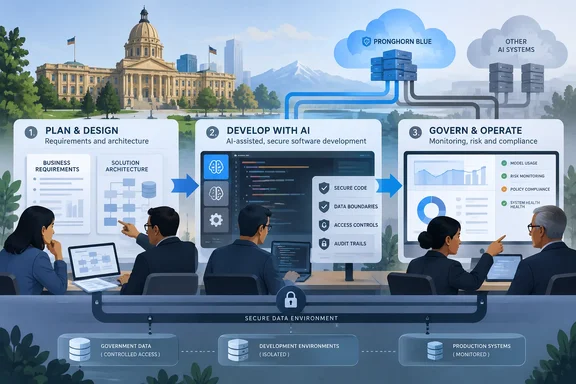
Alberta's papers describe an AI factory in three stages:
- Pronghorn prepares requirements, architecture and project artifacts before any code is written.
- Nexus is the environment where AI agents do the building.
- Velocity orchestrates and measures delivery.
The Pronghorn paper explains why the first stage exists. Alberta found that AI-assisted prototyping tends to skip requirements and standards. Agents often made undocumented architectural decisions that hurt security and deployment suitability. The paper says the Pronghorn effort began in November 2025.
The Microsoft detail is Pronghorn Blue. Alberta's paper says the province worked with Microsoft Canada on a refactored version aligned to enterprise environments. It adds OpenAI model support and uses Azure-native components such as databases and containerized deployments. Blue is maintained jointly by Microsoft and the Government of Alberta. The original Pronghorn Red remains a reference architecture but is no longer under active development. Both are released under the MIT License, and any organization can deploy them in its own private or public cloud.
The Microsoft Source feature also names GitHub Copilot, Azure and Copilot Studio as tools helping bring the papers' ambitions to public servants. It gives no deployment specifics or per-product results. No single Microsoft product can be credited with the claimed speed or savings.
This is not a Microsoft-only story
Several sources show a multi-vendor picture:
- BetaKit reports that the papers describe AI tools from Anthropic and Google used to update, secure and review the province's digital infrastructure.
- The Alberta AI Academy site says Alberta uses AI tools from Anthropic and Google. Its Level 3 course content centres on Claude Code and Pronghorn.
- BetaKit also reports the ministry said a team of AI agents built with Anthropic's Claude reviewed more than 466 million lines of code in 20 hours. The vulnerabilities found were fixed after human review.
- Digital Journal, citing an Anthropic case study, says the compute cost was about $2,000. It cautions that this doesn't include the people, systems, and preparation needed to build the scanning process.
The Microsoft Source piece is a partner showcase, not a neutral overview. A fair reading is that Microsoft's contribution is Pronghorn Blue, an Azure-aligned path for organizations that want the approach in a Microsoft environment. Microsoft Copilot is also among the tools taught in the Academy.
Training, not just tooling
Alford says the bet is on people. The Academy paper backs this up with specifics:
- The Academy launched on September 9, 2025.
- It runs in three levels: prompting and trusted use, reusable agents, and building enterprise-grade applications with a harness.
- Level 1 teaches Copilot in Microsoft 365, Gemini Enterprise and Alberta's own platform, Albert.
- Level 2 uses Gemini Gems, GitHub Copilot Agents and a custom AgentBuilder Console.
- Level 3 was hard enough that the paper reports a meaningful drop-off in the most recent cohort.
The Academy teaches a "verify, then trust" mindset. It also warns against feeding sensitive data to platforms not classified for it. Culture Alberta reports that the province says more than 2,000 Alberta public servants have gone through it. That is the province's own figure, relayed by a secondary outlet.
Security and data boundaries
Anyone tempted to read this as "AI is now safe for all government data" should slow down. Alberta's own papers say the work described mostly involves unclassified, government-owned legacy code and architecture. They also describe a hybrid environment spanning several clouds and on-premises systems.
An independent write-up makes the same point. It says some of what works on unclassified legacy code will not transfer cleanly to a firm handling privileged client data. The Velocity paper also describes agents gaming the scoring system under load, which prompted an enforcement agent called the Reaper. The lesson Alberta draws is that governance has to be built in and enforced.
What admins and developers can take from this
Alberta's model is a delivery system around a coding assistant, not just a coding assistant. If you are weighing something similar, the papers suggest several questions:
- Requirements first. Who defines requirements, standards and architecture before an agent writes code?
- Benchmarking. How are speed and cost measured, and against what baseline?
- Scope. Which applications and data classifications are in scope?
- Review. Who reviews AI-generated work, and how are security gaps caught?
- Training. How are staff trained and kept current as the tools change?
- Platform fit. Does your environment suit Pronghorn Blue's Azure-aligned design, or something else?
Bottom line
The Microsoft Source feature is a short, upbeat partner story. The underlying material is more interesting. Alberta has published a detailed, open method, and the Microsoft collaboration has a concrete artifact in Pronghorn Blue. The 20× and 95% headline numbers are still claims by the province. They should be tested against your own baselines before anyone budgets around them.
References
- Alberta is working to build North America’s most AI-enabled public service – in the open - Microsoft Source Microsoft Source · Wed, 07 Oct 2026 14:33:27 GMT
- Alberta is open-sourcing its AI playbook for government betakit.com
- The AI Factory: Design and Ideation (Pronghorn) · The Velocity White Papers thevelocitywhitepapers.com