

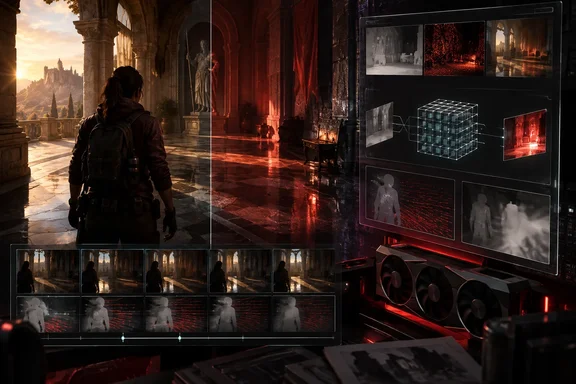
The work, published by AMD’s GPUOpen team on September 9 and scheduled for presentation at ECCV 2026, treats screen-space global illumination as an image-generation task. PC Gamer first connected the paper to AMD’s broader neural-rendering ambitions and speculated that the approach could someday inform an answer to Nvidia’s next generation of rendering technology. That connection is plausible, but AMD’s own research post does not mention FSR Diamond, Project Helix, a Radeon product generation, or a release timetable.
What AMD has actually demonstrated is technically significant: an attempt to make generative lighting coherent enough across moving frames that it could be useful in interactive graphics. What it has not demonstrated is a practical path to putting that model into a 60 fps or 120 fps PC game.
The model generates bounced light rather than tracing every bounce
Global illumination is the expensive part of realistic rendering that accounts for light bouncing off surfaces. A sunlit wall can cast a warm tint onto a nearby floor; a bright sign can illuminate a character standing beside it; a room can appear naturally lit even where no lamp shines directly. Traditional real-time games fake much of this through baked lighting, screen-space effects, probes, and limited ray tracing. Full path tracing models many light paths, but its cost remains high.
AMD’s method begins with a frame containing direct illumination, then supplies the model with scene data including normals, material attributes, lighting cues, and geometry-related signals. The model produces an estimate of the missing indirect illumination. That output is composited back with the directly lit render.
The choice of a one-step latent diffusion model is the central engineering decision. Conventional diffusion image models repeatedly refine noise into an image through many denoising iterations, which is far too slow for a per-frame rendering pass. AMD uses a distilled model intended to generate an output after one denoising step, then conditions it heavily with data from the actual 3D scene.
That conditioning is what separates this from asking an image model to “make the lighting look better.” The renderer provides information about the game world, and the network is supposed to infer illumination while preserving the underlying geometry and materials. AMD says its method avoided the geometry distortion and invented visual content seen in some previous diffusion-rendering approaches in its controlled comparisons.
Temporal stability is the real research contribution
A generated still image can look convincing while becoming unusable in motion. Small differences in a model’s output from one frame to the next become flicker, crawling shadows, unstable brightness, and lighting that appears to detach from objects as the camera moves. Those flaws are especially visible in games because players control the camera and expect lighting to react predictably.
AMD’s answer is a Temporal VAE decoder, or TVAE. It takes the current latent representation alongside the prior output reprojected with motion vectors—the same sort of scene-motion data familiar from temporal anti-aliasing, upscalers, and frame-generation systems. A history encoder then lets the decoder reuse relevant pixels from the previous frame when they match the current scene state.
In practical terms, it is a learned temporal-reuse system. The model is not independently painting a new lighting result every frame and hoping consecutive images match. It is explicitly given a route to carry information forward through the sequence.
That approach is meaningful for game engines, where temporal information is often the difference between a promising reconstruction technique and one that can survive real camera movement. GameDev.net’s independent technical summary made the same point: frame-to-frame stability, rather than simply producing attractive indirect light in a screenshot, is the hurdle that determines whether diffusion-based rendering has a credible interactive future.
Still, AMD’s results are based on synthetic interior scenes rendered with Blender Cycles and evaluated on unseen scenes from that dataset. The company says it also tested a compact variation on real photographs, but that is not equivalent to testing in a shipping game with streaming assets, foliage, particles, rapidly changing exposure, post-processing, UI composition, and a player moving unpredictably through an open world.
The reported speed shows why this remains research
The most sobering number is performance. According to PC Gamer’s reading of AMD’s paper and presentation, the method ran at roughly 0.29 seconds per 512-by-512 frame on an Nvidia GeForce RTX 3090—about 3.45 frames per second—and consumed around 8 GB to 9 GB of VRAM for the illumination step alone.
Even allowing for an experimental implementation, the gap between 3.45 fps and a game-ready lighting pass is huge. At 60 fps, the entire frame budget is 16.7 milliseconds. At 120 fps, it is 8.3 milliseconds. A 290-millisecond process would need orders-of-magnitude acceleration before it could run as an every-frame effect without becoming the dominant cost of rendering.
The 512-by-512 test resolution also matters. This is not 4K lighting, nor is it a complete game-rendering pipeline. The reported time covers the model’s global-illumination operation, while a game must still rasterize or ray trace primary visibility, render geometry and materials, simulate effects, apply post-processing, scale the final image, and present it with low enough latency to remain playable.
This does not invalidate the paper. Research prototypes routinely begin far away from product frame budgets. But it does put the “real-time” label in the proper context: AMD is describing a direction and a potential architecture for frame-by-frame generation, not documenting a feature ready for a DirectX 12 game to call today.
AMD already has a different neural lighting path in FSR
The more immediate AMD technology is FSR Radiance Caching, part of the company’s FSR “Redstone” SDK effort. AMD describes that technique as neural radiance caching: the system predicts light propagation from sparse path-traced samples and replaces many secondary rays with learned estimates. It has been offered as a technical preview for RDNA 4 Radeon hardware, initially requiring AMD Software: Adrenalin Edition 25.12.1.
Radiance caching and the ECCV paper pursue a similar goal—reducing the cost of high-quality indirect light—but they do it differently. Radiance caching works from sparse ray-tracing data and builds a learned representation of a scene’s radiance. The new diffusion research operates on screen-space rendering inputs and tries to generate an illumination image conditioned on those inputs.
That distinction has consequences. The research model may be able to reconstruct plausible lighting from a compact set of scene signals, but its screen-space framing means it is tied to information available in or derived from the current view. The paper’s controlled tests cannot settle how it would handle light transport whose important cause is off-screen, after a cut, or newly revealed by a rapid camera turn. Conventional ray tracing and radiance-caching approaches have their own limitations, but they are grounded in explicit scene sampling rather than an image generator’s learned prior.
AMD’s GPUOpen page offers no source code, SDK, engine plug-in, supported-GPU list, frame-time target, or integration path for the one-step diffusion work. It also does not state whether the model could run efficiently on Radeon AI accelerators, whether it needs a dedicated neural-rendering block, or whether the method will ever leave the research group.
FSR Diamond remains a broader promise, not a product map
AMD and Microsoft have already attached the FSR Diamond name to their long-term next-generation rendering plans around Project Helix. Xbox Wire said in March that Project Helix is being co-designed with AMD for next-generation DirectX and FSR technologies, with neural rendering among the graphics ambitions described around the project. Reporting from Tom’s Hardware and other outlets likewise framed FSR Diamond as a future package encompassing machine-learning upscaling, multi-frame generation, and advanced rendering techniques.
But no public record ties this diffusion paper to that product label. Folding every AMD neural-rendering paper into FSR Diamond would obscure the more useful story: AMD is investigating multiple ways to use machine learning in the rendering pipeline, and some are far nearer to developers than others.
FSR Radiance Caching has a technical-preview path and named hardware requirements. The new temporally stable diffusion system has a conference paper, a research demonstration, and a measured performance gap that makes productization speculative.
For Windows PC players, the practical outcome is simple. Do not expect a Radeon driver toggle or an FSR setting based on this research. For graphics developers, the paper is more valuable as evidence that AMD is investing in temporal, geometry-conditioned generative rendering rather than relying only on upscaling and interpolated frames. Before it can become a game feature, AMD must show it at game-class resolutions, within millisecond-scale frame budgets, on supported Radeon hardware, with stable results outside a synthetic interior-scene benchmark.