

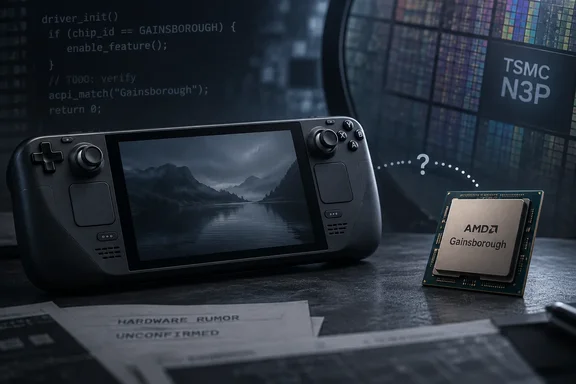
The useful distinction is between evidence of a reported chip project and evidence that Valve will ship it. Gainsborough could be relevant to Valve’s handheld plans. The reporting does not establish that a Steam Deck 2 using this processor is in production.
Why Gainsborough has attracted attention
The rumor rests on three circumstantial clues:
- The name: The original Steam Deck’s custom AMD APU was codenamed Aerith. Gainsborough is the surname of that Final Fantasy VII character, making the proposed connection conspicuous.
- A reportedly semi-custom design: Moore’s Law Is Dead claims AMD documentation identifies Gainsborough as a semi-custom processor. That would fit hardware developed for a particular customer rather than a general-purpose laptop product.
- A rumored N3P process: The chip is reportedly associated with TSMC’s N3P manufacturing technology, a plausible candidate for performance-conscious portable hardware.
Together, those clues explain the interest. They do not identify Valve as the customer. A fitting codename is an intriguing breadcrumb, not a purchase order.
There is also an important verification gap: XDA’s account does not identify the exact AMD driver version or reproduce the relevant reference. That leaves readers without a directly inspectable software artifact establishing what “Gainsborough” denotes.
What N3P actually tells us
The manufacturing-process claim deserves more context than “3nm means faster.”
TSMC’s own technical documentation describes N3P as an optical shrink of N3E, compatible with N3E’s design rules. The foundry says it improves performance, reduces power consumption and increases transistor density. Those are genuine process-level advantages, independent of whether the Gainsborough rumor proves accurate.
Crucially, TSMC positions its 3nm technologies for both smartphones and high-performance computing. N3P is not a handheld-specific fingerprint, so its rumored use cannot identify the eventual device or customer.
The practical interpretation is narrower: a more capable manufacturing process could help a designer balance speed and power consumption. It does not, by itself, provide a Steam Deck 2 frame-rate forecast or battery-life estimate. Treating the process name as a finished-device benchmark would skip the very engineering work Valve says matters.
Valve has already described the successor’s target
There is firmer evidence for Valve’s interest in a successor than for Gainsborough’s role in it.
In an interview published by Reviews.org on October 11, 2024, Valve designer Lawrence Yang rejected a yearly hardware-refresh cadence. He said Valve wanted a “generational leap in compute without sacrificing battery life” before releasing a true second-generation Steam Deck, and acknowledged that the company was working on it.
That statement corrects an overly broad reading of the rumor: work on a successor is not newly established by this leak. What remains uncertain is its processor, final specifications and schedule.
Yang also distinguished Steam Deck OLED from a second-generation device in that interview. Valve regarded OLED as a refinement of its original design rather than the generational successor. That distinction matters when assessing any future chip: being newer is not necessarily enough to meet Valve’s stated threshold.
What would turn this lead into stronger evidence?
For PC-hardware readers, the next useful developments would be:
- A verifiable driver reference, with the package or source location identified.
- Evidence connecting the processor to Valve, rather than relying on naming or semi-custom status.
- Confirmed device specifications, followed by performance and battery testing under comparable conditions.
Notebookcheck notes that Valve could have evaluated the processor and subsequently abandoned it, or AMD could repurpose the design elsewhere. Those possibilities remain compatible with the rumor.
The bottom line: Gainsborough is a plausible Steam Deck 2 lead, not a confirmed specification. Valve’s stated goal provides the meaningful yardstick: a substantial compute improvement without giving up battery life. Until evidence connects this chip to a finished handheld, the codename is worth watching—but it is not a launch announcement.
Update: Radeon 26.9.2 reportedly provides a traceable Gainsborough reference (October 3, 2026)
VideoCardz reports that AMD’s Radeon Adrenalin 26.9.2 driver, released September 29, contains entries for “Gainsborough,” alongside ATLite3 and AT2. The finding, attributed to AnandTech forum member SixPie, supplies the specific driver version missing from earlier coverage and gives researchers a package to inspect independently.
The report also adds alleged hardware-validation details: import and export records reportedly describe Gainsborough equipment using an FF6 BGA package with 1,179 contacts, with shipments occurring in late July. Kepler_L2 reportedly noted that the existing Steam Deck Van Gogh/Aerith platform uses FF3, making the package difference consistent with a new design rather than a revision of the original chip.
That is stronger evidence that Gainsborough is an active AMD project with associated hardware, but it still does not identify Valve as its customer. The Steam Deck 2 connection remains an inference based on the Aerith Gainsborough naming link and the reported semi-custom context, not a confirmation from Valve or AMD.
References
- AMD driver lists ATLite3 and Gainsborough, linked to PS6 Orion and Steam Deck 2 VideoCardz.com · 2026-10-02T15:55:42+00:00
- Hints of the Steam Deck 2 begin to emerge as a leak reveals a mysterious "Gainsborough" APU XDA · 2026-10-01T22:25:46+00:00
- Steam Deck 2 leak points to mysterious AMD Gainsborough APU on TSMC N3P - Notebookcheck News notebookcheck.net