

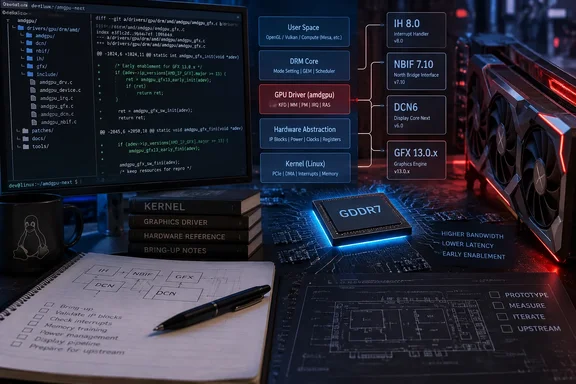
AMDGPU’s GDDR7 patch establishes preparation, not product specifications
The clearest change is modest: Phoronix’s Michael Larabel reports that AMD submitted a patch adding “GDDR7” as a video-memory name in AMDGPU. That is a concrete software change accounting for a new memory type. It does not establish that a complete graphics card using that memory can initialize, display an image, or run applications with the submitted code.
The documented before-and-after is therefore narrower than “AMD now supports GDDR7 graphics cards.” The reported addition gives the driver an explicit name for that memory technology; the reporting does not identify the exact code path using the name or demonstrate working hardware. Describing this as GDDR7 preparation preserves the useful finding without turning a small enablement step into a finished capability.
There is also a release boundary. These are reported patch submissions, not an identified stable-kernel release. Phoronix does not establish an accepted commit, a target kernel version, or a distribution package containing the change. No independent corroboration of this specific submission appears in the available search coverage, so the event remains attributed to Phoronix rather than presented as independently verified.
For current Radeon owners, the practical conclusion is straightforward: this report provides no reason to replace a working driver or move to a development kernel. It describes work for upcoming hardware, not a documented fix or performance improvement for an existing card.
IH 8.0 and NBIF 7.10 put the memory label in a broader hardware effort
The surrounding changes make the story more informative than a newly recognized string alone. According to Phoronix, AMD also submitted support for IH 8.0, an interrupt-handler hardware block, and NBIF 7.10, a new version of the New Bus Interface. Larabel places those submissions alongside recent Display Core Next 6, or DCN6, and GFX 13.0.x work. These details likewise rest on Phoronix’s reporting.
An IP block is a functional hardware component that the driver must understand. The Linux kernel’s AMDGPU documentation organizes support around distinct responsibilities, including graphics and compute, memory domains, virtual memory, interrupts, hardware blocks, and display management. That structure explains why support for an upcoming GPU can become visible through several separate development changes.
AMD’s older upstream interrupt-handler work offers a useful, documented example of this process. In a February 2024 mailing-list submission for IH 7.0, AMD’s Alex Deucher explained that GPU interrupts are written into a ring buffer, which the driver walks to process interrupt packets. That submission separated register definitions, interrupt-handler implementation, and discovery support into individual patches.
The older description explains the interrupt handler’s role; it does not verify the implementation of IH 8.0. Likewise, the reported NBIF 7.10 version does not establish a particular PCI Express generation or a retail-card feature. Those conclusions require the actual new implementation or a hardware specification.
Taken together, the reported submissions suggest a broader hardware-enablement effort. They still do not demonstrate that every component needed for a usable graphics stack is ready. Naming memory, handling hardware events, and supporting display components are different pieces of that work.
GDDR7 does not turn the RDNA5 inference into an AMD roadmap
Phoronix connects the new memory identifier and surrounding hardware-block work to what it considers likely RDNA5 hardware. That is an interpretation of development activity, not an AMD product announcement. The report also contrasts GDDR6-equipped RDNA4 cards with NVIDIA’s GDDR7-equipped GeForce RTX 50 desktop cards, providing context for why the memory transition would be unsurprising.
The commercial conclusion remains limited. A memory-generation identifier does not disclose a card’s memory capacity, operating speed, bus width, or measured performance. Without those specifications and working-hardware measurements, it cannot support a meaningful performance comparison or buying recommendation.
The distinction between AMDGPU and a specific consumer product is important, too. The Linux kernel documentation describes AMDGPU support across Graphics Core Next, Radeon DNA, and Compute DNA architectures. The driver’s breadth means that an addition to it is not, by itself, enough to map the change to a named Radeon model.
Larabel also repeats rumors of limited RDNA5 models arriving in 2027 and additional models potentially following in 2028 amid supply constraints. Neither an AMD announcement nor independent confirmation of those windows is established here. Those dates should remain outside a firm purchasing or deployment plan.
For Windows readers, the platform boundary is equally clear: these submissions concern the Linux kernel driver. They do not announce a Windows Radeon driver release, establish Windows compatibility for an unreleased card, or change the supported hardware list of an installed Windows driver package.
AMDGPU watchers should track release status before changing systems
Keep existing systems on their normal driver-maintenance path; use this development as a reason to watch future support announcements, not to install experimental software. The decision-changing evidence will be an identified hardware configuration and a released software stack that explicitly supports it.
- Existing Radeon owners have no documented upgrade action arising from the GDDR7 identifier alone.
- Linux administrators should distinguish a submitted patch from accepted code and from a kernel actually packaged for their distribution.
- Developers tracking future AMD hardware should treat GDDR7, IH 8.0, NBIF 7.10, DCN6, and GFX 13.0.x as reported development identifiers, not a confirmed retail specification.
- Windows users should not interpret Linux AMDGPU work as a new Windows driver or a compatibility announcement.
- Prospective buyers should base timing and performance decisions on announced products and measured results, rather than the reported RDNA5 launch rumors.
AMD’s reported GDDR7 groundwork is useful evidence of preparation in public-facing driver development. The next meaningful milestone is support tied to identifiable hardware and released software; until then, the concrete consequence is better visibility into AMD’s engineering work, not a new capability for today’s PCs.
References
- AMD Begins Preparing Open-Source Linux Driver For Graphics Cards With GDDR7 Phoronix · Mon, 21 Sep 2026 20:52:36
- drm/amdgpu AMDgpu driver — The Linux Kernel documentation kernel.org
- AMD Adds GDDR7 Support in GPU Driver, Preparing for RDNA 5 Launch TechPowerUp · 2026-09-22T15:25:20+00:00