

AMD RDNA 5 AT2: What the Kepler_L2 Leak Actually Claims
The figures come from Kepler_L2, a hardware leaker with a long record in Radeon rumours. OC3D reported them on September 23, 2026. According to OC3D, AT2 has 70 compute units (CUs). A CU is AMD's basic building block of shader, texture and ray-tracing hardware, so it's a rough measure of how wide a GPU is. Kepler_L2 also repeated the claim that AT2 will launch in 2027.
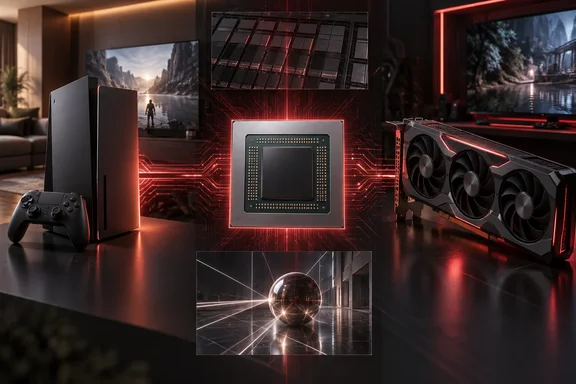
In OC3D's account, AT2 does two jobs. It powers AMD's next discrete Radeon cards, and it is also the graphics chip inside Project Helix. The console reportedly uses 68 of the chip's 70 CUs. Disabling a couple of units like this is a common way to improve manufacturing yields, but the 68-CU figure is still a report and not a Microsoft specification. OC3D also says AMD has other RDNA 5 designs, both above and below AT2, planned for 2028. If so, the Xbox chip would not be the top of the range.
The clock claim came earlier. Club386 reported on September 3 that Kepler_L2 said they had seen internal AMD documents mentioning 3.1–3.4 GHz clock targets for RDNA 5. No screenshots were shared. Club386 told readers to treat the claim with scepticism and pointed out that nobody knows how the range applies to desktop cards versus laptop GPUs.
A second leaker tells a broadly similar story. Wccftech, summarizing Moore's Law Is Dead, reported that the YouTuber claims to have documents in which AMD is targeting $550 for its successor to the 9070 XT GPU that will use the same chiplet as the Magnus APU, which is the name that leaker uses for the Helix chip. Two rumour sources agreeing on a shared console/PC design isn't confirmation. They could share upstream information, and neither has published documents. Still, it's more than a single tweet.
The RX 9070 XT Math Behind the "25% Faster" Headline
OC3D compares AT2 with the Radeon RX 9070 XT, AMD's current RDNA 4 flagship. The 9070 XT has 64 CUs and a maximum boost clock of 2,970 MHz. Club386 confirms the clock figure: the card tops out at 2,970 MHz, so 3.4 GHz would be about 14.5% higher and 3.1 GHz only about 4% higher.
The headline estimate multiplies these two ratios. Seventy CUs against 64 is a 9.4% increase. The clock gain is 4.3% to 14.5%. Multiply them and you get roughly 14% to 25%, which is OC3D's range. The arithmetic is right. What it describes is theoretical throughput: more units running faster, with everything else held equal.
Real GPUs don't scale that way. Club386 notes that clock speed is only one factor. Instructions per clock, CU count and many other architectural features together decide performance. Memory bandwidth, power limits, the clocks a card can sustain under load, drivers and game optimisation matter too, and the leak says nothing about any of them. For comparison, the RX 9070 XT has 16 GB of GDDR6 on a 256-bit bus (up to 640 GB/s) and a 304 W typical board power, according to AMD's published specifications. Nothing comparable has leaked for AT2, even as a rumour.
The clock range is also less dramatic than it looks. Club386 points out that the cheaper RX 9060 XT already boosts to 3.13 GHz. That makes the bottom of the RDNA 5 range roughly what AMD ships today on a smaller RDNA 4 die. It's also unclear whether Kepler_L2's figures are boost clocks, typical gaming clocks, or targets for a specific product.
OC3D goes further and says AT2 is expected to beat Nvidia's GeForce RTX 5080. That's a prediction with no test results behind it. Moore's Law Is Dead has made a similar estimate for the console chip: Shattered.io reports that the leaker pegs raster performance near an RTX 5080 and ray tracing potentially near an RTX 5090. The two sources agree, but it's one leaker's projection repeated, not a measurement.
Where the Upside Really Lives: RDNA 5 Ray Tracing and Neural Rendering
OC3D admits its CU-times-clock number leaves out architectural changes. This is where official statements carry more weight than the leak. Microsoft's claims about Project Helix concern ray tracing and machine-learning rendering, not raw shader throughput.
Microsoft has described its targets in public. GamingBolt reported that Jason Ronald, Vice President of Xbox's Next Generation division, promised "an order of magnitude increase in ray tracing performance and capability beyond what's currently possible with the Xbox Series X and S." OC3D's own coverage of that briefing says Helix also unlocks GPU-directed work graph execution, eliminating CPU bottlenecks, which lets the GPU generate some of its own work instead of waiting for the CPU. OC3D sums up the ray-tracing claim as "10x". Microsoft's wording was "order of magnitude," and it covered both performance and capability.
AMD has confirmed some basics. Wccftech's Project Helix roundup reports that AMD SVP Jack Huynh confirmed it uses the RDNA 5 GPU architecture and is manufactured on TSMC's 3nm process node. The same roundup says AMD's next upscaling and frame-generation stack, FSR Diamond, was confirmed for Helix at GDC 2026. It replaces FSR Redstone and is built into Microsoft's GDK. Wccftech also reports that it uses a dedicated NPU for multi-frame generation, neural texture compression, ray regeneration, and neural rendering.
Here's the limit. A 10x ray-tracing gain over Xbox Series X is a console-versus-console figure. Series X uses a much older RDNA 2 GPU, so that gain says little about how a PC AT2 card would compare with an RX 9070 XT, which already has far better ray tracing than Series X. It is also unclear whether a discrete Radeon card built on AT2 would get the dedicated NPU that Wccftech describes on the Helix SoC. A standalone GPU die might not include it. That's an open question, not an established fact.
Project Helix and Radeon on One Chip Changes the PC Porting Story
For Windows gamers and developers, the shared-silicon claim may matter more than the CU count. Microsoft has said openly that Helix is meant to narrow the gap between console and PC. Stuff reported that Microsoft confirmed plans for cross-compatibility with PC games. It quoted Xbox's Roland: "we're breaking down the barriers between console and PC games for more seamless cross-device play". Wccftech's roundup adds that Microsoft says Helix was co-designed for the next generation of DirectX.
This follows a partnership announced in June 2025. Shattered.io notes that Xbox and AMD then went public with a multi-year agreement to co-engineer silicon for future Xbox devices. At the time, AMD's Lisa Su said the company would build a roadmap of gaming chips for consoles, handhelds, PCs, and cloud. If AT2 really is the Helix GPU and a Radeon card at the same time, it would be the clearest example of that strategy so far.
The practical effect, and this is inference rather than something AMD or Microsoft has documented, is that games tuned for Helix's GPU would run on a very similar desktop Radeon part. Ray-tracing paths, FSR Diamond integration and work-graph code written for the console would face a similar hardware target on Windows. That doesn't guarantee better PC ports. Memory setups, CPU pairings and driver stacks will still differ. But developers would have one less variable to deal with.
RDNA 5 Launch Timing: 2027 Versus 2028
The dates are the least settled part of the story. OC3D, following Kepler_L2, says AT2 is due in 2027 and the rest of the RDNA 5 range in 2028. But as recently as September 3, Club386 wrote that the last rumour it had seen put the RDNA 5 launch in 2028. Coverage of the console is just as divided. NoobFeed reported that development kits are scheduled to be available in early 2027 and judged a 2028 launch more likely. Stuff counted from the Series X dev-kit timeline and estimated Helix was about 18 months away as of March 2026.
These dates can fit together. An AT2 Radeon card could arrive in 2027 with the wider family and possibly the console following later. But AMD hasn't published a date, and the sources disagree. Prices are equally uncertain. Moore's Law Is Dead's $550 figure for the RX 9070 XT successor is the only number in circulation, and it comes from that leaker alone.
Official information on Helix is still limited too. A fan-run specs tracker says Microsoft has confirmed the overall direction, but the exact RAM amount, GPU configuration, FPS targets, teraflops, storage capacity, and retail model split are still not official.
What this means for you
For anyone deciding whether to buy a graphics card now, this leak shouldn't change much. AT2 is at least a year away by the most optimistic rumour. It has no confirmed name, price, power requirement, memory configuration or benchmark. Waiting only makes sense if you're happy with your current GPU and planning to upgrade in 2027 anyway.
Developers and technical leads working on cross-platform Xbox and PC games have more to watch. Microsoft's official Helix statements about ray tracing, work graphs, next-generation DirectX and FSR Diamond are more solid than any leaked CU count. Those are the details to plan around.
- AMD has not confirmed the 70-CU count, the 3.1–3.4 GHz clock targets or the 2027 date for RDNA 5 AT2. All three come from Kepler_L2, who has published no documents.
- The claim that AT2 is "14%–25% faster than the RX 9070 XT" comes from multiplying CU count by clock speed. It is not a benchmark, and actual game performance could land well outside that range in either direction.
- The confirmed Project Helix facts are an RDNA 5 GPU on TSMC 3nm, an "order of magnitude" ray-tracing target over Xbox Series X, and FSR Diamond support. The 68-CU console setup is still a rumour.
- The 10x ray-tracing figure compares Helix with Xbox Series X. It does not predict how an AT2 Radeon card will compare with today's RX 9070 XT or GeForce RTX 5080.
- If you're buying a GPU in 2026, judge today's cards on their tested performance and price. The AT2 leak includes no price, power or availability information you can plan around.
The AT2 leak matters less for its 25% estimate than for what it suggests about AMD's plans: one RDNA 5 chip designed with Microsoft for the next Xbox, then sold to PC gamers as the successor to the RX 9070 XT. The console side is partly confirmed through AMD's RDNA 5 and 3nm statements and Microsoft's ray-tracing targets. The Radeon side, including the CU count, clocks and 2027 date, is still coming from leakers. Firm figures will have to come from AMD and Microsoft, most likely once Helix development kits reach studios, which reports place in early 2027.