

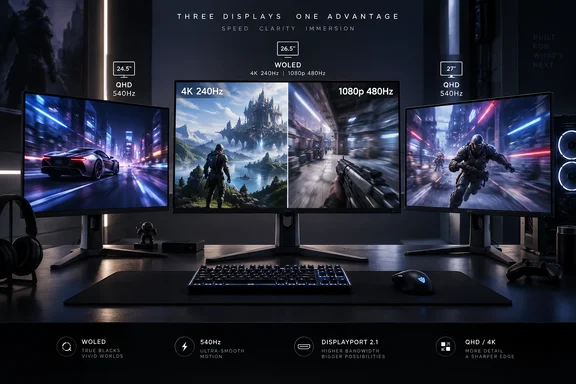
AntGamer’s launch statement published by 17173 also identifies all three models. These are announced specifications, however, rather than independently measured results: neither the launch statement nor IT Home’s reports establish how the monitors perform in motion-clarity, input-lag or sustained-brightness testing.
Three models, two different priorities
IT Home reports the following configurations and Chinese launch prices. The ANT272TUE costs 500 yuan more than either HMO model; choosing the smaller ANT255TQ does not reduce the reported price.
| Model | Screen size | Display technology | Advertised resolution and refresh rate | Chinese launch price |
|---|---|---|---|---|
| ANT272TUE | 26.5 inches | Tandem WOLED | 3840 × 2160 at 240 Hz, or 1920 × 1080 at 480 Hz | 6,999 yuan |
| ANT255TQ | 24.5 inches | HMO backplane with backlighting | 2560 × 1440 at 540 Hz | 6,499 yuan |
| ANT275TQ | 27 inches | HMO backplane with backlighting | 2560 × 1440 at 540 Hz | 6,499 yuan |
The practical dividing line is the resolution available at the highest refresh rate. The ANT272TUE doubles its refresh rate by moving from 4K to 1080p, reducing the displayed pixel count to one-quarter. The two 540 Hz models retain QHD, which contains about 78% more pixels than 1080p.
For someone splitting time between detailed desktop work and competitive games, the OLED model therefore offers two distinct operating modes. A player who wants to remain at QHD while pursuing the highest refresh rate has a more direct option in the ANT255TQ or ANT275TQ. Those are implications of the advertised modes, not conclusions from comparative testing.
ANT272TUE: what the OLED specifications establish
According to IT Home, the ANT272TUE has an RGB subpixel arrangement, VESA DisplayHDR True Black 400 certification, a claimed 1,000-nit peak brightness, a 0.03 ms response-time specification and average Delta E below 1. IT Home also lists a DisplayPort 2.1 input with UHBR20 support.
The brightness and color figures need to be read within their stated limits. A peak-brightness specification does not establish sustained brightness across the entire screen. Likewise, an average Delta E below 1 is a color-error claim; without the measurement conditions, it does not establish accuracy in every picture mode or make this a tested recommendation for color-critical work.
Wccftech describes the 0.03 ms figure as eliminating ghosting. The published response-time number alone does not support that conclusion, nor does it describe total input latency. It is safer to treat it as AntGamer’s advertised response specification until measurements establish the monitor’s actual behavior.
The DisplayPort connection is potentially useful for these demanding display modes. Wccftech reports UHBR20’s link bandwidth as up to 80 Gbps and characterizes it as supporting uncompressed visuals. However, the reporting does not establish the monitor’s complete resolution, refresh-rate and color-depth combinations, or their compression requirements. UHBR20 support alone is not confirmation that every advertised configuration operates without compression.
For a prospective buyer, the compatibility question is whether the graphics card, connection and monitor support the intended mode together. The announcement does not provide a verified input-by-input mode table, so it cannot establish that every port or PC configuration will deliver 4K at 240 Hz.
ANT255TQ and ANT275TQ: QHD at 540 Hz
IT Home reports that both QHD models use a new-generation high-mobility-oxide, or HMO, backplane. It also lists second-generation ultra-black display technology, a second-generation HFL-material display solution advertised as flicker-free, an AVS picture-quality engine and dual-sided backlighting.
HMO identifies the backplane technology rather than making these OLED displays. The reported backlighting distinguishes their design from the ANT272TUE’s WOLED panel. The associated marketing names do not, by themselves, establish measured contrast or motion clarity.
According to IT Home, both models carry response specifications of 1.31 ms gray-to-gray, or GtG, and 1.87 ms moving-picture response time, or MPRT, plus 98.4% DCI-P3 color-gamut coverage. Those detailed figures remain single-outlet reporting rather than independently corroborated measurements.
GtG and MPRT describe different aspects of display response and should not be treated as interchangeable scores. Similarly, color-gamut coverage describes the range of colors a display can reproduce, rather than proving how accurately it reproduces them.
The refresh-rate comparison is more straightforward. Calculated from the announced rates, the interval between refreshes is approximately:
- At 240 Hz, the display refreshes every 4.17 milliseconds.
- At 480 Hz, the display refreshes every 2.08 milliseconds.
- At 540 Hz, the display refreshes every 1.85 milliseconds.
Thus, moving from 480 Hz to 540 Hz shortens the refresh interval by about 0.23 ms. That calculation is not a measured reduction in end-to-end gaming latency. The more substantial configuration difference is that the HMO models offer their highest rate at QHD, while the OLED model’s 480 Hz mode uses 1080p.
Availability and the buying decision
The reported prices are Chinese launch prices. The available announcements do not establish international shipping dates, regional retail prices or warranty coverage outside China. Wccftech’s dollar equivalents should not be read as confirmed U.S. pricing.
On the documented specifications, the ANT272TUE is the choice to investigate for 4K use with a separate high-refresh 1080p mode. The ANT255TQ and ANT275TQ instead target buyers prioritizing QHD at 540 Hz, with screen size as their clearest reported difference. Before committing to any of them, buyers need confirmation that their intended input configuration supports the advertised mode—and regional availability and warranty terms that turn a Chinese launch announcement into a practical local purchase.
References
- AntGamer Launches Tandem WOLED-Based 4K 240 Hz Monitor Alongside Two 540 Hz Gaming Monitors With HMO Wccftech · 2026-09-21T15:12:35+00:00
- 蚂蚁电竞发布新一代 HMO 技术 QHD 540Hz 显示器 ANT255TQ、ANT275TQ - IT之家 ithome.com
- 蚂蚁电竞发布 ANT272TUE 显示器:Tandem WOLED,UHD 240Hz 双模 - IT之家 ithome.com