

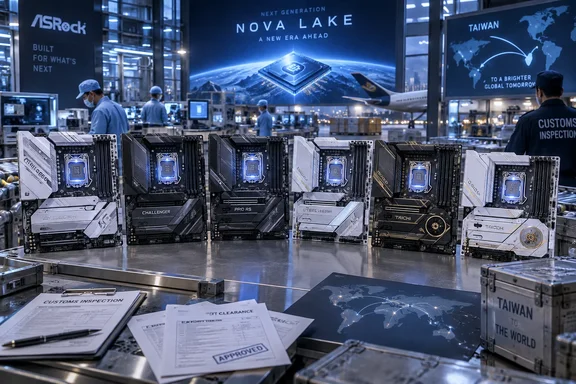
Club386 first reported the entries from NBD shipping data on September 17, and VideoCardz independently reviewed the listings and published the fuller six-variant breakdown. The records show assembled boards and bare PCBs travelling from Taiwan and Vietnam in late July 2026. Neither Intel nor ASRock has announced a Z990 chipset, a Nova Lake-S retail CPU, pricing, memory support, or a launch date, so the documentation is evidence of pre-release supply-chain activity, not a product announcement.
There is one important correction to make before reading too much into the timing. Club386’s live story says the shipments occurred in July 2027 — a future date relative to its September 17, 2026 publication date. VideoCardz identifies the records as late July 2026, which fits both the report’s chronology and the underlying claim that the boards are already in validation or pre-production circulation. The July 2027 reference is plainly a date error, but it is a useful reminder of how easily a single typo can distort a hardware-launch timeline.
Six ASRock names, not five boards
The names appearing in the shipping data are:
- ASRock Z990 Challenger WiFi.
- ASRock Z990 Challenger WiFi White.
- ASRock Z990 Pro RS WiFi.
- ASRock Z990 Steel Legend WiFi.
- ASRock Z990 Taichi Creator.
- ASRock Z990 Taichi White.
Club386 described “at least five” boards and named five product families, while VideoCardz counted the white Challenger separately after reviewing the same customs material. That is a small discrepancy, but it changes the practical reading of the leak: ASRock is not merely testing a flagship Taichi design and a single mainstream board. It appears to have at least two cosmetic or SKU variants within the Challenger tier as well.
The Challenger designation is the most consequential name in the list. ASRock has used Challenger for lower-cost Intel boards, including B860 products on the current LGA1851 platform. Putting that branding alongside Z990 suggests the company may intend to sell an entry-priced route into Intel’s highest 900-series chipset, rather than reserving Z990 exclusively for oversized, premium boards built around extreme power delivery and luxury I/O.
That does not establish that a Z990 Challenger will be cheap. Customs descriptions do not provide retail pricing, PCB layer counts, VRM specifications, networking hardware, storage allocation, or whether ASRock will disable features that differentiate it from Taichi. Still, the naming is meaningful. Intel’s Z-class boards frequently command a substantial premium over B- and H-class alternatives; a budget-oriented Z990 model would give unlocked Nova Lake buyers a less extravagant option, assuming Intel retains familiar CPU-overclocking segmentation.
The Pro RS and Steel Legend listings fit ASRock’s established tiers: Pro RS generally targets value-focused builders, while Steel Legend has occupied the midrange with more elaborate styling and feature sets. Taichi Creator and Taichi White, by contrast, point toward the high end. The list does not include an ASRock Phantom Gaming model, but absence from a July shipment record is not proof that no such board exists.
What customs data can — and cannot — establish
Shipping records often surface long before public launches because motherboard development requires boards, unpopulated PCBs, controllers, sockets, power-delivery components, firmware work, and qualification samples to move among suppliers and factories. The July records therefore support a narrow conclusion: ASRock had tangible Z990-labelled board hardware in the supply chain by late July 2026.
They do not reveal whether the boards used final chipset silicon, engineering-sample components, or placeholder descriptions. They also do not demonstrate that mass production has started. VideoCardz appropriately characterizes the activity as compatible with hardware validation or pre-production, and that is where the evidence ends.
That distinction matters for anyone delaying a PC build. A motherboard moving through a factory network can precede a retail product by weeks, quarters, or longer if Intel changes firmware requirements, binning plans, chipset availability, or CPU launch sequencing. Early hardware traffic narrows the range of possibilities; it does not put an LGA1954 board on a store shelf.
The records also say nothing about compatibility with existing components. Nova Lake is widely linked to LGA1954, which would make current LGA1851 Z890 and B860 motherboards physically incompatible. Reports from Computex have indicated that LGA1954 retains the same 45 mm by 37.5 mm package footprint as LGA1851 and may retain cooler compatibility, but Intel has not published the consumer platform specifications. Builders should therefore treat reuse of an existing cooler as likely but unconfirmed, and treat reuse of the motherboard itself as unrealistic.
Z990’s public trail began at Computex
The ASRock entries are not the first physical indication that Z990 exists. In June, Gigabyte displayed a covered-socket AORUS board at Computex 2026. Footage subsequently examined by PCWorld showed an “AORUS Z990 PRO” marking on the rear of the PCB, and Gigabyte confirmed to multiple outlets that the board was a Z990 model.
That appearance independently corroborated the chipset name before the ASRock customs records surfaced. It also showed a platform designed for more than a routine motherboard refresh: reports on the board described unusually substantial power provisioning, extensive M.2 accommodation, and more connectivity than Gigabyte’s existing AORUS Pro boards. Those details are observations from a high-end demonstration board, however, and should not be treated as baseline specifications for every Z990 product.
Tom’s Hardware reported seeing multiple Z990 boards at Computex, including a near-production example, and confirmed that LGA1954 uses Intel’s two-lever independent loading mechanism. The outlet also reported that the socket should accept current LGA1851 coolers. Those are the strongest indications so far that motherboard makers are well beyond conceptual designs, but the picture remains incomplete because neither Intel nor its board partners have issued final platform documentation.
This creates a more useful dividing line for buyers than the usual launch-rumor churn. Z990 itself is increasingly visible in physical hardware. The feature table circulating online — including claims of chipset PCIe 5.0 lanes, more USB capacity, and a Z970 tier with multiplier overclocking but no base-clock tuning — is still based on leaks rather than an Intel datasheet. Treat a photographed board and a customs manifest as stronger evidence than a copied specification chart.
The launch calendar remains unsettled
Intel has publicly signaled Nova Lake for the end of 2026, while reporting from Computex pointed to a less tidy sequence: channel shipments in the fourth quarter of 2026, a public unveiling around CES in January 2027, and retail availability during the first quarter of 2027. Tom’s Hardware reported that several vendors expected a CES-era debut, though accounts varied between late 2026 and early 2027 depending on whether they meant channel availability or consumer sales.
The July ASRock movements are consistent with either path. They do not settle the date. They do make a launch in the distant second half of 2027 harder to reconcile with the visible board activity, unless Intel is staging a long validation period or the listed products are only early reference designs.
Claims of a later 52-core Nova Lake flagship remain even less certain. Tom’s Hardware reported vendor discussions pointing to an initial 28-core flagship followed by a 52-core model later in 2027, but Intel has not confirmed a core count, SKU stack, power limit, or release cadence. The board leak should not be used to validate those CPU rumors. High-end Z990 boards may be built to accommodate ambitious processors, but their existence does not prove which chips Intel will actually sell.
What Windows PC builders should do now
For users on LGA1700 or AM5 who need a system today, the Z990 records are not a reason to postpone a purchase without a specific Nova Lake requirement. There are no independent benchmarks, prices, Windows performance figures, firmware maturity data, or final feature disclosures against which to judge the wait. A new socket also means budgeting for at least a CPU and motherboard together, and likely DDR5 memory if the platform does not support an older memory standard.
For LGA1851 owners, the evidence points toward a shorter upgrade path than Intel enthusiasts may want. Nova Lake’s expected LGA1954 socket means a Z890 or B860 purchase should be viewed as an Arrow Lake platform decision, not an assured stepping stone to Intel’s next desktop generation. Intel has yet to publish the final support matrix, but no shipping record, Computex board, or credible report suggests a cross-socket upgrade route.
ASRock’s six listed Z990 variants do not answer the questions that decide a build: cost, lane allocation, USB and Thunderbolt support, storage trade-offs, memory speeds, BIOS stability, and actual Nova Lake performance. What they do establish is simpler and more durable: motherboard vendors are already committing PCB designs to Intel’s next desktop socket, and the Z990 platform is moving from rumor tables into manufacturing logistics.