

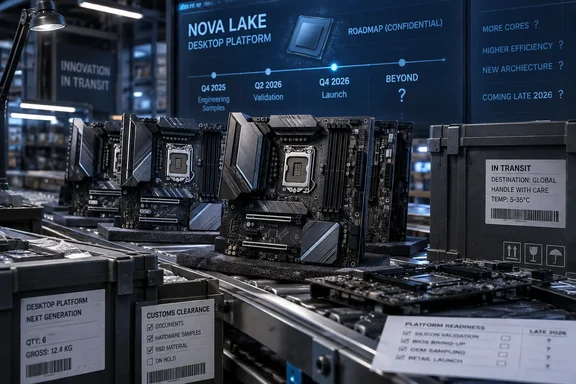
Tom’s Hardware argues that the growing number of leaks — including a purported roadmap slide, Z990 shipments, and an apparent next-generation HP EliteBook entry in SiSoftware — points to an imminent Nova Lake arrival. The stronger conclusion is narrower. Board partners are sufficiently far along to move physical hardware through their supply chain; Intel has not publicly replaced its late-2026 target; and the remaining dates, core counts, cache configurations, and rollout order remain unverified.
For Windows PC builders, that distinction affects whether an LGA1851 purchase is a sensible near-term build decision or whether waiting for Intel’s next socket makes sense. The evidence supports planning for a platform transition. It does not yet support buying around a presumed launch date.
Intel’s public deadline is late 2026
Intel Chief Executive Lip-Bu Tan gave Nova Lake its clearest official window during the company’s fourth-quarter 2025 earnings call in January 2026, saying the next-generation client processor was “coming at the end of 2026.” Intel made a substantially similar statement in its 2025 second-quarter earnings materials, placing Nova Lake at the end of 2026 while acknowledging gaps in its high-end desktop lineup.
That is stronger evidence than a leaked slide because it was a statement made to investors, where forward-looking product timing has consequences if it proves materially misleading. It also establishes that Intel sees Nova Lake as part of the company’s answer to its desktop problem, rather than merely the routine successor to Arrow Lake.
But an official broad window is still a broad window. “End of 2026” can mean an announcement, a limited unlocked desktop release, an OEM rollout, or availability that begins late in the quarter and expands later. Intel has not publicly specified which Nova Lake segment comes first, which products will be available at launch, or whether desktop and notebook parts will arrive together.
Intel’s July 2026 quarterly release highlighted the production ramp of Panther Lake — marketed as Core Ultra Series 3 — but did not provide a new Nova Lake date. That silence does not prove a delay. It does mean the January deadline remains Intel’s last meaningful public commitment, rather than a freshly reaffirmed shipping schedule.
The Z990 records show board work, not store shelves
The newly surfaced ASRock records are the most concrete part of this story. Club386 first reported that boards and bare PCBs carrying Z990 model names appeared in NBD Data customs records from Taiwan and Vietnam. ComputerBase subsequently listed six apparent ASRock variants:
- ASRock Z990 Challenger WiFi.
- ASRock Z990 Challenger WiFi White.
- ASRock Z990 Pro RS.
- ASRock Z990 Steel Legend WiFi.
- ASRock Z990 Taichi Creator.
- ASRock Z990 Taichi White.
The named range matters more than the existence of one prototype. Taichi is ASRock’s premium family, Steel Legend generally occupies the middle of its lineup, and Pro RS is often a price-conscious board line. The unexpected name is Challenger, which ASRock has used on lower-cost Intel B860 products. If those names survive to retail, Z990 may launch with a wider board range than the usual first-wave collection of expensive overclocking flagships.
Still, customs records do not tell buyers whether those boards are engineering samples, validation boards, early production units, components being routed between factories, or retail-ready stock. They also do not confirm that Z990 is Intel’s final chipset name, even if the branding is now widely repeated.
One reporting error illustrates why the timing claims need restraint. Club386’s live article says its records showed shipments in July 2027, even though the story was published on September 17, 2026. ComputerBase identifies the shipments as occurring in late July 2026, which fits the chronology and is almost certainly what Club386 intended. The future-date typo does not invalidate the boards’ apparent existence, but it does undercut attempts to build a precise launch calendar from the initial report alone.
A motherboard schedule cannot settle the CPU schedule
Tom’s Hardware estimates that a motherboard development process takes roughly four to six months, followed by further time for channel distribution, and uses the July shipment records to argue that Z990 boards could be on shelves by October or November. The calculation is plausible as an industry estimate, but it is not a demonstrated schedule for ASRock or Nova Lake.
Motherboard makers need working processor specifications, firmware development, electrical validation, memory compatibility testing, compliance work, packaging, and retail logistics. Yet an early physical board can move through that process long before its matching CPUs are ready for sale. Vendors may also distribute boards to BIOS teams, CPU partners, system integrators, reviewers, and manufacturing facilities without committing to a consumer launch date.
The situation is even less conclusive because the purported roadmap slide reported earlier this month points the other way. Tom’s Hardware said the slide indicated Nova Lake entering mass production in the fourth quarter of 2026, with an initial 28-core launch in the first quarter of 2027 and higher-end models arriving later. That would fit the appearance of pre-release boards in mid-2026 just as well as a fourth-quarter CPU release would.
Neither Intel nor ASRock has authenticated that slide, and its chain of custody is unknown. It reportedly originated with a Chinese-language source and contains references to later code names, including Hammer Lake, that have little public corroboration. Treating it as Intel’s final roadmap would be a mistake. But treating the shipping records as proof that the slide must be wrong would be the same mistake in reverse.
The supply-chain evidence establishes hardware preparation, not the retail date.
Core counts, bLLC and LGA1954 remain rumor territory
Nova Lake has accumulated an unusually detailed rumored specification list for an unreleased platform: a possible 52-core top-end desktop part, up to 288MB of big Last Level Cache or bLLC, new Coyote Cove performance cores, Arctic Wolf efficiency cores, and an LGA1954 socket. Reports have also tied the platform to Intel 900-series chipsets, including Z990.
None of that has been confirmed by Intel. The figures may prove directionally correct, but they should not be treated as purchasing information yet. The 52-core number is particularly vulnerable to misunderstanding: even if Intel ships such a part, it may be a later halo SKU rather than the first Nova Lake processor buyers can obtain. The same caution applies to cache-heavy gaming parts, maximum memory data rates, PCIe lane counts, and claimed power requirements.
The bLLC rumor deserves attention because it signals an apparent response to AMD’s Ryzen X3D strategy: use a substantially larger cache allocation to reduce memory bottlenecks in some games and other cache-sensitive workloads. But it also leaves basic questions unanswered. Intel has not said whether bLLC would appear across the product stack, whether it would be limited to one die configuration, how software scheduling would handle it, or how much it would affect prices and power consumption.
The LGA1954 claim carries the clearest practical consequence if it proves accurate. Nova Lake would require a new motherboard, ending the upgrade path for current LGA1851 systems after Arrow Lake and its refresh. Rumors of multigeneration LGA1954 support are encouraging for builders who dislike Intel’s short socket cycles, but there is no public commitment to that longevity. A socket being technically capable of supporting another generation is not the same as Intel guaranteeing that it will.
What PC buyers should do before Intel speaks
Current LGA1851 owners should not assume that a BIOS update will take them to Nova Lake. The reported LGA1954 socket change suggests the opposite: Nova Lake would be a CPU-and-motherboard upgrade, likely with fresh chipset and firmware considerations. That is reason to avoid buying an expensive Z890 board specifically for a future CPU swap.
Buyers who need a machine this autumn should choose based on the hardware that exists now, its price, application performance, and platform support — not on a 52-core processor or cache configuration that Intel has never announced. The most rational reason to wait is not a belief that Nova Lake will definitely arrive on a particular week in November; it is the chance that Intel will clarify its desktop roadmap before the year closes.
The next hard evidence will be an Intel product briefing, named processor models in official documentation, or retail listings that are corroborated by actual availability. Until then, the ASRock boards show Nova Lake is progressing through the partner pipeline, while Intel’s own record still points to late 2026. The gap between those two facts is where the uncertainty remains.
References
- Details about Intel's next-gen Nova Lake CPUs keep leaking — an attempt to establish a timeline based on what we know so far Tom's Hardware · 2026-09-18T19:45:41+00:00