

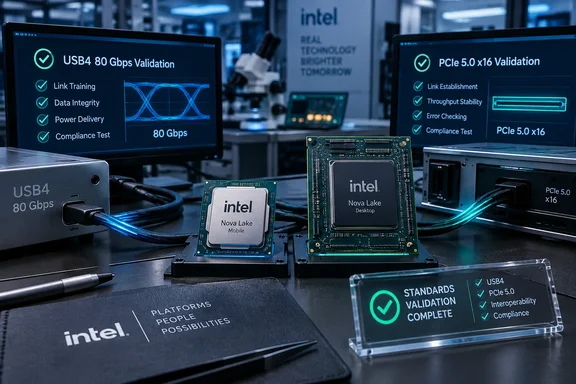
This isn't a launch, a spec sheet or a benchmark. It is a sign that the platform has moved from roadmap slides into formal validation.
What was listed
The USB-IF entries are the clearest part of the story. According to Tom's Hardware, the USB-IF listing confirms that Intel's mobile Nova Lake-H processor (Device ID D331, D333) is compliant with the USB4 80 Gbps specification (which is not surprising, as the part is also supposed to support Thunderbolt 5). The desktop chipset got a lower-speed certification: Intel's desktop Nova Lake PCH-S chipset (Device ID 6E6E) is compliant with the USB 3.2 Gen2 standard and supports a data transfer rate of up to 20 Gbps.
On the PCIe side, the PCI-SIG Integrators List has included Intel's 900-series chipset (Device 6E38-6E3F, 6E30-6E35, 6E40-6E47) for Core Ultra 400-series 'Nova Lake-S' processors since April 2026, according to the report. Tom's Hardware adds that in early August, an Intel processor it could not identify (device IDs D461, D465 and D467–D46A) passed interoperability testing with a PCIe 5.0 x16 root complex. The publication thinks it's probably the desktop Core Ultra 400-series chip but says it can't confirm that.
| Listing | Device IDs (as reported) | Standard / result |
|---|---|---|
| USB-IF: Nova Lake-H mobile CPU | D331, D333 | USB4, 80 Gbps |
| USB-IF: Nova Lake PCH-S desktop chipset | 6E6E | USB 3.2 Gen 2, 20 Gbps |
| PCI-SIG: 900-series chipset | 6E30–6E35, 6E38–6E3F, 6E40–6E47 | Listed since April 2026 |
| PCI-SIG: unidentified Intel processor | D461, D465, D467–D46A | PCIe 5.0 x16 root complex, added early August 2026 |
The Nova Lake desktop processor, which is expected to support USB4, is missing from the USB-IF list for now. That's a snapshot of a membership database, not evidence that the chip lacks the feature.
Section summary: A mobile Nova Lake-H chip has USB4 80 Gbps certification. The desktop chipset has USB 3.2 Gen 2 certification. PCI-SIG has listed the 900-series chipset since April, plus a PCIe 5.0 x16 processor that is probably, but not definitely, desktop Nova Lake.
Do the device IDs match anything else?
One useful check is whether these ID ranges match what Intel has already sent to the Linux kernel. They look consistent. A March 2026 stable-kernel patch for Intel's sensor hub driver adds two new #define entries for PCI device IDs (0xD354 for NVL_H, 0x6E78 for NVL_S). Another patch adds a single PCI device ID (0xd323) for Intel Nova Lake PCH-H SPI serial flash.
Put that next to the listings and a pattern appears: Nova Lake-S desktop parts use 6Exx IDs, and Nova Lake-H mobile parts use Dxxx IDs. That's our own inference, and ID blocks alone can't prove which product is which. Still, it fits the reported split between the Nova Lake-H USB4 entry (D331/D333) and the desktop chipset entries (6Exx). The unidentified PCIe 5.0 x16 processor, with D46x IDs, is harder to place from this pattern. Its identity stays uncertain, as Tom's Hardware says.
Section summary: Nova Lake IDs in Intel's own Linux patches follow the same 6Exx (desktop) and Dxxx (mobile) split seen in the listings. That's a sanity check on the reporting, not proof of what each ID is.
Why these parts came first
Certifying a desktop chipset and a high-end laptop CPU before everything else looks odd at first. The USB-IF's Qualification by Similarity (QbS) program probably explains it. Tom's Hardware notes that since USB4 and USB 3.2 circuitry in different Nova Lake products is similar, Intel can submit select CPUs and chipsets for USB-IF compliance tests and then follow up with the QbS.
The USB-IF's own QbS documentation adds a few details:
- It isn't automatic. Certification applies to one exact product name, model and revision. A product with even a slightly different name or model number is not considered certified. Companies must use QbS to get approval for close relatives. Tom's Hardware makes the same point: differently named products are not certified automatically simply because they contain identical USB circuitry.
- Only USB-IF decides. After reviewing a request, it can grant QbS, deny it and require full testing, or grant it only if the new product passes a subset of tests.
- Silicon rules suit a chip family. For chips, retesting is usually not needed when features are removed through bond or fuse options, or when the package changes within the same package family. It usually is needed for metal steppings, die changes or a change of package family. That's a good match for a lineup where lower-end models are cut down from the same die.
- Test the top model first. USB-IF recommends certifying the most fully featured, most power-hungry version of a product. It says versions with features removed are more likely to get QbS.
- Time limits. A parent product for host silicon can be up to three years old, so an early certification can support derivative parts for a long time.
A caveat: none of this shows that Intel has filed, or received, QbS approval for any other Nova Lake part. It only explains why the order of certification matters less than it seems.
Section summary: Intel certifies a few representative chips, then uses QbS to seek approval for close variants. USB-IF still reviews every request and can demand more testing.
What PC builders and IT buyers should take from this
Keep expectations tied to the evidence:
- Board specs aren't settled yet. The chipset's USB 3.2 Gen 2 listing describes the silicon, not your future motherboard. Port routing, extra controllers and cabling decide what you actually get. A February 2026 leak reported by Tom's Hardware says the top Z990 and W980 chipsets would offer 48 PCIe lanes (including 12 PCIe 5.0 lanes from the chipset and 16 PCIe 5.0 lanes from the CPU), two Thunderbolt 4/USB4 ports supported by the processor, 5 USB 3.2 20 Gbps, and 10 USB 3.2 10 Gbps ports. The same leak says inexpensive B960 and Z970 will only support 34 PCIe lanes. Treat those numbers as unconfirmed.
- Faster USB on desktops will likely come from the CPU. Both the leak and the certified 20 Gbps chipset point the same way: USB4 on desktop Nova Lake is expected to be wired to the processor, not the chipset. That's also why the missing desktop CPU entry matters.
- Laptops look ready for 80 Gbps. Premium Nova Lake-H notebooks appear set up for top-tier USB4. You'll still need cables certified for 80 Gbps; USB-IF says full speed requires them.
- A listing isn't a promise. PCI-SIG says its list is limited to member companies and can't be used for individual marketing. Neither group's list is a public spec sheet, and neither confirms a ship date.
Section summary: The certifications tell you what the silicon can do. Motherboards and laptops will decide what you actually get, and reviews will decide whether it's worth buying.
When will it launch?
Intel hasn't set a firm date, and the reporting disagrees. Tom's Hardware's latest compliance story cites leaks pointing to a Core Ultra 400-series launch in Q1 2027. The same outlet's September 18 timeline piece notes that CEO Lip-Bu Tan said in prepared earnings remarks that Nova Lake was coming at the end of 2026. That article argues a late-2026 launch is more likely, citing ASRock Z990 motherboard shipments in July and motherboard makers pointing to Q4. It also questions a leaked partner slide showing Q4 mass production and a Q1 2027 launch.
So is it Q4 or CES? Either way, standards testing is the kind of paperwork you do months ahead, not a release-date announcement. Tom's Hardware expects more compliance listings in the coming weeks or months. Regulatory and environmental filings will follow too, though those rarely become public before launch.
Bottom line
Nova Lake has cleared real steps with the USB and PCIe standards groups: USB4 80 Gbps for mobile Nova Lake-H, USB 3.2 Gen 2 for the desktop chipset, and a PCIe 5.0 x16 processor that is probably desktop Nova Lake. The ID patterns match Intel's own Linux patches, and the certification order makes sense under USB-IF's rules. None of this settles prices, performance or the launch date. Until Intel announces those, anyone planning an LGA 1954 build should treat leaked board specs as rumors.
References
- Intel's next-gen Nova Lake platforms pass compliance at USB and PCIe standards bodies as launch looms Tom's Hardware · 2026-09-29T12:00:00+00:00
- Details about Intel's next-gen Nova Lake CPUs keep leaking — an attempt to establish a timeline based on what we know so far | Tom's Hardware tomshardware.com
- (PATCH AUTOSEL 6.19-6.18) HID: intel-ish-hid: ipc: Add Nova Lake-H/S PCI device IDs lkml.iu.edu