

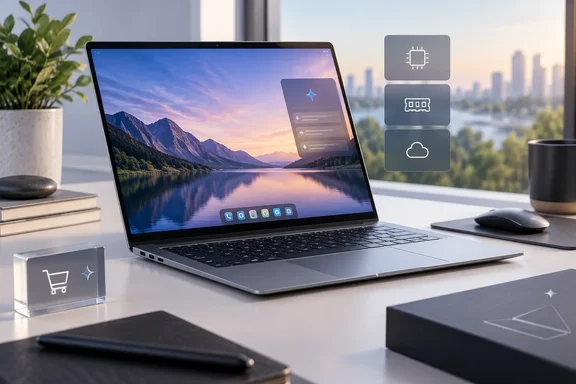
ASUS Googlebook 14 Pre-Orders Open at $1,299.99, With a Core Ultra 5 Inside
ASUS's US press release calls the Googlebook 14 a 14-inch ultraportable laptop that's the first ever ASUS laptop designed for Gemini Intelligence. The release went out through GlobeNewswire dated September 21, and ASUS's pressroom lists a September 23 version. Pre-orders are live: priced at $1,299.99, is now available for pre-order online at the ASUS Store and Best Buy. A footnote adds that third-party retailers set their own prices, which can change without notice.
The first reports skipped the processor detail. In the release, ASUS describes the performance as an Intel Core Ultra 5 325, 16GB of LPDDR5X memory, and up to a 512GB PCIe 4.0 SSD. The spec table lists two US models at the same $1,299.99 MSRP:
| Model | CPU | Memory | Storage | MSRP |
|---|---|---|---|---|
| CX9406CAA-U5_16.512 | Core Ultra 5 325 | 16GB LPDDR5X-8533 | 512GB PCIe 4.0 NVMe | $1,299.99 |
| CX9406CAA-DH566T | Core Ultra 5 325 | 16GB LPDDR5X-8533 | 256GB PCIe 4.0 NVMe | $1,299.99 |
Other outlets confirm this. Guru3D reports that ASUS has opened U.S. preorders for the Googlebook 14 CX9406CAA at $1,299.99 and that the notebook uses Intel's Core Ultra 5 325 with 16GB of LPDDR5X memory and up to a 512GB PCIe 4.0 SSD. The live ASUS eShop listing is for the DH566T and describes 16GB of LPDDR5X memory on board and a 256GB PCIe Gen 4 SSD.
It is odd that a 256GB and a 512GB model carry the same MSRP in ASUS's table. It could be a pricing error or a sign that the two models will be sold through different stores. Either way, the model number you check out with decides whether you get twice the storage for the same money.
The Core Ultra 7 355 and 64GB Are Catalogue Maximums, Not Launch SKUs
The "up to Core Ultra 7" wording comes from ASUS's global spec sheet, which lists two processors for the CX9406CAA family. The Intel Core Ultra 7 355 runs at a 2.3GHz base and up to 4.7GHz, with 12MB of cache, 8 cores and 8 threads, and an Intel AI Boost NPU rated up to 49 TOPS. The Core Ultra 5 325 runs at 2.1GHz base and up to 4.5GHz, with 12MB of cache, 8 cores and 8 threads, and an NPU rated up to 47 TOPS. Both use Intel integrated graphics.
ASUS's US product listing shows the Core Ultra 7 355, "up to 64 GB LPDDR5X memory" and "up to 1 TB M.2 PCIe 4.0 SSD". The detailed spec page only lists 16GB and 32GB memory entries with a stated maximum of 64GB, and its storage entries stop at 256GB and 512GB. None of the US models announced so far matches those maximums. ASUS's general caveat applies: specifications and availability can differ by country and change without notice.
Leaks gave an early look at the bigger configurations. Chrome Unboxed reported weeks before launch that early regulatory filings showed up to 64GB of RAM, and that a Canadian retailer listing with model number CX9406CAA-DSU51T-CB pointed to a Core Ultra 5 model. The US launch pricing is now official, and it matches the lower tier.
One discrepancy is worth knowing about. ASUS's US press-release table describes the Core Ultra 5 325 as having "18 cores, 18 Threads", while the global spec page says 8 cores and 8 threads. The spec page is more detailed and agrees with the other processor it lists, so the "18" is most likely a typo in the release. That is our inference, and ASUS has not issued a correction. Anyone comparing core counts with a Windows laptop should go by the 8-core figure.
The processor is part of a wider split among Googlebook makers. According to Guru3D, unlike the Dell and HP models, it uses Intel's x86 platform rather than Snapdragon X Elite.
A 3K OLED Panel Whose 1,000-Nit Figure Needs Context
The display is the headline feature. Its 14-inch 16:10 OLED touchscreen provides 2880 ?? 1800 resolution and a 120Hz refresh rate. ASUS covers it with Corning Gorilla Glass Victus and adds Gorilla Matte anti-glare treatment to cut reflections. Its spec page also lists 100% DCI-P3 coverage, Pantone validation, and a 91% screen-to-body ratio.
The brightness numbers need separating. ASUS's press materials give "up to 1000 nits peak HDR brightness". The detailed spec page gives a 450-nit rating for the same panel. These describe different things. Guru3D explains that peak HDR output normally applies to limited highlighted regions rather than a completely white full-screen image. For a spreadsheet or a white web page, 450 nits is the more realistic number. The 1,000-nit figure applies to small highlights in HDR content.
Matte coatings on OLED panels involve a trade-off that no one has measured on this laptop yet. Guru3D notes that independent testing will be needed to establish whether the matte surface introduces visible grain on bright content. No reviews have been published, so the panel quality comes from ASUS's claims alone.
Thunderbolt 4, a 70Wh Battery and an 18-Hour Claim With Fine Print
For such a thin laptop, the port selection is generous. The Googlebook 14 has two Thunderbolt 4 USB-C full-function ports that support Power Delivery and DisplayPort 1.4; two USB 3.2 Gen 2 Type-A ports; an HDMI 2.1b port; and a 3.5 mm audio combo jack. ASUS says the USB-C ports support 4K displays. Wireless is Wi-Fi 7 (802.11be, triple band, 2x2) with Bluetooth 6.0. There is a 1080p webcam with a privacy shutter, a fingerprint sensor built into the power key, and Google's Titan C security chip.
The chassis measures 31.09 x 21.28 cm and is 1.09 to 1.64 cm thick, with a starting weight of 0.99 kg (2.18 lb). Guru3D calls it the lightest clearly specified model in the initial lineup. The body is CNC-machined magnesium-aluminum alloy in a colour ASUS calls Dusk Ash, finished with what ASUS calls Nano Ceramic Technology to resist scratches, stains and abrasion. That durability claim has not been tested independently.
The US MIL-STD-810H rating comes with ASUS's own fine print. The company says testing is done on selected products under laboratory conditions and varies by device. It also says the rating does not mean the laptop is fit for military use, and that damage from trying to recreate the test conditions counts as accidental and is not covered by the standard warranty. Guru3D puts it simply: the rating denotes defined environmental testing rather than a guarantee against all accidental damage.
The battery is 70Wh. ASUS advertises up to 18 hours, but the footnote explains how that was measured: ASUS internal testing at 50% brightness, playing a local FHD video, with a 3.5mm headphone jack in use. That is a light, best-case workload. Heavy browsing, video calls, or HDR content at high brightness will shorten runtime. Charging uses a 65W USB-C adapter (20V, 3.25A). ASUS's global spec page also mentions SKUs sold without an adapter, so check what's in the box for your region.
Two details from ASUS's spec page matter for how long you keep the machine. Memory is listed as "on board", which means it cannot be upgraded later, so buy the capacity you will need for the laptop's whole life. Storage is an M.2 2280 NVMe drive, and the spec page lists one M.2 2280 PCIe 4.0 x4 slot. ASUS has not published whether owners can service or replace the drive.
ASUS also describes a six-speaker system with dual force-canceling woofers and two tweeters, a haptic touchpad with six-point force sensing, and a backlit keyboard with 1.5mm travel. The US spec table is less detailed on audio and lists "2 x 2W stereo speaker", so the six-speaker description comes from the marketing text only.
Googlebook OS and the Google AI Pro Bundle Come With Terms
Windows readers should note the operating system first. ASUS's spec table lists Googlebook OS for both US models, and the machine is built around Google's Gemini features. ASUS highlights Magic Pointer, which activates Gemini when you wiggle the cursor so you can select things on screen and ask about them, compare them, or act on them. It also highlights proactive suggestions based on what is on screen. The footnotes say these features need an internet connection, are limited to users aged 18 and over, and vary by country and language. Some may need a subscription for heavier use.
Phone integration is similarly limited. ASUS says you can start a task on an Android phone and finish it on the laptop, or cast phone apps to it. The footnote says this needs setup and only works on supported devices running Android 17 or later. iPhone users and owners of older Android phones should assume these features won't work for them.
The bundled subscription is the biggest part of the value pitch, and it has conditions. ASUS calls the 12 months of Google AI Pro and 5TB of cloud storage a $239.88 value based on monthly auto-renewal rate, for a limited time only. The terms say the Google AI Pro trial offer is available to eligible users with the purchase and activation of an eligible Googlebook on or after October 1, 2026. The offer is limited to Australia, Canada, France, Germany, Ireland, New Zealand, the UK and the US. It must be redeemed by March 31, 2027 at 11:59pm PT. After the trial, it renews at $19.99 a month (or the price at that time) unless you cancel.
Chrome Unboxed reports a longer list of extras for every retail unit: 3 months of YouTube Premium, Adobe Photoshop, and CapCut, 1 year of GeForce NOW, and Google's commitment of up to 10 years of guaranteed OS updates and feature drops. ASUS's own announcement does not mention these extras. PC gamers may care about the GeForce NOW year most, because cloud streaming is the realistic way to play games on a Googlebook with integrated graphics. Until ASUS or Google confirms these offers, treat them as reported rather than guaranteed.
Reports disagree on availability outside the US. Guru3D says availability outside the United States has not been announced, while Chrome Unboxed says retail availability officially begins on October 4 in the U.S., with global markets following shortly thereafter. ASUS's US release covers only the United States.
What this means for buyers weighing the Googlebook 14 against a Windows ultraportable
If you are cross-shopping, the choice comes down to whether a Core Ultra 5, 16GB laptop running Googlebook OS at $1,299.99 beats a Windows 11 ultraportable at the same price for your work. Thin-and-light Windows laptops at this price often offer more memory or storage, and they run Windows desktop apps, which ASUS's material does not claim the Googlebook does. The Googlebook's case rests on its 0.99 kg weight, the OLED panel, Thunderbolt 4 plus full-size USB-A and HDMI, Android phone integration, and a year of Google AI Pro. You should need most of those, not just one, before paying the premium.
If you pre-order, do it deliberately. The Core Ultra 7 355 and 64GB models are not on sale in the US yet, so waiting will not get you a cheaper Core Ultra 7. Watch for a higher-priced SKU instead. Anyone whose work depends on Windows-only software, Intune-managed policies, or Microsoft 365 desktop apps should wait for independent reviews and documentation before considering a switch.
- The US Googlebook 14 models at $1,299.99 (CX9406CAA-U5_16.512 and CX9406CAA-DH566T) both use the Core Ultra 5 325 with 16GB of onboard LPDDR5X. No US Core Ultra 7 model has a published price.
- Check the model number at checkout, because ASUS's table lists 256GB and 512GB versions at the same MSRP.
- Memory is soldered to the board, so the 16GB you buy is the 16GB you keep.
- The 1,000-nit rating is an HDR peak figure. ASUS's spec page lists 450 nits for everyday brightness.
- The 18-hour battery claim comes from ASUS's test with 50% brightness and local FHD video playback, so expect less with mixed workloads.
- The Google AI Pro trial needs activation on or after October 1, 2026 in eight listed countries and redemption by March 31, 2027, then renews at $19.99 a month unless you cancel.
ASUS's Googlebook 14 is a well-equipped, very light Panther Lake laptop, but at launch it is a $1,299.99 Core Ultra 5 machine, and the Core Ultra 7 flagship implied by the headlines isn't on sale. The next milestones are October 1, when the Google AI Pro offer becomes redeemable, and October 4, when ASUS plans shelf availability in the US. Independent reviews of the OLED panel, battery life, and Googlebook OS should arrive around the same time. Buyers who wait until then give up very little, since the Core Ultra 7 models are not on sale yet either.