

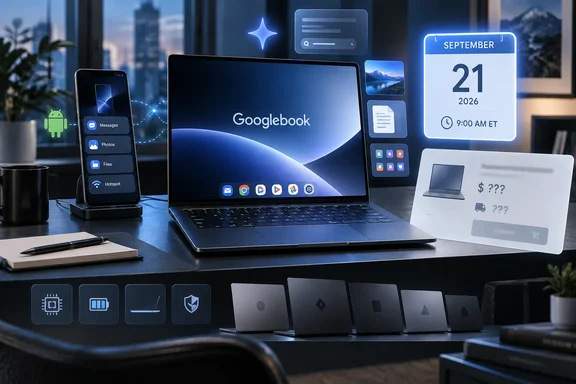
Google’s own Googlebook page confirms the September 21 date and says the first systems will arrive in the fall from Acer, Asus, Dell, HP, and Lenovo. VideoCardz, Chrome Unboxed, and Android Central each report that a Google email to people registered for updates adds the 9 a.m. ET time. Those reports agree on the timing, but Google’s public page still does not identify the first models, their configurations, prices, markets, or shipment dates.
That is an unusually incomplete setup for a pre-order window. Readers should treat September 21 as the point when Google and its hardware partners are expected to reveal the missing commercial details, rather than as a reason to reserve a machine before the basic terms are known.
Googlebook Is a New Laptop Category, Not a Renamed Chromebook
Google introduced Googlebook in May as a new class of laptop built around what it calls “Gemini Intelligence.” The company says it is combining Android’s app platform with ChromeOS’s browser experience, then selling that combination through established PC makers instead of as a single Google-branded notebook.
The distinction from a Chromebook is consequential. Google’s own FAQ says Chromebooks continue to run ChromeOS and are meant to prioritize simplicity, speed, and efficiency. Googlebooks, by contrast, are described as flagship machines with premium materials, higher performance expectations, Gemini features, and closer integration with Android phones.
For Windows users and PC administrators, the interesting part is not the branding. Google is trying to establish a third mainstream client platform in the laptop market: neither traditional Windows nor macOS, and no longer simply ChromeOS with Android apps added on top. Its success will depend on whether applications, device management, peripherals, browser workflows, and support policies behave predictably on actual hardware—not on whether a cursor can summon an AI assistant.
Google’s first public feature list is centered on two Gemini functions. Magic Pointer is meant to let a user select something on screen and ask Gemini to interpret, compare, or create from it. Create My Widget generates a desktop widget from a written prompt and can pull information from Google services such as Gmail and Calendar.
Those are product claims, not evidence of a mature desktop platform. Google has not yet published the sort of details IT departments need to assess: supported management frameworks, update cadence, local versus cloud processing behavior, data controls for Gemini features, encryption and recovery options, enterprise licensing, or compatibility with existing Android Enterprise and Chrome Enterprise deployments.
The Operating System Still Has No Public Name
The submitted report describes Googlebook as running “AluminiumOS,” a hybrid intended to replace ChromeOS. That goes beyond what Google has publicly confirmed.
Google has said Googlebook is built using part of the Android technology stack and brings together elements of Android and ChromeOS. It has not, however, publicly used AluminiumOS or Aluminum OS as the name of the Googlebook operating system. Android Central likewise reported that Google had not disclosed the operating system’s official marketing name as of the pre-order announcement.
That leaves an important gap between the project’s public pitch and claims circulating around it. A platform can borrow Android components, expose Android applications, and use Chrome technology without being a clean replacement for ChromeOS in the way customers understand that phrase. Google has not announced a retirement plan for ChromeOS, a migration tool for existing Chromebooks, a support cutoff, or a timetable for moving schools and enterprises from ChromeOS administration to Googlebook.
The official Googlebook page points the other direction in one respect: it explicitly keeps Chromebooks and Googlebooks as separate categories. That does not rule out deeper convergence later, but it means prospective buyers should not interpret the September 21 pre-order opening as confirmation that their existing ChromeOS fleet has a defined upgrade path.
Android Phone Integration Has a Clear Catch
Googlebook’s most concrete capability is its reliance on an Android phone as a companion device. Google says Cast My Apps will allow users to open phone apps on a Googlebook without installing them locally, while Quick Access will make phone files available through the laptop’s file interface.
This is more specific than a generic Android-app promise. Google’s public fine print says the phone integration features require setup and an Android 17-or-newer phone. The experience therefore depends on having a compatible handset, keeping it configured, and accepting that some workflows originate on the phone rather than being native laptop applications.
That could be useful for personal users who frequently move between an Android phone and a laptop. It has a more complicated implication in managed environments. A company with mixed iPhone and Android use, older Android deployments, bring-your-own-device policies, or restrictions on personal-device access will not get the full headline experience for every employee. Google has not said whether the feature works with a managed work profile, what data crosses between devices, or how administrators can control it.
The same caution applies to the claim that Googlebook will run Android applications. Google has emphasized Android’s Google Play catalog, but it has not published a compatibility list, listed desktop-specific application requirements, or explained which apps can take full advantage of keyboard, mouse, multiple windows, external displays, and laptop-class processors. Mobile apps can be plentiful without being good desktop software.
Cloud services and browser-based tools can fill part of that gap. Google Workspace runs in a browser, and services such as GeForce NOW can deliver games through a web app. But neither point answers the harder question for buyers considering a premium laptop: whether the applications they depend on will feel native and reliable rather than merely accessible.
Pre-Orders Arrive Before the Essential Buying Details
Google has placed five major PC vendors behind the first wave: Acer, Asus, Dell, HP, and Lenovo. That provides more potential choice than a single-vendor launch, but it also raises practical questions that remain unanswered six days before pre-orders begin.
Google has not publicly said which of those manufacturers will have machines available on September 21. It has not announced processor families, memory and storage tiers, displays, ports, battery targets, repair options, regional availability, or prices. It has also not confirmed when ordered systems will ship.
VideoCardz noted that the email carrying the pre-order timing did not provide prices or identify the specific devices that will be available. Android Central separately reported the same omissions, including the lack of a shipping date. Those are not small missing footnotes: they are the information buyers need to compare a Googlebook with an ARM Windows laptop, a Copilot+ PC, a MacBook, or a high-end Chromebook.
The timing is also split from Google’s September 15 media presentation. Chrome Unboxed reported that coverage of that event remains under embargo until the pre-order date. If that holds, the practical effect is that the first comprehensive hands-on reporting, full hardware specifications, and the checkout window should arrive together on September 21.
That is a defensible launch tactic only if Google and its partners disclose the full story before asking for money. A pre-order system can make sense for a scarce, fully specified product. For a new computing category whose operating system, application behavior, and management model remain only partly defined, it risks asking early adopters to fund the discovery process.
What Existing Chromebook and Windows Users Should Do
Chromebook owners should not assume Googlebook replaces their machine or that they need to upgrade immediately. Google continues to position Chromebooks as a distinct ChromeOS category, and it has announced no migration program. Organizations with ChromeOS fleets should wait for formal statements on administration, lifecycle support, identity controls, and device policy interoperability.
Windows users should judge the launch against their real workloads rather than Google’s Gemini demonstrations. A Googlebook may be appealing for Android-phone continuity, browser-first work, Google services, and users who want AI features woven into the interface. It remains an unproven choice for Windows-only applications, conventional desktop software, specialized peripherals, local development environments, and line-of-business tools until vendors and independent reviewers establish what works.
September 21 will determine whether Googlebook is ready to be bought or merely ready to be watched. Google has confirmed the date; it has not yet supplied the price, the hardware, the delivery schedule, or the operational answers that turn a new laptop platform into a credible purchase.
Update: First Googlebook models and core specifications are now public (September 21, 2026)
Engadget reports that Acer, ASUS, Dell, HP, and Lenovo have now opened pre-orders for their first Googlebook laptops, ending the earlier uncertainty over whether all five partners would participate at launch.
According to Engadget’s hands-on report, every announced model is positioned as premium hardware with at least 16GB of RAM. Google says the systems are rated for up to 14 hours of video playback or 16 hours of web browsing. Acer, ASUS, and Lenovo use Intel Core Ultra 5 Series 3 chips, with Acer and ASUS also planning Core Ultra 7 configurations; Dell and HP use Qualcomm Snapdragon X Elite processors.
The report also identifies a shared “Glowbar” light array on each laptop lid. It displays startup, battery, and Gemini-related animations, with Google reportedly planning developer access later. Pricing, regional availability, detailed configurations, shipping estimates, and enterprise-management documentation remain the key outstanding buying and deployment details.
Update: UK pricing and October sales window reported for Googlebook (September 21, 2026)
According to the Daily Express, Googlebook pricing in the UK will start at £999, with the first machines going on sale next month. That fills part of the commercial gap left at pre-order opening, although the report does not provide model-by-model pricing, exact delivery dates, or availability outside the UK.
The Daily Express also reports additional cross-device features, including Continue On, which is intended to let users resume compatible Android work on the laptop, and Rambler, a voice-driven drafting tool that uses Gemini to turn spoken notes into cleaned-up text. Googlebook owners are also reportedly promised a year of GeForce NOW access.
For Windows buyers, the £999 entry point places Googlebook directly against premium Windows ultrabooks rather than mainstream Chromebooks. The value proposition will therefore depend less on low cost and more on whether Android continuity, browser workflows, native-capable creative apps, and cloud gaming can justify choosing a new platform over an established Windows laptop.
Update: U.S. prices, launch dates, and bundled services reported for Googlebook (September 21, 2026)
According to How-To Geek, the first Googlebooks will reach U.S. stores on October 4, with Canada, the UK, Ireland, France, Germany, and Australia following on October 5.
The report puts the Acer Googlebook 14 at a $899 starting price, making it the lowest-cost launch model and the only convertible. ASUS’s Googlebook 14 reportedly starts at $1,299, Dell’s Snapdragon X Elite-based XPS Googlebook at $1,199, and HP’s Googlebook 14 at $1,299. The Lenovo Googlebook 15 is positioned as the larger 15.3-inch option, although its U.S. starting price was not listed.
How-To Geek also reports that buyers will receive one year of Google AI Pro with 5TB of cloud storage, one year of GeForce NOW, and three months each of YouTube Premium and Adobe Photoshop. Google is said to promise operating-system updates for “up to” 10 years.
For Windows buyers, the $899 Acer establishes a more direct entry-level comparison with premium Windows ultrabooks, while the Dell and HP models place Qualcomm-based Googlebooks squarely against Snapdragon Windows PCs. The reported support commitment and bundled services improve the launch proposition, but they do not resolve the central question for professional users: whether required desktop software, specialist tools, and native gaming libraries are available and well optimized.
Update: Hands-on report casts Googlebook as an Android-phone companion (September 21, 2026)
PCWorld’s hands-on report says Googlebook’s practical identity is less “AI-first laptop” and more a desktop companion to an Android phone. The outlet describes the new platform as an Android-derived system it calls Aluminum, with a conventional desktop layout, Chrome as the sole browser, Play Store apps, web apps, touchscreen support, and access to a file system.
That reporting offers a clearer view of the daily software experience than Google’s launch feature list. PCWorld says the interface resembles an enlarged Pixel-style environment, including mobile-like desktop widgets and Google’s Material Expressive design, rather than a conventional Windows-style application ecosystem.
The most important implication is workload fit. According to PCWorld, users should expect browser and Android-app workflows to dominate, with fewer third-party desktop applications and advanced tools than on Windows. That reinforces the concern for buyers who depend on specialized native software, while making Googlebook potentially more compelling for people already centered on an Android phone and Google services.
PCWorld’s use of the Aluminum name is also notable, but Google has not yet independently published a clear official operating-system branding statement.
Update: PCWorld details Googlebook’s local and cloud AI controls (September 21, 2026)
According to PCWorld, Googlebook lets users individually enable or disable its Gemini features through system settings. The report also says lower-level functions, including text selection and basic transcription, run locally, while more demanding tasks—such as chat, editing, research, and complex analysis—use cloud-based Gemini processing.
PCWorld reports that cloud features are managed through Google Account settings, adding a concrete control distinction that was previously unclear. For IT administrators and privacy-conscious users, that suggests Gemini behavior is not governed solely at the device level and may involve both local configuration and account-based controls.
The outlet also says Rambler can be invoked through the dedicated Quick Insert key and pasted into applications such as Gmail.
Update: Googlebook OS name and Aluminium project branding confirmed (September 21, 2026)
The Verge reports that Google’s new laptop platform is officially called Googlebook OS, resolving the earlier uncertainty around its public operating-system branding. In interviews with Google hardware chief Rick Osterloh and laptop-and-tablet engineering leaders, the outlet says the software is built primarily on Android technology while incorporating ChromeOS-style capabilities such as multi-window support, fast startup, and streamlined updates.
The report also confirms that “Project Aluminium” was the internal development name, using the British spelling. Contrary to the earlier lack of an official statement, Googlebook OS is not presented as an unnamed ChromeOS replacement; it is a distinct Android-based laptop platform intended to run Android applications natively while integrating closely with Android phones.
The Verge says Googlebook’s core pitch is Android continuity rather than AI alone: phone apps, files, and connected-device data are designed to follow users onto the laptop. That reinforces the platform’s likely fit for Android-centric users, while leaving iPhone users and organizations with mixed mobile fleets with a less complete experience.
Update: Notebookcheck reports shared 2.8K displays and haptic touchpads across launch models (September 21, 2026)
Notebookcheck reports that the first Acer, Asus, Dell, HP, and Lenovo Googlebooks share a more standardized premium hardware baseline than earlier launch coverage established. Alongside the already reported 16GB minimum memory and Glowbar lid lighting, the outlet says the systems include 2.8K touchscreens and haptic touchpads.
The report also characterizes Gemini Intelligence as offering native on-device AI capabilities, while describing Googlebook as an Android-core platform optimized for desktop use. That adds weight to the distinction between lower-level local AI functions and cloud-dependent Gemini tasks, though Google’s own technical documentation remains necessary to determine which models and features can operate entirely offline.
For Windows buyers, the shared display and input specifications make these machines more clearly comparable with premium ultrabooks rather than conventional Chromebooks. They still do not answer the more consequential deployment questions around enterprise controls, peripheral support, application compatibility, or whether Android-first software can replace required Windows desktop tools.
Update: TechRadar reports Linux Terminal, MediaTek options, and October 5 shipping (September 21, 2026)
TechRadar’s hands-on report adds several deployment-relevant details not previously confirmed in launch coverage. According to the outlet, Googlebook OS includes a Linux Terminal and supports traditional coding workloads, while application downloads appear to be handled exclusively through Google Play. The report also says the first range extends beyond Intel Core Ultra and Qualcomm Snapdragon X Elite systems to include MediaTek-based models.
The outlet reports hardware differentiation between partners, including facial recognition on some models, fingerprint readers on others, a 2.2-pound Asus model, and Acer convertibles with pen support. It also describes cross-device file search that can examine content on both a Googlebook and linked Android phone, rather than merely matching filenames.
TechRadar says the laptops will begin shipping October 5. That conflicts with the earlier How-To Geek report of an October 4 U.S. retail date, so buyers should treat delivery timing as unconfirmed until Google or individual manufacturers publish region-specific shipping estimates.
Update: PCWorld details model-by-model Googlebook hardware and pricing (September 21, 2026)
PCWorld’s hands-on comparison provides fuller per-model specifications for the five launch Googlebooks. It reports that the $899 Acer Googlebook 14 pairs Intel Core Ultra 5 Series 3 hardware with a 14-inch 2.8K, 120Hz OLED touchscreen, 16GB of RAM, 512GB of storage, and a convertible design.
According to PCWorld, the $1,299 Asus Googlebook 14 uses similar Intel specifications but adds a larger battery, HDMI and USB-A ports, and a lighter 2.18-pound chassis. Dell’s Snapdragon X Elite-based XPS Googlebook has a 13.4-inch IPS display and is listed at $1,199 through Google, although PCWorld says Best Buy was showing it at $999.
The report also puts the HP Googlebook 14 at $1,299 and the 15.3-inch Lenovo Googlebook 15 at $1,099. Both Intel and Qualcomm variants therefore enter the market with broadly comparable memory and storage, but differ substantially in screens, ports, form factors, and claimed battery life.
For buyers, the apparent $999 Dell retail price is the most consequential new detail: if confirmed broadly, it would narrow the premium between Googlebook and comparable Snapdragon Windows laptops. PCWorld still advises waiting for full reviews before pre-ordering.
Update: Acer confirms Googlebook 14 regional rollout and fuller specifications (September 21, 2026)
Acer’s official announcement confirms its Googlebook 14 will be available in North America and EMEA in October 2026, followed by Australia in November. North American pricing starts at $899, while EMEA pricing starts at €1,199; Acer says configurations and final prices will vary by region.
The company also provides fuller specifications for the convertible model. It can be configured with up to an Intel Core Ultra 7 355 processor, 32GB of LPDDR5X memory, and 512GB of PCIe Gen 4 storage. Acer describes its touch display as a 14-inch 3K OLED panel with 500-nit brightness, USI 2.0 stylus support, and a 360-degree hinge.
For connectivity and deployment planning, Acer lists Thunderbolt 4, two USB 3.2 Gen 2 Type-C ports, Wi‑Fi 7, Bluetooth 6.0, a fingerprint reader, a physical webcam shutter, and Google’s Titan-C security chip. The laptop includes 12 months of Google AI Pro and 5TB of cloud storage.
Update: ASUS confirms $1,299.99 price, 18-hour battery claim, and full port selection (September 21, 2026)
ASUS has confirmed that its Googlebook 14 (CX9406CAA) is available for pre-order through the ASUS Store and Best Buy at $1,299.99. The company specifies an Intel Core Ultra 5 325 processor, 16GB of LPDDR5X memory, and up to a 512GB PCIe 4.0 SSD.
ASUS now claims up to 18 hours of battery life from a 70Wh battery, exceeding earlier broad battery estimates for the Googlebook range. Its 14-inch 3K OLED touchscreen is rated at 120Hz and up to 1,000 nits of peak HDR brightness, with Gorilla Glass Victus and a matte anti-glare treatment.
For Windows users weighing peripheral compatibility, ASUS confirms two Thunderbolt 4 USB-C ports, two USB 3.2 Gen 2 Type-A ports, HDMI 2.1b, and a 3.5mm headset jack. The laptop also includes Wi‑Fi 7, a six-speaker system, and a force-sensing haptic touchpad.
The official specification resolves several ASUS-specific hardware questions, but the 18-hour figure remains a vendor battery-life claim rather than an independent test result.
Update: HP sets $1,199.99 starting price and claims 19-hour battery life (September 21, 2026)
HP’s official announcement, carried by TechPowerUp, says the Snapdragon X Elite-based HP Googlebook 14 is expected at HP.com and Best Buy in October starting at $1,199.99. That undercuts the previously reported $1,299 price point by $100.
HP also claims up to 19 hours of battery life, backed by a vapor-chamber cooling system and a 10.91mm chassis. The model adds a 3K OLED touchscreen with up to 120Hz variable refresh rate, a 5MP IR camera with facial recognition, quad speakers, and support for up to two UHD external displays.
For buyers with desk-based workflows, the dual-monitor capability and facial recognition are meaningful additions. HP confirms the same 12-month Google AI Pro and 5TB cloud-storage bundle, alongside promotional access to Adobe Photoshop, CapCut, YouTube Premium, and GeForce NOW.
References
- Google Confirms Googlebook Pre-Orders Start September 21 TechPowerUp · 2026-09-15T23:47:43+00:00