

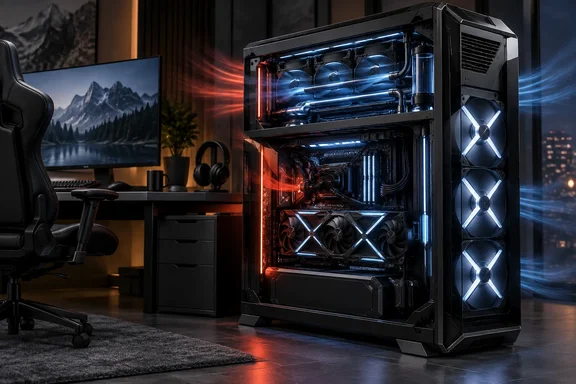
The ASUS ROG G1000 (GM1000) finally reaches retail, with two U.S. configurations
The G1000 has been around for a while. VideoCardz reported that ASUS brought the ROG G1000 to CES 2026 as a full-tower system that mixes high-end gaming hardware with a new visual feature called AniMe Holo. At that point ASUS listed a broad set of graphics options: ROG Astral GeForce RTX 5090 or RTX 5080, ROG Strix GeForce RTX 5070 Ti, or an AMD Radeon 9070 XT. In March, Wccftech still said more details on pricing and availability were to come shortly.
The September 22 press release, distributed through GlobeNewswire, says the ROG GM1000 is available for purchase today from ASUS Store and retailer partners Amazon, BestBuy, ExcaliburPC, Newegg, and MicroCenter. ASUS's U.S. specification page tells a narrower story. It lists two standard SKUs, both with the same core platform:
| GM1000TY-DS787 | GM1000TY-XS987 | |
|---|---|---|
| CPU | Ryzen 7 9800X3D, 8 cores / 16 threads, 4.7 GHz base, up to 5.2 GHz, 96 MB cache | Ryzen 9 9950X3D, 16 cores / 32 threads, 4.3 GHz base, up to 5.7 GHz, 128 MB cache |
| GPU | ROG GeForce RTX 5080 16 GB GDDR7 OC (3x DisplayPort, 2x HDMI) | Same |
| Memory | 32 GB DDR5 (2x 16 GB), four slots, up to 128 GB | Same |
| Storage | 2 TB M.2 NVMe PCIe 4.0 SSD | Same |
| OS | Windows 11 Home | Windows 11 Pro |
| PSU | 1000 W 80 Plus Gold (2000 W peak) | Same |
The page header shows an ASUS Store price of $4,999.99 next to a "Buy Now" button. In the side-by-side configuration listing, both SKUs are marked "Coming Soon." The page doesn't say which configuration the $4,999.99 figure belongs to. Until an individual SKU can actually be added to a cart, U.S. buyers shouldn't assume the retailer list in the press release reflects real stock.
The launch is confirmed in at least one market. ASUS Malaysia announced the G1000 on September 11 as available immediately at RM29,999. That regional model (GM1000TY-R9950X111WP) pairs the Ryzen 9 9950X3D with an ROG Astral RTX 5080, 64 GB of DDR5-5600 and a 1 TB PCIe 4.0 SSD, and it comes with a three-year on-site warranty. Configurations vary by country, so a spec sheet from one region won't necessarily match a box sold in another.
The Ryzen 7 9800X3D in the G1000 has 8 cores, not 16
The worst error in the launch copy affects the model choice directly. The press release describes the Ryzen 7 9800X3D as having 16 cores and 32 threads. ASUS's own U.S. spec table lists it at 8 cores and 16 threads. The 16-core, 32-thread part is the Ryzen 9 9950X3D in the more expensive SKU. ASUS Malaysia's release describes the 9950X3D correctly, which suggests the U.S. copy swapped in the Ryzen 7 name without updating the core count.
This affects which configuration makes sense. Both chips use AMD's 3D V-Cache (extra cache stacked on the processor die), which mainly helps games. The 9950X3D doubles the core count and raises the boost clock to 5.7 GHz, so the gap shows up in video encoding, code compilation and heavy multitasking alongside gaming. A buyer who only plays games and was drawn to the Ryzen 7 SKU by the "16 cores" claim is getting half the cores the copy promised. A buyer who does creative or development work alongside gaming should look at the Ryzen 9 model.
The press release also says the 9950X3D option is "slated for later this year." That doesn't match the other records. The U.S. spec page already lists the 9950X3D as a standard SKU, and it is the only CPU in the Malaysian model that went on sale on September 11. Wccftech's March report mentioned a Ryzen 7 9850X3D config too, but ASUS's current U.S. listing names the 9800X3D. Treat the spec table as the record.
The operating system split matters to Windows buyers. The Ryzen 7 SKU ships with Windows 11 Home, and ASUS's own listing adds that it recommends Windows 11 Pro for business. The Ryzen 9 SKU ships with Pro. Anyone planning to join the machine to a work domain or manage it with business tooling should either buy the Pro SKU or budget for an upgrade. ASUS also bundles two months of Xbox Game Pass, which has to be claimed within 30 days of device activation.
ROG Thermal Atrium moves the 420 mm radiator into its own chamber
The main engineering idea is what ASUS calls Tri-zone airflow. The case is split into three separate thermal areas for the CPU, GPU and power supply, so that hot air from one part doesn't warm the air another part breathes. In most towers, the CPU radiator draws air that has already passed over a hot graphics card. The G1000 is built to avoid that.
The CPU sits under the ROG Thermal Atrium, a chamber separated from the main chassis that houses a 420 mm all-in-one (AIO) liquid cooler. In ASUS's airflow animation, three 140mm fans pull fresh air from the outside and exhaust hot air through the top. ASUS calls this the first 420 mm AIO in a prebuilt PC, based on its own market research as of December 2025. According to ASUS's U.S. product page, the GPU zone gets two 200 mm front intake fans, a 140 mm rear exhaust and a 140 mm bottom intake. The PSU sits in its own shrouded compartment and draws air from beneath the chassis.
ASUS claims CPU intake air runs up to 16°C cooler, with 100% more airflow, than a "conventional layout." The footnote defines that baseline as ASUS's older ROG G700 desktop, with results measured by ASUS Labs. It is a vendor comparison against a single in-house predecessor, not an independent test against competing towers.
ASUS's own figure has also changed. The company's January launch article said the configuration keeps the intake air up to 10°C cooler. The September materials say 16°C. ASUS hasn't explained the change. It could reflect a different test setup or a revised baseline, but the published record doesn't say. The press release also claims the thermal system can dissipate over 1000 W of heat, while the U.S. product page calls this "thermal headroom." That figure is separate from the 1000 W rating of the power supply. Until reviewers measure CPU temperatures and noise under sustained load, these are ASUS numbers.
The design also brings practical features. The Fan Key is a physical button that ASUS says immediately sets the fans to maximum airflow. According to ASUS, the top, bottom and front of the case have dust filters, with slide-out panels at the bottom and front. The main board is an ASUS PRIME X870-P WIFI. ASUS lists a 14+2+1 80 A power stage design and Q-Release and Q-Latch mechanisms for tool-free GPU and M.2 swaps.
AniMe Holo turns the G1000's fans into a spinning display
The other headline feature is AniMe Holo. It uses three X-shaped fans whose blades carry LEDs and light up in patterns as they spin. Your eye blends that into a floating image. ASUS calls it the world's first holographic fan system in a prebuilt gaming PC. The side panel carries a 380 mm fan with 720 LEDs, and the front has two 215 mm fans with 404 LEDs each, according to ASUS's product page and its Malaysian release.
Control runs through Armoury Crate, ASUS's Windows utility. Users can set AniMe Holo to showcase MP4, GIF, JPEG, or PNG images. The front pair can display images on each fan independently with Solo Mode, harmonize with Sync Mode, or daisy-chain them for a seamless flow with Fusion Mode. The press release also mentions custom text and system stats. A dedicated AniMe Holo key turns the effect on or off, and the side module sits behind a hinged door for maintenance. ASUS states that the AniMe Holo system has been rated for over 30,000 hours of continuous operation.
ASUS is upfront about the limits of the technique. On the related limited-run G1000 Edition 20 page, the company says holographic projection differs from traditional screen displays, and due to physical limitations of rotational imaging, slight variations in image stability may occur and are considered normal. In the product FAQ, ASUS lists flicker or a thin line through the center, slight wobble in static images, and uneven or ring-like solid colours as normal behaviour. Buyers expecting a panel-quality image should adjust their expectations.
The press release's noise claim is 20.5 dBA for the AniMe fans in their sealed housings. The Malaysian release only says the fans run "silently" in isolated modules, with no figure, and nothing public explains how the 20.5 dBA number was measured. The fan sizes also don't line up. The AniMe front fans are listed at 215 mm, while the GPU-zone description names 200 mm front intakes. The published material doesn't say whether these are the same fans measured differently or separate parts.
Spec discrepancies across ASUS's G1000 listings are worth checking before purchase
Beyond the CPU error, ASUS's own pages disagree on several points. Here are the ones to confirm on the order page or with the seller:
- The U.S. spec table lists one RJ45 Gigabit Ethernet port, while the U.S. feature page advertises 2.5Gb Ethernet and the Malaysian spec names a Realtek 2.5Gb port.
- The U.S. feature page says the four M.2 slots support "the latest PCIe Gen 5 standard" and that systems ship with up to 4 TB, but both U.S. SKUs list a 2 TB PCIe 4.0 SSD.
- The U.S. feature page advertises "up to" an RTX 5090 and a Radeon RX 9070 XT option, but neither appears in the two standard U.S. SKUs, which both use the RTX 5080.
- The Malaysian release confirms Wi-Fi 7 with Bluetooth 5.4 and a dedicated discrete TPM (dTPM) module. The U.S. spec table doesn't list a TPM line.
These look like marketing pages written for the whole G1000 range, alongside spec tables for specific configurations. For any single box, the spec table is the reference.
The physical size is consistent everywhere, and it's large. The tower measures 29 × 58.27 × 61.48 cm (11.42 × 22.94 × 24.20 inches) and weighs 40 kg (88.18 lb). At almost 23 inches deep and two feet tall, many desks can't hold it, and moving it is a two-person job. Measure the space before ordering.
What this means for ROG G1000 buyers
The decision comes down to the CPU SKU and whether you can actually buy one yet. Wait until a specific configuration can be added to a cart at a listed price before planning around the September 22 date. Compare SKUs using the spec table, not the launch copy.
ASUS says the machine can be upgraded. The system memory, storage, GPU, CPU, AIO, and motherboard are all user upgradable with compatible off-the-shelf parts, and the board has four DDR5 slots, four M.2 connectors, six SATA ports and one PCIe 5.0 x16 slot. That makes the RTX 5080 limit in the U.S. SKUs less permanent than it looks. Warranty implications of swapping parts aren't spelled out beyond "ROG standard warranty coverage."
- The Ryzen 7 9800X3D model has 8 cores and 16 threads. Only the Ryzen 9 9950X3D model has 16 cores and 32 threads.
- Both U.S. configurations pair an RTX 5080 with 32 GB of DDR5 and a 2 TB PCIe 4.0 SSD. The RTX 5090 advertised on the feature page isn't in either standard U.S. SKU.
- As of publication, ASUS's U.S. spec page marks both SKUs "Coming Soon," even though the press release says they are available now.
- The 16°C cooler intake claim comes from ASUS Labs and compares against ASUS's own ROG G700. ASUS's January launch material said 10°C.
- Plan for a 40 kg tower almost 23 inches deep, and choose the Windows 11 Pro SKU if the PC will be used for business.
- Expect AniMe Holo to be a spinning LED effect with some normal flicker and wobble, not a conventional screen.
The G1000 is one of the more ambitious prebuilt designs ASUS has shipped. Giving the CPU its own air supply is a sensible answer to a real heat problem in tall towers, and standard, swappable parts mean the $4,999.99 purchase isn't locked in. The launch paperwork doesn't match that engineering, though. The first independent reviews should settle whether the Thermal Atrium delivers against something other than a G700, and U.S. stock should show up on ASUS's own SKU listings before it counts as "available today."
Update: Amazon listing reportedly accepts ROG G1000 orders despite no stock (September 27, 2026)
ThePCEnthusiast reports that Amazon has listed the Ryzen 7 9800X3D/ROG Astral RTX 5080 G1000 configuration, model GM1000TY-DS787, at $4,999.99. The outlet says the listing was temporarily out of stock when checked but was still accepting orders, with delivery timing to be provided after inventory becomes available.
That is a more concrete U.S. retail signal than ASUS’s own configuration page, which previously marked both standard models as “Coming Soon.” It does not, however, confirm immediate shipment or establish availability for the Ryzen 9 9950X3D/Windows 11 Pro SKU.
Prospective buyers should still confirm the exact Amazon seller, delivery estimate, and the GM1000TY-DS787 model number before ordering. An orderable listing with no inventory is not the same as confirmed in-stock retail availability.
Update: Philippines launch confirms a separate 1TB Ryzen 7 G1000 configuration (September 29, 2026)
ASUS has now launched the ROG G1000 in the Philippines, according to Unbox PH. The local GM1000TY configuration uses the Ryzen 7 9800X3D, 32GB of DDR5, a 1TB SSD, and a 16GB ROG Astral RTX 5080, priced at Php 399,995 through select ROG Exclusive Stores.
That differs from the U.S. Ryzen 7 SKU, which ASUS lists with a 2TB SSD. It reinforces that G1000 specifications are regional rather than globally fixed, so buyers should verify the exact model number and storage capacity rather than relying on broad G1000 marketing pages.
References
- ASUS’s New ROG G1000 Gaming PC Turns Heads With Holographic Displays, RTX 5080 and Ryzen X3D - ThePCEnthusiast ThePCEnthusiast · 2026-09-26T13:49:51+00:00
- ASUS ROG G1000 Gaming Desktop now in the Philippines - Unbox PH Unbox PH · 2026-09-29T02:38:27+00:00
- (PR) The ASUS ROG G1000 Gaming Desktop Brings Top-Tier Performance TechPowerUp · 2026-09-22T19:55:17+00:00