

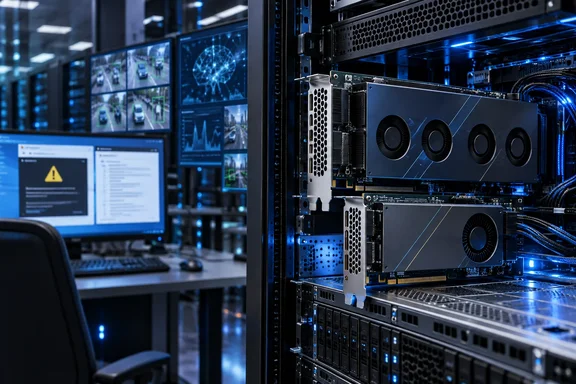
TechPowerUp first highlighted the formal launch and the headline claim of up to 629 TOPS. Axelera’s own original Europa announcement, published October 21, 2025, makes an important qualification that is easy to lose in the launch copy: the 629 TOPS figure is an INT8 peak-performance rating. It is not a general measure of real application throughput, and it does not establish how a particular language model, computer-vision pipeline, host CPU, memory configuration, or batch size will perform in an enterprise rack.
The practical news is that Europa has moved from an architecture announcement into purchasable card hardware, with Axelera naming validated configurations in Dell XE5 and Supermicro 111AD systems. StorageReview and Network World independently report the same basic product layout and deployment target: local inference in conventional PCIe servers, especially for organizations that need to keep model inputs and results on infrastructure they operate themselves.
A 45 W AIPU aimed at the gap below GPU servers
Europa is Axelera’s successor to Metis, its earlier inference-focused accelerator family. The single AIPU combines eight second-generation AI cores, 16 RISC-V vector cores, 128 MB of L2 SRAM, a 256-bit LPDDR5 interface rated at 200 GB/s, PCIe 4.0 x4 connectivity, and integrated H.264/H.265 video decode. Axelera positions the RISC-V cores and media engine as a way to perform data preparation and output processing on the accelerator rather than repeatedly handing those jobs back to the host CPU.
That architecture tells a clearer story than the TOPS number. A conventional server inference installation often has to account for video decode, image resizing, normalization, token processing, model execution, and output handling as separate resource consumers. Europa attempts to concentrate more of the vision and inference pipeline on one add-in card, which could matter in camera-heavy deployments where host CPU cycles and PCIe traffic become constraints before raw model throughput does.
Axelera rates Europa at up to 45 W TDP, while its product page separately describes typical power as 30 W to 40 W. Those are different measures and should not be substituted for one another when calculating rack power or cooling capacity. The Edge 232p is the easier fit for an existing server: one AIPU on a half-height, half-length PCIe card. The Server 250p is a substantially different planning exercise, putting four AIPUs on a full-height, full-length, dual-slot card.
The four-chip card is rated for more than 2,500 TOPS and is available in 128 GB and 256 GB LPDDR5 configurations, according to Network World. Memory capacity matters more than TOPS for many language-model deployments: it affects which quantized models can remain resident, how much key-value cache can be maintained, and how many concurrent requests can be served without forcing a model or cache out of accelerator memory.
The Qwen figures are vendor benchmarks, not a buying specification
Axelera says the Edge 232p reaches 83.4 tokens per second on Qwen 30B, while the Server 250p reaches up to 4,205 tokens per second on Qwen3 8B and up to 32.1 tokens per second per watt. Those figures are useful signals that the company is targeting generative AI serving rather than only its original computer-vision market. They are not, however, interchangeable results.
Qwen 30B and Qwen3 8B are different models; throughput varies sharply with quantization, input length, output length, batch size, concurrent users, sampling settings, and whether a benchmark measures prompt processing, token generation, or a blended end-to-end figure. A four-AIPU card producing 4,205 tokens per second on an 8B model under a large batch is a capacity metric for a service with many simultaneous requests. It does not mean a single interactive user will see that generation rate, and it does not predict performance on a 30B or 70B model.
There is also a record worth separating. Before this week’s shipment announcement, Axelera’s own public performance material labeled a Qwen3-30B-A3B result of 53.5 tokens per second as pre-silicon simulation, using a 1,024-token context, W8A8 quantization, an 8-bit KV cache, one user, and one chip. The new Edge 232p page now advertises 83.4 tokens per second for “QWEN 30B,” but it does not place the test conditions beside that headline number.
That does not make the new claim false. It does mean the two figures cannot be used as a direct before-and-after comparison without the model variant and test methodology. StorageReview and Network World both noted another limitation: Axelera’s performance-per-watt and performance-per-dollar comparisons pair its internal testing with publicly available competitor figures. Until an independent lab runs Europa and the competing cards on identical software versions, prompts, models, batch sizes, host systems, and power measurements, the claimed multiples over GPUs remain vendor comparisons.
Dell and Supermicro validation narrows the first deployment path
The launch’s most concrete enterprise detail is not the sales-pipeline figure or the claim of more than 600 customers. It is the named server validation. Axelera says the Edge 232p is available in a fully validated Dell XE5 and Supermicro 111AD, and says its broader validated-system list includes 2CRSi, Advantech, Axiomtek, HPE, Lenovo, and Seco.
Validation is meaningful because inference add-in cards can fail long before a model is loaded. Firmware settings, PCIe lane allocation, slot clearance, cooling, power delivery, BIOS behavior, DMA handling, operating-system drivers, and virtualization policies can all complicate a nominally standard PCIe deployment. A 45 W single-card accelerator may be modest beside a large data-center GPU, but its placement in a compact edge server still requires airflow verification and an available PCIe 4.0 slot with four lanes.
The Server 250p needs a separate compatibility review. Its full-height, full-length, dual-slot physical profile rules out many short-depth and dense edge chassis. Its four AIPUs can increase local model capacity and request concurrency, but they also increase the consequence of a server chassis that cannot sustain the required cooling or a platform whose PCIe topology is already committed to storage and networking.
Axelera has not published list prices for Europa cards in the material reviewed for this launch. That omission prevents a meaningful total-cost comparison against an NVIDIA GPU, an AMD Instinct accelerator, Intel’s Gaudi line, or smaller inference parts from Hailo and others. The claimed $1.5 billion sales pipeline is likewise a measure of prospective opportunity, not booked revenue, product shipments, or installed Europa capacity.
Windows support remains the unresolved operational issue
For WindowsForum readers, the public documentation creates a material caution. Axelera’s current Voyager SDK documentation includes a Windows 11 setup path, but the pages and compatibility matrix currently identify Metis hardware rather than Europa. The Windows instructions describe native Windows inference through an Axelera runtime API, while model deployment requires Linux or WSL2. They also state that the Windows driver is not yet Microsoft-certified and requires Windows test-signing mode for installation.
Test-signing mode is unsuitable for many managed Windows estates because it changes the platform’s driver-signing posture and requires careful BitLocker recovery planning before boot-configuration changes. Axelera’s own documentation warns administrators to suspend BitLocker before altering the boot configuration, or the system may enter recovery on restart. That is a major operational distinction between a lab evaluation and a fleet deployment.
The current Windows guide also says the device is inaccessible inside WSL2: model compilation can occur in the Linux environment, but hardware verification and inference run on the Windows side. For a Windows Server or Windows 11 deployment, that split workflow adds another handoff point for model artifacts, software versions, firmware management, and support ownership.
Europa may gain Windows coverage in a forthcoming Voyager SDK release, but Axelera has not published a Europa-specific Windows driver, firmware compatibility matrix, or native Windows support statement in the launch material. Administrators considering the Edge 232p should therefore request those items in writing before treating the Dell or Supermicro validation as validation of their preferred operating system.
Europa’s arrival gives enterprises a new PCIe inference option aimed at keeping smaller generative AI and vision workloads close to their data. The immediate deployment path is clearest for the named validated server configurations running Axelera’s established software flow. For Windows environments, the hardware is shipping now; the publicly documented production-support path for Europa still needs to catch up.
References
- Axelera Launches Europa AI Processing Unit (AIPU) With Up to 629 TOPS TechPowerUp · 2026-09-16T19:36:41+00:00