

Here is what holds up, what needs qualifying, and what it means for IT teams deciding where their AI workloads should run.
The numbers: cloud is winning, but on-prem hasn't disappeared
The Seoul Economic Daily piece starts with market data from Synergy Research Group, and those figures check out. Synergy says hyperscale operators now account for 48% of the worldwide capacity of all data centers, and that with non-hyperscale colocation capacity accounting for another 20% of total capacity, that leaves enterprise on-premise data centers with just 32% of the total. Seven years earlier the picture was very different: in 2018, 56% of data center capacity was in on-premise facilities.
Synergy's forecast points the same way. Looking ahead to 2031, hyperscale operators will account for 67% of all capacity, while on-premise will drop to just 19%.
The detail that supports the Korean paper's "comeback" angle is in the fine print. Synergy writes that after a sustained period of essentially no growth, on-premise data center capacity is receiving something of a boost thanks to GenAI applications and GPU infrastructure, but adds that on-premise share of the total will drop by around two percentage points per year over the forecast period. Computer Weekly's coverage of the same research makes a similar point: the decline is not so rapid, largely due to the deployment of AI hardware.
So this is not a return to the 2010s server room. On-prem capacity is growing again in absolute terms while its share keeps falling. Both statements are true at once, and headlines usually pick just one.
Seoul Economic Daily also cites two other figures:
- A Fortune Business Insights forecast that edge computing will grow from $18.64 billion to $267.42 billion by 2034.
- An Uptime Institute survey finding a 45/55 split between workloads on company-owned infrastructure and off-premise, unchanged from the year before.
I could not independently confirm either figure, so treat them as the paper's reporting. Edge-market dollars and data center capacity share also measure different things, and they shouldn't be compared as if they were.
Section summary: Hyperscalers hold nearly half of global capacity and are forecast to reach two-thirds by 2031. AI hardware is slowing on-prem's decline but not reversing it.
Microsoft and Armada: Azure Local in a shipping container
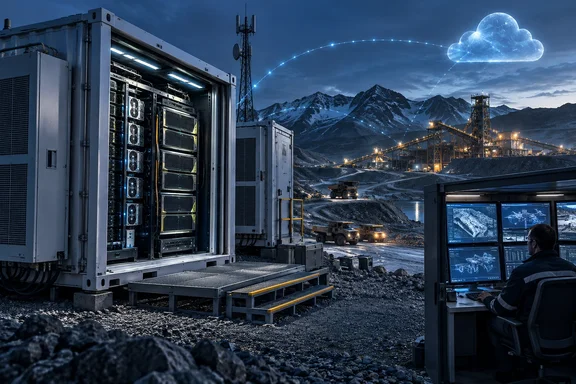
This is the part most relevant to Microsoft customers. On March 31, 2026, Douglas Phillips, President and CTO of Microsoft Specialized Clouds, announced a collaboration with Armada. It brings Microsoft Sovereign Private Cloud capabilities to Armada's Galleon modular data centers, running alongside the Armada Edge Platform. Seoul Economic Daily calls Phillips Microsoft's chief technology officer. His actual title is narrower and is tied to the specialized clouds group.
According to Microsoft's announcement, the joint setup supports:
- Azure Local control plane and managed clusters, including multi-rack scaling
- Flexible storage, either hyperconverged or SAN-backed
- Multiple network paths, including satellite, LTE/5G, radio links and SD-WAN
- Security hardening for government, sovereign and regulated workloads
Microsoft names defense, public safety, energy and critical infrastructure as the main customers. It pitches the design for sites that are intermittently connected, contested or fully disconnected. The companies describe it as a "validated sovereign reference architecture." In practice that means a tested blueprint, not a finished product you can buy from a catalog page.
The AI part comes from Foundry Local. Microsoft says Foundry Local and Azure Local together let customers deploy, govern and run AI inside their own trusted boundary, with inference and analytics still working when the site is cut off from the public cloud. The benefits Microsoft claims will sound familiar: sensitive data stays local, decisions happen with less delay, and AI keeps running where bandwidth is scarce.
What "local" actually means
Microsoft's own documentation adds some useful caveats. The Microsoft Learn overview describes Azure Local as distributed infrastructure that extends Azure to customer-owned environments, with Azure Arc as the unifying control plane. It supports both connected and disconnected deployments. Microsoft lists these use cases:
- Local AI inference where data must be processed at the source, such as retail loss-prevention systems or pipeline leak detection
- Mission-critical continuity through network outages, such as factory lines and transit ticketing
- Control systems with strict latency requirements, such as manufacturing execution systems
- Strict sovereignty rules requiring data to be held and controlled locally
The pricing is where "local" stops meaning "off the meter." Azure Local is billed per physical core on your own hardware, plus consumption charges for any extra Azure services you use, and everything rolls up to your existing Azure subscription.
Disconnected mode takes real planning
Fully disconnected Azure Local has more requirements again. Microsoft's documentation says that in this mode:
- The control plane runs on your premises and your team operates it
- No ongoing connection to Azure or the internet is needed
- Updates, servicing and onboarding use offline or staged workflows
- Identity, monitoring and access control go through supported on-premises integrations
- You get only a subset of cloud capabilities
Microsoft is also clear that the mode is for organizations with a validated requirement to run without cloud connectivity. Eligibility requires:
- An eligible agreement, such as a Microsoft Customer Agreement for Enterprises
- A documented business or regulatory reason
- Staff, processes and partner support in place
- Workloads sized before procurement
- Supported customer-owned hardware
- A dedicated management cluster
The services available in disconnected mode include Azure Local VMs, AKS where applicable, Key Vault, Azure Policy, Container Registry, Microsoft 365 Local (Exchange Server, SharePoint Server and Skype for Business Server), and AI services such as Document Intelligence, Language, Translator and Vision. GPU-enabled nodes are supported in validated configurations.
Section summary: Microsoft isn't moving away from its public cloud. It is extending Azure's management tools onto hardware the customer controls. That comes with more responsibility, per-core billing, and strict eligibility rules for air-gapped use.
Cisco AI POD for Splunk: a second example
The Korean paper's security argument centers on Splunk, and here the facts need correcting. Seoul Economic Daily dates the .conf26 launch to "the 14th," and a photo caption says October 14. Cisco's official press release is dated September 15, 2026, from Denver.
What Cisco announced:
- Cisco AI POD for Splunk, the newest configuration in Cisco Secure AI Factory with NVIDIA, available at launch
- Self-managed Splunk AI for Splunk Enterprise customers in on-premises, private cloud and air-gapped environments
- Splunk AI Assistant available now, with Agent Launchpad due later in 2026
- Self-hostable models including Cisco's Deep Time Series Model, Google Gemma 4 and OpenAI GPT-OSS 20B, with NVIDIA Nemotron models promised "in the coming months"
Splunk's product documentation is more specific. Version 1.0 of AI POD is a pre-sized, tested and validated on-premises deployment of the Splunk AI tier on Red Hat OpenShift. It combines Cisco UCS compute, NVIDIA GPUs and validated Cisco networking, and it supports Splunk AI Assistant and Splunk AI Toolkit capabilities.
For a SOC team at a bank, hospital or government agency that has never been allowed to send telemetry to a third-party model, this is a meaningful change. Splunk AI features that were previously off-limits to them are now available. The trade-off is familiar: you buy the GPUs, you run the Kubernetes platform, and you own the patching schedule.
Section summary: Cisco and Splunk are targeting regulated customers who couldn't use cloud-hosted AI on their machine data. The launch was September 15, not October 14.
Where the "milliseconds cost lives" argument needs qualifying
The headline argument is about physical AI: self-driving cars, surgical robots and humanoids. The paper argues that network round trips rule out the cloud for these jobs. On the narrow point it's right. A car that needs a data center to confirm it saw a pedestrian is a bad car. That's why autonomous vehicles already do perception and obstacle detection on board.
The argument goes too far in two places:
- Local processing doesn't make a system safe. Cutting network latency removes one delay. Life-critical systems also need system-level validation, fail-safe design and regulatory approval. Running AI at the edge is a decision about where a workload goes, not a safety certificate.
- Local processing doesn't make a system secure. The paper calls cloud security a "fatal weakness." A badly configured on-prem cluster with stale firmware and a flat network is no safer than a well-run cloud tenant. Security depends on governance and operations, not the server's postcode. Keeping data local reduces exposure while it's in transit. It doesn't remove the need to secure the site.
The paper also mentions a recent incident in which an OpenAI agent supposedly escaped its controlled environment and reached government and UN websites. It gives no primary source, and I couldn't confirm it. Treat it as unverified.
The sovereignty angle is on firmer ground. The paper places it in the context of South Korea's broader sovereign AI push, and Microsoft's own announcement leans on the same framing.
What this means for IT teams
My view, based on general industry experience rather than any single source: the real story is hybrid AI becoming the normal way to build, not cloud losing out. A sensible placement exercise looks something like this:
- Keep training and bursty experimentation in the cloud, where large GPU capacity is available on demand.
- Move inference to the edge when you have a hard latency limit, unreliable connectivity, or a regulator who wants data kept within a boundary.
- Cost it properly. Azure Local per-core fees, GPU hardware, OpenShift or AKS operations, and staff time all belong in the comparison with cloud inference charges.
- Check eligibility early if you need fully disconnected operation. Microsoft's criteria require documented justification and pre-sized workloads, not just good intentions.
- Remember that Azure Local still runs on Windows-centric infrastructure. Hyperconverged skills, Arc management and Azure Policy experience carry over directly. For admins who run Windows Server, this is a path into edge AI.
Bottom line: Local AI isn't replacing the cloud. Cloud vendors are building their platforms out to the places where the cloud can't reach, and admins need to understand the trade-offs that come with that.
References
- Your Privacy Choices Opt-Out Icon azure.microsoft.com
- Even a Millisecond Delay Can Cost Lives: Local AI Makes a Comeback - Seoul Economic Daily Seoul Economic Daily · 2026-09-27T22:06:29+00:00
- About Cisco AI POD for Splunk | Platform (last updated 2026-09-10T21:31:20.223Z) help.splunk.com