

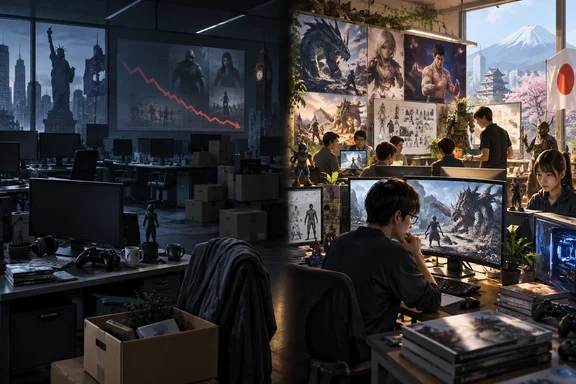
The core observation holds up against the public record, with an important qualification: the layoff totals are a moving tracker estimate, rather than an audited industry census. GamesBeat previously reported Satvat’s tracking showed North America accounting for 17 of the 20 most recent layoff situations in early 2026. A more recent GameDev Reports summary of the ASGC tracker put the five-year 2022–2026 total at 58,494 jobs as of August 11, rather than the 57,628 cited by Notebookcheck. That difference does not disprove the earlier figure; it demonstrates why a single headline number should be treated as a snapshot.
What the corporate data does support is the more useful part of the story: several large Japanese publishers have been hiring or holding their development capacity while much of the West has been retrenching. Capcom’s consolidated workforce rose from 3,206 at the end of March 2022 to 3,976 at the end of March 2026. Its development headcount climbed from 2,369 to 3,011 over the same period.
That does not mean Japan has found a pain-free business model, or that every Japanese studio is protected from cancellations, outsourcing, temporary contracts, and the other forms of instability that do not always appear in public layoff trackers. It does mean the popular claim that industry layoffs are simply an inevitable correction after pandemic-era expansion is incomplete. The correction has been shaped by where publishers expanded, how they staffed games, and what kinds of businesses they chose to build.
The layoff number is large, but the regional split is the bigger story
Satvat’s ASGC tracker has become one of the most widely cited running counts of games-industry job losses because there is no official, comprehensive global database. The tracker combines announced cuts, reporting, and industry sourcing; it is valuable, but its figures can change as events are confirmed or forecasts are revised. Satvat’s own 2026 forecast rose repeatedly during the year, which makes precision important when comparing articles published weeks apart.
The direction of the data is much clearer than the exact cumulative tally. GameDev Reports, summarizing the tracker’s August data, said North America accounted for 66 percent of recorded layoff events in 2026 and roughly 79 percent of the people affected. Europe accounted for about another 30 percent. Together, that left very little of the recorded layoff activity elsewhere.
For Windows and PC users, this is more than a labor-market statistic. North America and Europe contain the biggest concentrations of AAA PC development: Xbox’s internal studios, Electronic Arts, Ubisoft, Epic Games, Take-Two’s Western labels, Unity, major outsourcing firms, and a long tail of independent developers that rely on the same financing and publishing market. When those regions pull back at once, the likely effects include cancelled projects, fewer experimental mid-budget releases, consolidation around familiar franchises, and a greater dependence on external co-development.
Microsoft has particular exposure to this regional concentration. Xbox’s publishing, Game Pass, Bethesda and Activision Blizzard operations are global, but many of the company’s largest first-party development teams are based in the United States, Canada and Europe. The industry’s geographic unevenness means the companies that dominate Windows gaming and subscription distribution are operating in the part of the market where layoffs have been most severe.
Capcom’s headcount shows why “Japan avoided layoffs” needs nuance
The strongest independently verifiable evidence in the submitted report is not a generalized comparison of national corporate culture. It is the staffing data disclosed by individual companies.
Capcom reported 3,976 consolidated employees as of March 31, 2026, including 3,011 development personnel. Those are increases from 3,766 employees and 2,846 developers a year earlier. Capcom also reported a 2.6 percent turnover rate for its non-consolidated workforce, down from 2.8 percent in the prior fiscal year.
Those numbers support a narrow conclusion: Capcom was expanding its in-house development organization during a period in which Western game companies were cutting thousands of positions. They do not prove that Capcom’s approach can be transplanted wholesale into a publisher with a different portfolio, labor market, ownership structure or cost base. But they do refute the idea that major headcount reductions are the only available response to higher development costs.
Nintendo’s publicly disclosed group workforce also rose to 8,666 as of the end of March 2026. Konami reported growth in its Digital Entertainment regular employee count, from 2,208 in fiscal 2025 to 2,312 in fiscal 2026. These are corporate workforce figures, not a count of every external studio, contractor, localization provider or support company attached to a game. Even so, they point in the same direction as the tracker’s regional pattern.
The phrase “staff retention above 97 percent,” attributed to Satvat in the Notebookcheck report, should be read carefully. Capcom’s own 2.6 percent turnover figure implies retention of roughly 97.4 percent among the particular non-consolidated full-time population it measures, but that is not the same metric as a worldwide, company-wide promise of job security. Konami’s published human-capital data also uses more than one retention measure, including retention of new graduates after three years. The companies are not reporting one standardized number.
That measurement problem is material. A publisher may avoid headline layoffs while reducing contractors, allowing fixed-term work to expire, shifting jobs to partner studios, or declining to backfill departures. The available evidence supports a real contrast in full-time staffing trajectories, particularly at Capcom, but it does not justify treating three Japanese publishers as a complete proxy for an entire national industry.
Smaller teams helped, but so did avoiding the live-service arms race
Satvat’s explanation, as conveyed by Edge and repeated by GamesRadar, is that Japanese publishers generally kept teams smaller and did not chase the same live-service expansion that swept through Western games companies. There is a credible mechanism behind that observation.
A live-service game is not merely a game with updates. A successful service requires continuous content production, server and platform operations, community management, customer support, anti-cheat work, live balancing, commerce systems, analytics, marketing, and a pipeline capable of shipping new material on a schedule. Publishers scaled up for the possibility of the next Fortnite, Call of Duty, Apex Legends or Genshin Impact. Most of those bets could not become category leaders, because the market only has room for a limited number of games that demand years of a player’s time and spending.
The result is a cost structure built around recurring revenue that may never arrive. When a service title misses its target, the cuts can reach teams beyond the failed project because publishers have already committed office space, executive plans, technology spending and multi-studio staffing models designed for growth.
Capcom’s recent strategy offers a contrast. The company has expanded developers while relying heavily on recurring premium releases and long-tail catalog sales, including PC versions, rather than presenting every major project as a permanently staffed service. That is not a low-risk strategy; premium games can still miss badly, and franchises still require significant budgets. Yet a publisher built around discrete releases can more readily staff for a defined production cycle than one that needs to finance years of post-launch operations before knowing whether the audience will remain.
Nintendo’s model is different again, built around first-party hardware, internal franchises and closely managed release timing. Konami combines games with businesses including amusement and gaming systems. Lumping those companies together as proof of a single “Japanese model” obscures meaningful differences. Their shared advantage is less cultural mystique than a lower apparent reliance on huge, speculative live-service organizations.
Executive pay is a symptom, not a layoff budget
The compensation comparison in the submitted report is accurate in its broad outline. Electronic Arts’ amended fiscal 2026 annual filing lists CEO Andrew Wilson’s total compensation at $38,649,984, alongside a CEO-to-median-employee pay ratio of 305 to 1. Nintendo president Shuntaro Furukawa’s disclosed compensation has been far lower in dollar terms.
The comparison makes a legitimate governance point: companies signal priorities through compensation structures, especially when stock awards reward executives for short-term financial targets. But it should not be presented as an arithmetic solution to layoffs. Even eliminating one large CEO package would not, by itself, permanently fund a global development organization with hundreds or thousands of employees, benefits, tools, facilities and multi-year project obligations.
The more consequential issue is the decision-making model that large compensation packages can reinforce. If leadership is rewarded for margin expansion, buybacks, cost cutting or an acquisition narrative, reducing staff after an expensive project misses may appear financially rational even when it destroys team knowledge and delays future work. A publisher that grows more gradually and keeps a larger share of its spending tied to durable development capacity is choosing a different risk profile.
Japan’s advantage is not immunity; it is that several major publishers entered the downturn without the same scale of speculative staffing to unwind. Capcom’s rising headcount offers the clearest documented example. For Xbox and the broader PC market, the warning is that layoffs have become concentrated where the industry’s biggest platforms and studios are based — and that makes the West’s development pipeline more fragile even as some Japanese publishers continue adding developers.
Update: Satvat projects slower hiring and a possible industry contraction (September 19, 2026)
PC Gamer reports that Amir Satvat’s Edge interview adds a broader warning beyond the regional layoff split: he estimates the games business may add only 18,000 to 25,000 jobs per year, barely enough to offset normal attrition.
According to PC Gamer, Satvat’s data puts total layoffs from 2022 through 2026 at roughly 58,000, while new jobs over that span may reach 32,000 to 67,000—far below the approximately 150,000 jobs added between 2017 and 2021. He reportedly expects 14,500 layoffs during 2026.
The practical implication is that a return to pre-downturn staffing levels is not assured even if major layoff announcements slow. For Windows game developers and IT teams supporting PC publishing, the near-term market may remain defined by selective hiring, smaller production teams and less capacity for speculative projects rather than a broad rebound in AAA employment.
References
- Gaming industry faces its worst crash in decades — but Japan is dodging the bullet Notebookcheck · 2026-09-17T21:28:00+00:00
- Japanese devs aren't facing the same layoff crisis because their executives are paid an order of magnitude less, 'they didn’t get swept up in the live-service trend,' and their teams are smaller, says industry expert PC Gamer · 2026-09-19T18:13:42+00:00