

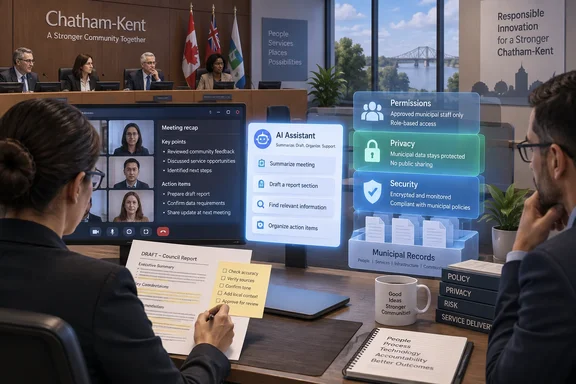
Catherine Fitzgerald, the municipality's director of information technology and transformation, briefed council on how Chatham-Kent is handling AI. Tom Morrison reported the briefing for the Chatham Daily News. Two pilots are running. About 180 staff members are using Microsoft Teams Premium, and a separate Microsoft Copilot pilot is now taking applications from business units. In her words, the principle behind both is that AI works as "a very fast, but inexperienced assistant."
For Windows admins and Microsoft 365 administrators, the Copilot branding matters less than the order of the work. Chatham-Kent is reviewing permissions, cleaning up information governance and checking security readiness before it scales anything. Fitzgerald's reason: "Poor permissions, poor information practices are not fixed by AI. In fact, they may be amplified by it."
What council heard
Fitzgerald told council that staff use AI as help with their work, but they still own the decisions and the work itself. She said staff must check the facts, apply professional judgement, and remain responsible for the final product or decision. She added that the trust placed in local government means AI has to be used carefully.
Her description of the risk will sound familiar to anyone who has used a large language model. AI can give staff a starting point, but it can also give wrong information while sounding confident.
Other points from the briefing:
- AI isn't new at the municipality. Chatham-Kent has used AI "for some time" to automate processes. One example is part of invoice processing, but a person still has to approve payment.
- The municipality is working with its peers. Chatham-Kent sits on an AI subcommittee of 16 Ontario municipalities under the regional and single-tier chief administrative officers' group. The group compares work to avoid duplicating effort, and Chatham-Kent contributes the view of a single-tier municipality.
- It is watching government direction. The municipality says it follows provincial and federal guidance and tracks relevant legislation. No specific laws or directives were named.
- Council will get a follow-up. Fitzgerald will report back on the pilots and other AI uses. The pilots are meant to show whether the results justify more investment.
A separate account from The1News, dated September 24, says council received the briefing that Monday. It also names the subcommittee as the RSTCAOs AI Subcommittee. That report describes the Copilot plan as phased: technical groundwork first, then selected business pilots, evidence-gathering and eventually decisions on scaling up. Expansion would happen only where value, readiness and safeguards have been shown.
Summary: Chatham-Kent isn't racing to roll out AI. It is running controlled tests with named Microsoft products and has promised to report back to council.
The two Microsoft pilots
| Pilot | Reported status | Features named in the briefing |
|---|---|---|
| Microsoft Teams Premium | About 180 staff using it | Automated minute-taking, compiling action items, meeting transcription, real-time captions, language translation |
| Microsoft Copilot solution | Technical staff have assessed the guardrails; applications from business stakeholders now open | Not specified |
The two pilots are at different stages. Teams Premium is in use by a defined group of staff. Copilot has passed technical review and is now recruiting business participants. The briefing didn't say which Copilot product or licence is involved, how many people will take part, when it starts, or what the guardrails are. Readers shouldn't assume a particular SKU.
On Teams Premium, Fitzgerald pointed out that live captions and translation can help make content accessible to staff. The briefing did not cover recording policies, retention settings, or whether every participant uses every feature.
What the policy requires
The pilots operate under Chatham-Kent's Corporate Artificial Intelligence Policy, which took effect April 26, 2025. The policy document, published through AMCTO (Ontario's municipal professionals' association), includes several requirements that matter to IT staff:
- Scope: The policy covers the municipality, including its Public Library Board and Board of Health. It states that "Chatham-Kent Police Services (CKPS) is out of scope."
- Accountability: The policy defines accountability as the obligation of all staff to explain and take responsibility for the outcomes of the use of AI.
- Intake: AI systems and tools will be implemented through the ITT Project Intake process, or at a minimum, a ticket with the ITT Service Desk, and in coordination with the ITT Division.
- Assessments: A Security Risk Assessment (SRA) and Privacy Impact Assessment (PIA) will be conducted for all AI systems and tools.
- Annual review: Annual reviews of AI systems and tools will be conducted to reassess and confirm use cases for the AI system and tool, including updating any use cases that involve personally identifiable information.
- Conduct: AI will be used in accordance with the Municipality of Chatham-Kent Employee Code of Conduct.
The intake rule is the practical part. AI tools come in through the IT division's project process, not through a department head's credit card. That doesn't prevent shadow AI, but it gives IT a formal claim to review every tool. The document also listed an April 2026 review date. The sources available don't show whether that review took place or whether the policy has changed.
Summary: The "human accountability" in the briefing is written into the policy. Every AI tool requires a security risk assessment and a privacy impact assessment and is reviewed annually.
Why the permissions warning matters
Fitzgerald's most useful point for administrators was that AI tools inherit the environment they are deployed into. As a general industry point (not something Chatham-Kent reported), assistants like Copilot work with content the signed-in user can already reach. Old sharing links, overly broad team memberships and neglected file shares therefore become much easier to find once people can ask for their contents in plain language. The access was always there. AI just makes it quick to use.
That is why Chatham-Kent's preparation list — permission reviews, information governance and security-readiness assessments — makes sense as a checklist for any organization:
- Review permissions. Find content shared "with everyone" or kept open long after a project ended.
- Tighten information governance. Classify sensitive records and decide what AI tools should be allowed to see.
- Assess security readiness. Fitzgerald noted that AI makes it easier to target "people, information and our infrastructure," but also offers tools to defend the organization.
- Run a small pilot with measures set in advance. Chatham-Kent's stated test is whether the results justify further investment. That is an honest yardstick.
- Keep a person at the approval step. The invoice example shows this: automation handles the processing, and a person approves the payment.
None of this suggests Chatham-Kent has had an AI-related incident. None was reported. The warning is about prevention.
The other side
The municipality's own framing deserves some scrutiny. "Human oversight" is only as strong as the time and training staff get to do it. If a reviewer has 40 AI-generated meeting summaries to check before lunch, the review can become a rubber stamp.
The briefing also reported no results yet: no time savings, accuracy rates, adoption numbers or costs. The1News account notes that Ontario municipalities see risks such as bias, misinformation and vendor dependency. Lock-in to a single vendor is a fair concern when both pilots use Microsoft products. Council should expect the promised report back to include measured evidence, not just staff impressions.
There is a good case for the approach, too. For a municipality of Chatham-Kent's size, sharing work across 16 municipalities means it doesn't have to write every policy, assessment template and lesson from scratch.
Summary: Chatham-Kent is taking a cautious, well-documented approach to AI, based on policy and pilots. Whether it works will depend on what the pilot results show and whether human review stays meaningful as use grows.
For WindowsForum readers running their own Copilot or Teams Premium trials, this is a useful case study. The Microsoft products aren't the hard part. The hard part is making sure permissions, records and accountability rules are sorted out before an AI assistant can search everything.
References
- Municipality of Chatham-Kent keeping human oversight over AI use - Chatham Daily News Chatham Daily News · 2026-09-28T14:42:52+00:00
- Council receives briefing on municipality’s approach to artificial intelligence the1news.com
- Corporate Artificial Intelligence Policy Policy Owner amcto.com