

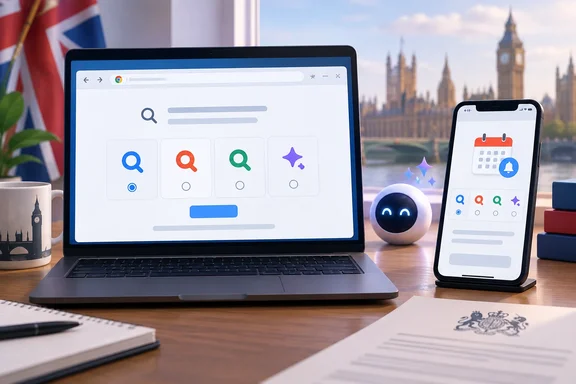
The CMA's revised User Choice requirement puts Chrome on Windows in scope
The announcement is a further consultation on one of four conduct requirements, which are legally binding behavioural rules that the CMA can impose on firms it has designated with "strategic market status" under the Digital Markets, Competition and Consumers Act 2024. The CMA gave Google that status in general search and search advertising on October 10, 2025. On January 28, 2026 it consulted on four requirements: user choice, data portability, fair ranking and publisher controls. The CMA's case record shows it imposed the publisher requirement on June 3 and the fair-ranking and data-portability requirements on June 17. The user-choice requirement is the one still open.
According to the CMA's press release, Google would have to give Android and Chrome users a choice of search services when they first use an Android phone or open Chrome, "followed by a prompt every year to choose the default provider they want to use." Reuters' report on the announcement confirms the dates: the proposals are open to consultation until October 9, with the CMA expected to make a final decision by the end of the year.
Windows readers should look at how the scope is drawn. The draft consultation document covers UK-distributed Chrome on desktop, mobile and tablet operating systems wherever Google Search is the default. It names Windows, Android and iOS/iPadOS explicitly. In Chrome, the regulated search access point is the address bar. On Android, the draft covers devices sold in the UK where the manufacturer preinstalls Google Search, the Search Widget and/or Chrome with Google as the default. There it reaches the default search app, the home-screen Search Widget and Chrome's address bar. Chrome running on a covered Android phone is handled under the device rules, not the browser rules.
Engadget's report says the requirement would apply to "Google and Android smartphone makers". The CMA's own announcement puts the obligation on Google. Engadget also points out, correctly, that UK users can already pick a search provider on Android and Chrome. What the CMA proposes goes further than confirming that existing option. It would make the screen a formal legal obligation and change who sees it, how often, which providers qualify, and how switching works afterwards.
Annual prompts in Chrome and Android come with a six-month off-ramp
The recurring prompt is the most visible change, and it is less intrusive than "choose again every year" suggests. Under the draft, a new covered device or browser shows a choice screen during setup or first use. For existing Chrome installs, a choice screen would appear after the first major browser update once the requirement takes effect. After that, users would get at least annual notifications that they can tap to open the screen. Covered Android devices would get a skippable notification at least once a year, starting with the first major device update after the rule applies.
There is an exemption. The draft lets Google skip the notification if the user deliberately picked or changed their default search provider in the previous six months. Someone who has already chosen Bing, DuckDuckGo or anything else wouldn't be nagged on schedule, and the annual prompt can be dismissed.
The CMA's reasoning goes back to its January proposal. That document said the existing Android choice screen appeared only once per device, at initial setup. It estimated the screen reached about 20% of Android devices in UK use each year. Among devices able to show it, about 40% got one in 2024. The CMA also cited survey data showing that 21% of users had bought their current Android phone three to four years earlier, and another 6% more than five years earlier. For those people, a choice made at setup happened before most of today's AI search products existed.
The draft also sets rules for the screen's design:
- Before the list appears, users would see an information screen that the draft says must be clear, accurate and balanced.
- Providers would appear in fully random order, and users would have to scroll through the list before confirming a choice.
- If 12 or fewer providers qualify, all of them appear. If more qualify, Google picks 12 fairly and gives users a way to see and choose from the rest.
- A short "test-drive" option would let users try a provider before committing. When the trial ends, a skippable notification leads to the default-setting screen unless the user has already switched on purpose.
- The chosen provider would become the default across all covered access points, not just one entry point.
Switching after the first choice is covered too. Google would have to provide accessible default settings at both device and browser level, with a route to the full list of eligible providers. The draft also proposes APIs that let eligible providers check whether they are a user's default, plus links that take users straight to the right settings page. For a rival search engine or assistant, that would replace the current situation, where it often can't tell whether a user who says they switched actually did.
Some of these features come from the CMA's user research, which it published alongside the consultation. That research was qualitative: 40 self-guided and 40 moderator-guided tests, not a representative survey. Participants often rushed through choice screens, skipped explanatory text and went for familiar names. Preparation screens, confirmation of what a choice would change, and trial options helped some of them engage. The report says the findings shape the design but don't point to one correct screen.
AI assistants such as ChatGPT and Perplexity get a conditional place on the list
The other headline change is about who appears on the screen. CMA chief executive Sarah Cardell said the regulator is responding to AI assistants, "which people are increasingly using as their search service, but aren't included on Google's choice screens." The CMA's announcement names ChatGPT and Perplexity as examples of how search habits are changing.
Qualifying is not automatic. The press release says AI assistants could be included "where they meet the relevant criteria, including technical and security requirements." The draft's eligibility tests are deliberately technology-neutral. A service must handle the full range of general-search tasks across many subjects, including web search. It must work as a general search experience at the covered access points. And a significant proportion of its UK users must regard it as a general search service. A chatbot that can't take an address-bar query and return a usable search experience would not qualify. Engadget's line that phone makers would have to offer "a choice of AI assistants" goes further than the proposal does.
Under the draft, Google would review provider eligibility every six months. The process must be clear, fair, robust and transparent, and Google would report its decisions, including reasons for any rejections, to the CMA. Because Google both runs the screen and competes on it, the reporting requirement is how the CMA would check that the gatekeeping is fair.
Some things remain unclear. None of the published material says which products would pass the tests on day one. Engadget notes that Gemini is still tightly integrated into Google Search. Whether Microsoft's Bing or Copilot would appear in a given slot depends on the eligibility process and the random ordering. Neither the CMA nor Google has named specific entrants.
Publisher attribution applies to choice-screen providers, separately from Google's June 3 rules
The third part of the proposal is aimed at publishers. The CMA wants search providers that appear on choice screens to "fairly attribute publisher content when used," so that people can reach the source material and see where their results came from. Engadget describes this as a requirement on all search providers. The CMA's wording ties it to providers featured on the screens, so it works as a condition of getting on the list, not a UK-wide attribution law.
It should also be kept separate from the rule already in force. The publisher conduct requirement the CMA imposed on Google on June 3 gives publishers controls over how their content is used in Google's generative AI features. It also requires Google to provide information and metrics about that use and to take reasonable steps to make sure content is clearly attributed in search. The CMA calls the opt-out part "a world first." The September proposal would extend a similar attribution expectation to rivals, including AI assistants, that want a place on Google's choice screens.
This affects the AI competition directly. An assistant that answers questions without showing where the answers came from would have to change how it presents results in order to qualify. That could be a real product cost for some entrants. The CMA hasn't published how it would judge whether attribution is "fair".
Google has already pushed back on annual choice screens
Google's position is on record. In its March response to the January consultation, the company argued that the proposal that we show more choice screens every year, on top of when you set up a new device, would annoy users. It said it had proposed instead a less intrusive, permanent central switch in your device's settings, making it easy to change your default search engine any time.
The revised draft seems to take on parts of both positions. It keeps the annual prompt but makes the Android notification skippable, drops it for anyone who changed provider in the past six months, and adds permanent, accessible default settings, which is close to Google's central switch. In January the CMA had already chosen an annual rather than six-monthly cadence because of concerns about user fatigue. Whether Google accepts this version will show up in consultation responses, which the CMA published the last time round.
Reuters also placed the proposal alongside earlier action, noting that in June, the Competition and Markets Authority ordered Google to provide greater transparency on how its search rankings work. The pattern since January is consistent: the CMA consults, revises and then imposes. That suggests a final user-choice requirement is likely, though its exact form is not settled.
What UK Chrome and Android users, and Windows admins, should do now
For now, nobody needs to do anything. Nothing takes effect before the CMA's final decision, expected by the end of 2026. Even after that, the prompts are tied to the "first major update" after the requirement applies, so they won't appear the day a decision is announced.
UK home users who already chose a non-Google default gain the most from the six-month exemption, but only if their choice counts as a recent deliberate change. Users who are happy with Google can dismiss the annual prompt. For IT administrators with UK-deployed Chrome on Windows, the draft names Windows as covered, but none of the published material says how managed or enterprise-configured Chrome installs would be treated. Anyone relying on a centrally set search default should watch the final text before assuming users will or won't see a prompt.
- The CMA's user-choice requirement is still a proposal. Comments close October 9, 2026, and a final decision is expected by the end of 2026.
- The draft explicitly covers UK-distributed Chrome on Windows, Android and iOS/iPadOS where Google is the default, with the address bar as the regulated access point.
- Existing users would see a choice screen after the first major update, then at least annual prompts. A deliberate provider change in the previous six months would exempt them.
- AI assistants such as ChatGPT or Perplexity would only appear if they meet eligibility tests for general search, technical and security requirements, and publisher attribution.
- The screen would show up to 12 randomly ordered providers, with a test-drive option and APIs that let rivals confirm whether they are a user's default.
- UK organisations that manage Chrome's default search provider should check the final requirement for how managed installs are treated before planning user communications.
If the requirement is adopted in something close to this form, the search default in Chrome, including Chrome on Windows PCs in the UK, would stop being a one-time setup choice and become something users are asked about again every year. The version the CMA confirms around the end of 2026 will decide how often UK users see these screens, which AI assistants appear on them, and how much of Google's advantage from being the default survives.