

That ambition needs a careful reading. The processor and memory ceiling are substantial, and the connectivity specification is unusually strong. Yet the UniBox remains an announced product without published pricing, an availability date or independent performance testing. The difference between the machine’s headline potential and its eventual sustained performance, noise, thermals and value will matter far more than its exceptionally large specification list.
What CHUWI announced at IFA
CHUWI presented two related systems during IFA Berlin, which ran from September 4 to 8, 2026: the flagship UniBox AI495 Pro and the lower-tier UniBox AI395. The higher-end model uses AMD’s Ryzen AI Max+ PRO 495, while the AI395 uses the Ryzen AI Max+ 395.
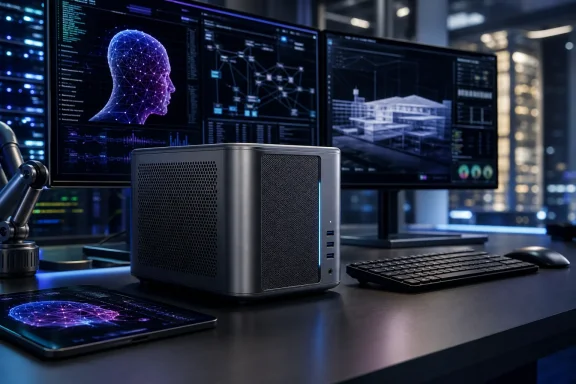
For the AI495 Pro, CHUWI lists a compact 209.6 × 209.6 × 67mm enclosure, or roughly 2.9 litres. That is small for a machine with workstation-oriented specifications, especially the network ports and memory capacity. The company says the system will ship with a 240W power adapter and Windows 11 Pro.
Its published storage and expansion outline includes a 2TB SSD and three M.2 2280 PCIe x4 slots. It also lists dual 10GbE Ethernet, Wi-Fi 7, Bluetooth 5.4, OCuLink and two 40Gbps USB4 ports. On a practical level, that combination could make the UniBox more versatile than the typical compact Windows PC:
- Dual 10GbE could suit fast network storage, direct high-speed links between workstations, or segmented office networks.
- Three M.2 slots potentially allow a user to separate the operating system, active projects and local model files, rather than immediately relying on external storage.
- OCuLink offers a potential route to external PCIe devices, although the final implementation and real-world compatibility still need confirmation.
- USB4 can cover fast external drives and docks, but buyers should not assume every dock or peripheral combination will behave identically until retail hardware is tested.
These are vendor-published specifications, not final retail validation. In particular, CHUWI has not yet clarified the precise configurations that will be sold, whether all versions include the stated 2TB SSD, or the final port and storage implementation in shipping systems.
The processor is the central story
The Ryzen AI Max+ PRO 495 is the decisive component here. AMD specifies it as a 16-core, 32-thread Zen 5 processor with boost clocks of up to 5.2GHz. Its integrated Radeon 8065S GPU has 40 graphics cores and a maximum listed clock of 3,000MHz. AMD also specifies support for a 256-bit LPDDR5x interface and up to 192GB of LPDDR5x-8533 memory.
This is not a conventional low-power mini-PC chip paired with modest integrated graphics. It is a high-end integrated design intended to give the CPU, GPU and AI hardware access to one large shared memory pool. That matters most for workloads that are difficult to fit into the dedicated VRAM of mainstream graphics cards: large datasets, high-resolution media tasks and, particularly, local AI models.
AMD rates the processor at up to 131 total AI TOPS, including up to 55 TOPS from its NPU. TOPS figures are useful for describing theoretical AI acceleration capacity, but they are not a direct substitute for measured application performance. Different workloads use the NPU, integrated GPU and CPU in very different proportions, and software support is often as important as silicon capability.
The UniBox AI395 has a smaller ceiling but is not a minor configuration. CHUWI lists up to 128GB of LPDDR5x-8000 unified memory and up to 96GB allocated to graphics. AMD specifies the underlying Ryzen AI Max+ 395 with Radeon 8060S graphics, 40 graphics cores running at up to 2,900MHz, and up to 126 total AI TOPS with a 50-TOPS NPU. For buyers whose projects fit comfortably below 128GB, that model may become the more rational choice—if its eventual price creates meaningful separation from the AI495 Pro.
192GB unified memory is compelling, but it is not 192GB of VRAM
CHUWI’s biggest number is its claim of up to 192GB of LPDDR5x-8533 unified memory in the AI495 Pro. It further says as much as 160GB can be allocated to graphics. This is a significant capability for an integrated mini PC, but the terminology deserves precision.
The 160GB figure is allocated shared memory, not 160GB of physically separate video memory mounted beside a discrete GPU. The CPU and Radeon 8065S draw from the same unified memory pool. Allocating more to graphics can help a workload whose model or assets need a large graphics-addressable memory space, but it also leaves less capacity for Windows, applications and CPU-side processing.
That trade-off is especially relevant for local AI. A model may technically load only when a large part of memory is reserved for the GPU, yet the overall experience can still be constrained by available system memory, memory bandwidth, software overhead, context size and thermal limits. Buyers should therefore treat maximum allocation as a capacity claim, not a guarantee that every model fitting within the number will run quickly enough to be useful.
CHUWI says the AI495 Pro can support local language models of up to 300 billion parameters at 4-bit quantization. AMD separately says the Ryzen AI Max+ PRO 495 can support up to 160GB of graphics memory and is capable of running models above 300 billion parameters at 4-bit quantization. Those statements establish why this processor class attracts local-AI interest.
They do not establish the experience on this particular mini PC. There are no disclosed results for token generation speed, prompt processing, model choice, context length, inference engine, driver stack or sustained power behavior. A 300-billion-parameter model that loads but produces output too slowly for an interactive workflow is a very different proposition from a workstation that delivers reliable, practical local inference.
For a Windows user, the most realistic early expectation is flexibility rather than a blanket replacement for cloud AI or a discrete-GPU workstation. The UniBox could enable private experimentation with models and local tools that exceed the memory limits of many smaller PCs. It will not remove the need to check application compatibility, model requirements and performance data for a particular workflow.
Windows 11 Pro and the Copilot+ question
CHUWI lists Windows 11 Pro, and the 55-TOPS NPU in the AI495 Pro exceeds Microsoft’s published hardware requirement of more than 40 NPU TOPS for a consumer Copilot+ PC. That is an important numerical comparison: the processor passes the stated NPU performance threshold.
It is not proof that the UniBox AI495 Pro is a certified or marketed Copilot+ PC. Meeting one hardware threshold does not by itself confirm that a specific system configuration has completed the relevant platform, driver and product requirements. Until CHUWI or Microsoft identifies the retail system accordingly, buyers should not make a purchase decision on the assumption that every Copilot+ feature is assured.
The distinction also helps avoid a common specification mistake. The processor’s up-to-131 total AI TOPS figure combines multiple processing resources. Microsoft’s published Copilot+ requirement specifically concerns NPU performance, so the relevant number for this comparison is the up-to-55-TOPS NPU figure, not the larger aggregate figure.
Windows 11 Pro may nevertheless be useful independently of AI branding for users who need business-oriented operating system features. But the machine’s broader appeal will depend on whether its firmware, drivers and cooling design prove dependable under the mixed CPU, GPU, NPU and network workloads that a workstation-style PC invites.
Gaming claims need to wait for tests
The Radeon 8065S is clearly more substantial than the integrated graphics found in mainstream mini PCs, and large unified memory can be valuable for graphics-heavy tasks. However, no reproducible UniBox AI495 Pro gaming results have been established.
In particular, a suggestion that its Radeon 8065S can exceed a GeForce RTX 4060 at 1080p should not be treated as a demonstrated result. There is no disclosed game list, graphics preset, resolution scaling setting, frame-generation configuration, driver version, system power limit or test methodology. Even a well-designed benchmark comparison can shift sharply with those choices.
The same restraint applies to comparisons with existing Ryzen AI Max+ mini PCs. The PRO 495’s specifications are known, but the final chassis determines how consistently it can sustain clocks and power. A compact enclosure may be highly capable while still facing hard engineering trade-offs between heat, fan noise and long-duration performance. Independent testing will need to establish CPU and GPU output, local-AI throughput, acoustics, power consumption and temperatures before the system can be judged as a gaming machine or a production workstation.
“Agent Computer” is a direction, not a product category guarantee
AMD describes an Agent Computer as a system built to run AI agents continuously and says that Ryzen AI Max+-based systems are particularly well suited to become Agent Computers. This explains the emphasis on memory capacity and local inference.
It should not be mistaken for a separate certification that automatically applies to every PC with this processor. Nor does the phrase resolve real deployment questions: whether an agent can run safely, how Windows manages long-running tasks, what local data it can access, and whether the required software is mature enough for unattended use. For businesses, local processing may improve control over sensitive data, but it also transfers responsibility for updates, access control, logging and operational reliability to the organization.
The buying decision is still incomplete
As of September 10, 2026, CHUWI had not announced pricing, availability, launch regions or a binding shipping schedule for either UniBox model. Its product page is collecting notifications rather than presenting a completed retail offer.
That missing price is central. The AI495 Pro’s value will need to be assessed against mini PCs using related AMD platforms, discrete-GPU desktops, compact workstations and the cost of cloud AI services. Its unusual memory capacity, dual 10GbE and expansion may justify a premium for the right buyer, but only if the final system delivers on its specifications without unacceptable noise or compromised sustained performance.
For now, the UniBox AI495 Pro is best understood as a promising local-AI Windows workstation design rather than a proven finished product. The hardware platform makes the headline claims plausible in a way ordinary mini PCs cannot match. What remains unknown is whether CHUWI can turn that platform into a well-priced, well-cooled and well-supported machine that performs as impressively after an hour of real work as it does on a specification sheet.