

What Cisco announced
Cisco introduced the products on October 7, 2026, in Austin. They span the Webex suite, meeting-room devices, and customer experience tools, including Claude Managed Agents in Webex, the RoomOS 27 device operating system, and the Dialog agentic harness. RoomOS 27 is the part that matters for room and endpoint admins.
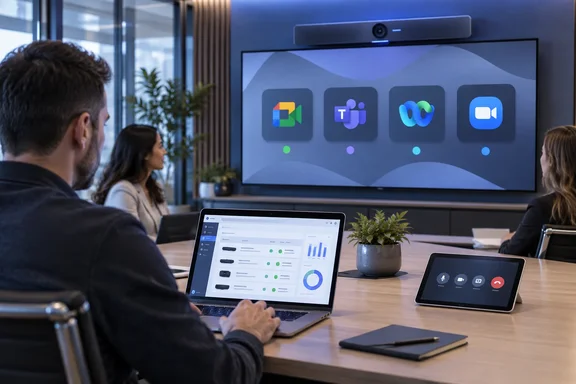
Cisco says that through a new partnership with Google, its devices now support fully featured Google Meet natively, joining Webex, Microsoft Teams and Zoom. Cisco says RoomOS 27 will be available in November. No specific day was given. Cisco also hasn't published a list of eligible devices, an upgrade procedure or licensing terms.
UC Today interviewed Espen Løberg, Cisco's VP and GM of Collaboration Devices. It reports that RoomOS 27 centers on three things: more AI inferencing on the device, a more open ecosystem, and stronger manageability and assurance. In that interview Løberg says the meeting service "cannot be a barrier to adoption" of Cisco's agentic workplace vision. He also says Cisco already considers itself the fastest-growing Microsoft Teams Rooms ecosystem partner. UC Today reports that the Zoom Rooms integration reaches general availability this month. These are Cisco's own claims, relayed through the interview.
Why Teams Rooms admins should care
Many large organizations don't run a single meeting platform. Cisco's own InfoComm blog from June says customers commonly run Webex, Teams, Zoom and Google Meet side by side across their estates. Cisco's pitch is that the device and its management layer should stay constant while the meeting app changes.
For a Microsoft shop, there are two practical implications.
- Mixed fleets could simplify. Cisco hardware could cover the Teams rooms and the rooms that still use another service. Cisco describes managing it all through Cisco Cloud Control. That is a potential benefit, not a proven saving. Cisco hasn't published cost data or shown that one configuration will meet every platform's certification and operational requirements.
- Teams Rooms on Cisco is already a running product. Cisco's June blog says it shipped the Desk Pro G2 and Room Kit Pro G2, both built to run the Microsoft Device Ecosystem Platform (MDEP) for Teams Rooms. It also introduced the Board Pro G3, which it calls its first MTR Certified board powered by MDEP. The same post describes Teams Rooms device channels in Control Hub and a beta that uses Copilot to query Cisco workspace data. Treat the Copilot item as beta.
"Native" Google Meet versus what came before
Be careful with the word "native." Cisco's June blog said Google Meet on RoomOS used an enhanced WebRTC experience. It supported sharing over HDMI, Miracast and AirPlay. The October announcement describes fully featured native support. The sources don't explain the architecture or say which capabilities are new. So it would be wrong to say Cisco had no Google Meet support before October. It would also be wrong to assume full feature parity with Google's own room hardware.
The Zoom story has a similar timeline. The June blog said the public beta would start that month, with general availability expected in September. That makes the "this month" GA claim plausible, but you should confirm it with Cisco before planning a rollout around it.
The AI assistant
Cisco says its AI Assistant on Collaboration Devices can now engage in 32 languages. Its example is that telling it a room is too warm automatically adjusts the temperature and lowers the blinds. UC Today adds that organizations can customize the assistant with services available in their environment. It says users could ask for help with room services and location, including from devices in hallways. It also says the goal is to replace menu hunting with conversation.
Those examples come with caveats.
- Cisco hasn't named supported HVAC or shade vendors, sensors or integration requirements.
- It hasn't given language-by-language coverage.
- Any building-control demo depends on facilities systems that sit outside the collaboration team's remit.
A Cisco blog from the event adds that audio intelligence includes an enhanced director agent and contextual noise removal. These are powered by RoomOS and the NVIDIA deep learning accelerator built into its latest devices. That wording suggests some features need newer hardware. Older rooms may not get everything, so check eligibility once Cisco publishes it.
Management and assurance
Cisco says Workspace Advisor, Smart Room Assurance, Divisible Rooms, Splunk and agent integrations give IT greater visibility into how spaces are used. Cisco also says that bringing RoomOS telemetry into Splunk and managing devices through Cisco Cloud Control will help organizations understand room performance and connect it to the broader enterprise.
UC Today also reports that Workplace Designer, the successor to Workspace Designer, plans whole floors, buildings or campuses. That includes the collaboration devices plus the network gear and wireless access points they depend on. It says Smart Room Assurance calibrates and validates rooms, while Workplace Advisor shows how spaces are performing.
The strategy is to tie collaboration closely to Cisco's networking business. That could appeal to organizations that already buy Cisco networking. It also raises the stakes on how well the layers work together once deployed. A Teams-centric shop might reasonably ask how much of this telemetry it can use alongside Microsoft's own management tools. Cisco's June blog says Cloud Control works alongside each platform's admin tool rather than replacing it.
The Ceiling Speaker Pro
Cisco's announcement also covers the Ceiling Speaker Pro. Cisco says it uses AI to adapt audio across the space and connects through a single Ethernet cable, replacing complex multi-vendor audio setups. UC Today reports that Løberg framed it around making every voice equal in medium and large rooms. SiliconANGLE quotes him on spatially aware voice lift, which distributes a voice to where it's needed in the room. Cisco hasn't published pricing or availability for the speaker in the material reviewed.
What to ask Cisco before you plan
- Which device models will get RoomOS 27, and which AI features need the newer NVIDIA-accelerated hardware?
- What does "native" Google Meet cover compared with the earlier WebRTC experience? Do the Google Workspace editions and admin prerequisites matter?
- Can a single device be switched between Teams, Zoom and Meet, or is each device provisioned for one platform at a time? UC Today's phrase that a device can "boot into" a service is not a documented procedure.
- Which management features are included in existing licenses, and which are separate Cloud Control packages?
- Which building systems can the assistant actually control in a real deployment?
Bottom line
This is a vendor announcement and should be read as one. Cisco's press materials, its blogs and the UC Today interview all come from or through Cisco's own framing. No independent testing of performance is available yet. What's established is the November target for RoomOS 27, the Google Meet partnership, the 32-language assistant and a set of management features. For Teams Rooms administrators, the sensible move is to wait for the device support matrix and feature documentation, then pilot before committing a mixed fleet.
Update: Additional details (October 8, 2026)
UC Today quotes Cisco’s Espen Løberg describing RoomOS as the “trusted operating system” for the workplace. He also says Cisco’s strategy depends on meeting-platform choice not becoming a barrier to adopting its agentic-workplace tools.
References
- WebexOne 2026: Cisco Bets on AI to Redefine the Meeting Room - UC Today UC Today · 2026-10-07T20:15:24.412000+00:00
- Cisco Brings Claude Managed Agents, Dialog, and RoomOS 27 to Webex unite.ai
- Cisco Unveils New Agentic Collaboration Experiences - AIwire hpcwire.com