

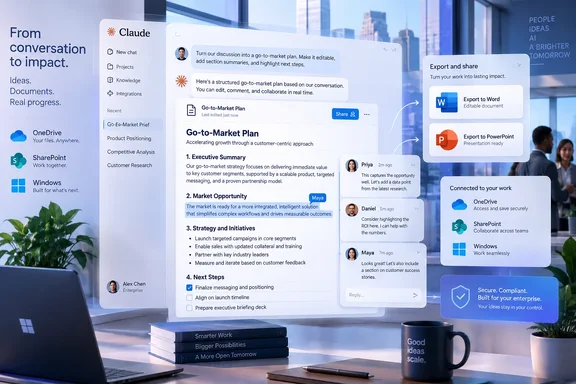
Engadget first reported that the new feature, called Claude Docs, lets users ask Claude to produce a document directly within a conversation, then edit it there or share it with colleagues. Axios independently reports that users can revise sections, leave editorial comments, and collaborate within the document before exporting to Word or Google Docs. Claude Slides and Claude Design are also being surfaced from ordinary chats, rather than requiring users to switch into separate product areas.
For Windows users and Microsoft 365 administrators, the practical change is straightforward: Claude is positioning itself as the place where a document begins and evolves, while Word and PowerPoint remain the formats many organizations use to circulate, archive, govern, and finalize the work.
Anthropic says the unified experience is beginning a rollout to Pro and Max subscribers on web, desktop, and mobile over the next several weeks. Team and Free users are promised access “soon,” but the company has not published a firm date, a regional rollout schedule, or a detailed feature matrix explaining which sharing and export functions will reach each plan.
Claude Docs changes the workflow, not the file format
Claude has been able to generate downloadable Word documents, Excel workbooks, PowerPoint files, and PDFs for some time. Anthropic announced file creation and editing in 2025, and its current support documentation says Claude can produce .docx, .xlsx, .pptx, and PDF files directly from a conversation.
That distinction is important. Claude Docs is not the debut of Claude-generated Word files. The new element is the editable, shareable document surface living inside the chat experience, where the model can keep participating in the revision loop rather than producing a file and effectively ending the interaction.
For an individual, that means a rough brief can become a one-page plan, then a polished Word document, without copying responses between chats and an editor. For a team, the intended workflow is more consequential: a person can ask Claude to draft a document from connected context, edit the substance manually, request targeted changes from the model, and share a version before exporting it to the company’s usual document system.
Anthropic’s pitch is that users should no longer need to decide whether a task belongs in Chat, Cowork, or Design. The company is merging those routes into what it calls a “One Claude” experience. Cowork has been Anthropic’s agentic work mode for longer, multi-step tasks across selected files and connected services; Design was launched as a separate visual workspace for one-pagers, prototypes, slides, and graphics.
The company’s own release notes show that Chat and Cowork had already begun sharing a common home for projects and artifacts in July. Wednesday’s release is the next interface step: instead of picking the work mode first, the user starts with a request and Claude chooses an output surface.
That is a sensible reduction in product complexity. It also places more responsibility on the user to understand what Claude can access before treating a quick chat prompt as a harmless drafting request.
Word and PowerPoint remain the enterprise handoff
The Microsoft angle is not that Claude Docs replaces Word or PowerPoint overnight. It does not. Anthropic is explicitly retaining Word and PowerPoint export, which acknowledges the reality of business workflows: documents usually need to leave an AI workspace for tracked changes, retention, legal review, accessibility work, template compliance, records management, and external exchange.
Exporting a document is also where an attractive in-chat draft meets the less glamorous requirements of enterprise production. A generated document can contain incorrect facts, invented references, weak formatting, inconsistent heading styles, inaccessible tables, or language that conflicts with an approved policy. A PowerPoint deck can look coherent in a preview while still needing careful checking of speaker notes, editable elements, slide-master behavior, image licensing, data labels, and brand fonts after it opens in PowerPoint.
Anthropic’s own file-creation guidance makes the limitation clear in plainer language: users may need to review and refine generated outputs to meet their exact requirements. That is not a disclaimer to skip past. It is the operating rule for AI-created business material.
Windows shops should therefore treat Claude Docs as a drafting and synthesis layer, not a substitute for document controls already built around Microsoft 365. If a policy requires a Word template, a SharePoint location, an approval workflow, sensitivity label, retention label, or legal signoff, those requirements do not disappear because the first draft lived in Claude.
Anthropic has also expanded its Microsoft 365 connector beyond search. Its July release notes say that, with write tools enabled, Claude can create and update files in OneDrive and SharePoint, while also handling certain email and calendar actions. That capability requires Microsoft Entra administrator consent to the updated permissions and must be enabled by a Claude administrator.
The result is a meaningful boundary for IT departments: exporting a document manually to Word is one thing; allowing an AI service to create or update material in OneDrive and SharePoint is another. Those should not be evaluated as the same deployment decision.
The administrative question is access, not document generation
The most useful policy response to Claude Docs is not a blanket ban on AI-created documents. It is to decide which content Claude may receive, which connectors it may use, who can share resulting documents, and where approved final records must live.
Anthropic says new artifacts are saved to a user’s account and can be shared with colleagues or, depending on organizational settings, more broadly. Its support guidance for the updated artifacts system says administrators can limit external sharing, while artifacts connected to apps or capable of asking Claude questions may have tighter sharing restrictions. The exact controls available for the new Docs experience have not yet been fully detailed in public documentation, so administrators should not assume that an older artifact policy maps perfectly onto every new document workflow.
There are already concrete controls elsewhere in Claude that organizations should examine. Anthropic says Team and Enterprise owners can enable or disable code execution and file creation across the organization, control network access, and whitelist approved domains. In Cowork, the company says admins can set permissions by team, manage tool access, and send activity telemetry through OpenTelemetry.
Those controls matter because generated documents can be downstream products of broad access. A one-page sales brief may pull from customer data; a proposed policy may synthesize internal guidance; a slide deck may package material from a connected drive. The risk lies in the source data and in the sharing route, rather than in the .docx extension alone.
A workable rollout for a Microsoft-centered organization should include a short test using non-sensitive material before enabling broad connector access:
- Create a document from approved reference files and inspect the resulting Word export for styles, tables, citations, comments, and document properties.
- Test whether a shared Claude document exposes information differently from a file stored in SharePoint or OneDrive.
- Verify which Claude plan, connector permissions, Entra consents, and organizational sharing settings are required before users can write to Microsoft 365 content.
- Establish whether the Claude-created draft or the final Word file is the system of record for retention, eDiscovery, and approval purposes.
That test will reveal more than a vendor demo can. A model can generate a polished first pass in seconds; finding out that it ignored a mandatory template or used the wrong source version often takes longer.
“One Claude” is a direct challenge to suite software
Anthropic is trying to remove the handoffs that traditionally separate a chatbot from office software. The company wants a single conversation to become a workspace for research, document creation, slides, visual design, and agentic tasks across files and services.
Axios frames the rollout as a direct escalation against Microsoft’s Office business, and that reading is fair. Claude does not need to persuade every organization to abandon Word, Excel, or PowerPoint to become strategically important. It only needs to own the high-value front end of knowledge work: the request, the research, the first draft, the revisions, and the conversion from notes into a deck.
That is where Copilot, Microsoft 365, Google Workspace, and standalone AI tools are competing. The contest is increasingly about which assistant has the context and permission to turn scattered material into a decision-ready document, rather than which application can render a page or open a slide.
Anthropic has not released independent evidence showing that Claude Docs produces more accurate, more compliant, or better-formatted documents than existing Word, PowerPoint, or Google Docs AI workflows. It has also not said how existing Cowork and Design work will migrate into the new unified interface, beyond the promise that users will no longer need to choose the correct workspace at the outset.
For now, the immediate consequence is operational rather than revolutionary: Pro and Max users will increasingly encounter Claude as a workspace capable of producing editable deliverables, while Microsoft Word and PowerPoint remain the formats where organizations will need to inspect, approve, distribute, and preserve them.
Update: Unified Claude rollout adds migration details and feature limits (September 16, 2026)
Neowin reports that existing Cowork users’ tasks, projects, connectors, skills, artifacts, and files will carry into the unified Claude interface. Once an account receives the new design, however, users reportedly cannot switch back to separate Chat and Cowork modes.
The report also identifies early limitations not detailed in the initial rollout: GitHub import and conversation branching are unavailable; Incognito chats remain on the older experience and cannot create files or run code; and search does not yet cover older Cowork tasks. Existing Dispatch users can continue using it for now, but new users cannot access it.
For IT teams, the more concrete Enterprise timing is notable. Neowin says Enterprise customers will receive at least 30 days’ advance notice before the interface change reaches their organizations, while Pro and Max users receive the rollout first. That window should give administrators time to test migrated projects, review connector behavior, and communicate the loss of separate workspace selection before the experience becomes mandatory.
Update: Claude Docs reportedly adds guided drafting comments (September 17, 2026)
According to Computerworld, Claude Docs and Slides add a rich-text editing surface directly inside Claude, with the assistant asking clarifying questions before beginning a draft. The report also says Claude can leave comments explaining its editorial or structural choices.
For users producing Word documents or PowerPoint decks, that suggests Claude’s in-chat workspace is intended to be more than a canvas for generated text: it is also becoming a guided drafting environment where assumptions can be surfaced before export. Organizations should still review those comments and the finished Office files against approved sources, templates, and compliance requirements.
Update: Report details in-Claude presenting and administrator enablement (September 19, 2026)
Techzine reports that Claude Slides can be presented directly from within Claude, in addition to being edited collaboratively and exported as PowerPoint or PDF. That could reduce the need to open PowerPoint for informal reviews, although teams will still need the exported deck for normal Microsoft 365 approval, branding, and archival processes.
The outlet also reports that Enterprise administrators can choose when to enable Docs and Slides, rather than receiving the features automatically. Anthropic’s promised 30-day notification period would therefore be a planning window, not necessarily a deployment deadline.
Techzine further says users can adjust how frequently Claude seeks permission before acting, including allowing longer stretches of autonomous work. Administrators should assess that setting alongside connector and file-access controls, since fewer interruptions may make agentic document workflows faster but less visible to end users.
References
- Anthropic's Claude can now create editable documents for you Engadget · 2026-09-16T16:30:00+00:00