

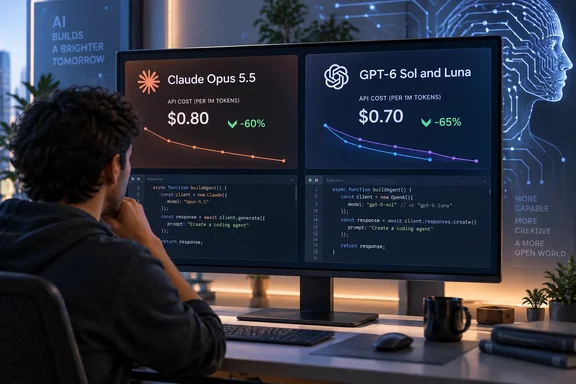
Claude Opus 5.5 and GPT-6 Sol Arrive Within an Hour of Each Other
The timing is well documented. Developer Simon Willison wrote that Anthropic released Claude Opus 5.5, and around an hour later OpenAI released GPT-6 Sol and GPT-6 Luna, and 9to5Google and Decrypt report the same sequence. SiliconANGLE opened its coverage the same way The Register did, saying that despite rampant worries about runaway artificial intelligence, the two big AI model makers aren't yet slowing down.
Anthropic calls Opus 5.5 the first model in its Claude 5.5 family. It says the model performs at the level of Claude Fable 5.1 on most work and calls it "the strongest-performing model we've tested to date" on its automated behavioral audit, which it describes as its most comprehensive alignment test. Anthropic also says external evaluators, including Frontier Design and METR, tested Opus 5.5 before release. SiliconANGLE confirms that Frontier Design and METR both tested the model before release.
OpenAI's API changelog lists gpt-6-sol and gpt-6-luna as reasoning models. They accept text and image inputs and produce text through the Responses and Chat Completions APIs. They fill out the GPT-6 range that began with GPT-6 Astra on September 3. According to SiliconANGLE, Sol and Luna were built on much the same training methods as GPT-6 Astra, which the company began rolling out Sept. 3, then tuned for cost.
The independent benchmarker Artificial Analysis says Opus 5.5 is roughly level with GPT-6 Astra on agentic work. It also puts Opus 5.5 at the top of its Intelligence Index with a score of 58, a composite of 10 benchmark evaluations.
What the "Pacing the Frontier" Letter and Amodei's Essay Actually Request
The July statement, titled Pacing the Frontier, carries the names of 1,386 employees of frontier AI companies. Signatories include OpenAI chief scientist Jakub Pachocki, Anthropic co-founder Jared Kaplan, Google DeepMind co-founder Shane Legg and Amodei himself. The statement asks the U.S. government to support an international effort to build the technical and governance tools needed to "deliberately pace the frontier of automated AI development."
Its argument rests on competition. Each company, and each country, is under pressure not to slow down on its own, and the world currently lacks the tools to slow the whole frontier at once. The main worry is that AI could help automate AI research, speeding up progress beyond people's ability to understand or control the systems that result.
Amodei's essay, "We Must Pace the Frontier," says explicitly that pacing does not mean stopping model training or technical progress. What he wants is enough time for alignment work and safeguards, plus third-party evaluation. He proposes three stages:
- Embedded third-party evaluators with ongoing access to models.
- Coordination among frontier companies in democratic countries on safety standards and limits to unchecked progress.
- Global coordination, including engagement with authoritarian governments where possible.
Anthropic says it has committed to the first stage. The other two depend on other companies and governments. Against that plan, Opus 5.5 is consistent with Amodei's essay: it had outside evaluators, and Anthropic calls it "our first release since we called for pacing the frontier." The model is still a large capability step, and pacing as Amodei defines it cannot be seen in a release date. The step he describes as needing coordination is the one neither company can take alone.
The Release Calendar That Undercuts the Rhetoric
The Register's timeline makes the tension clear. Opus 5.5 arrived 21 days after Claude Fable 5.1 and Claude Mythos 5.1, which themselves came 39 days after Opus 5. By The Register's count, Anthropic has gone from shipping models roughly every quarter in 2025 to almost monthly in 2026.
OpenAI's pace has been uneven. It shipped several model variants in February and March and GPT-5.5 in April. GPT-5.6 reached general availability on July 9, 77 days after GPT-5.5. GPT-6 Astra followed on September 3, and GPT-6 Sol and Luna came 19 days later.
Other labs are shipping too. Willison noted that the day before, Monday, brought Grok 4.7 (pelicans) and MiMo v2.6 Flash/Pro. The Register adds that both Anthropic and OpenAI are preparing for initial public offerings: Anthropic's could come before the end of this year, and OpenAI's is not expected until 2027. No other outlet in this reporting confirms the IPO timing, so treat it as The Register's account.
Read as a release calendar, the September launches look like a race rather than a pause. They are also consistent with the literal proposals, which ask for evaluator access and coordination tools, not a moratorium. Both points are true at the same time.
Opus 5.5 Pricing, Safeguards and "Preserved Thinking" Change the Claude Bill
For anyone paying for Claude through the API, the price is the main news. Anthropic's published per-million-token prices compare as follows:
| Token type | Claude Opus 5 | Claude Opus 5.5 | Change |
|---|---|---|---|
| Input | $5.00 | $4.00 | −20% |
| Output | $25.00 | $20.00 | −20% |
| Cache reads | $0.50 | $0.20 | −60% |
| Cache writes | $6.25 | $5.00 | −20% |
The cache-read cut does most of the work. Anthropic says cache reads make up the majority of costs in agentic and coding work, because agents replay long context on every step. The company says Opus 5.5 also uses fewer tokens per task, so the lower per-token price and the lower token count together produce its 40% lower cost on typical workloads. It also claims output is generated more than 30% faster. SiliconANGLE notes that a faster serving mode carries a premium, at $8 per million input tokens and $40 per million output. Anthropic says that fast mode, available in Claude Code and on the Claude Platform, runs at up to 2.5 times normal speed. Subscribers also get higher five-hour usage limits on the Pro, Max, Team and seat-based Enterprise plans.
Anthropic's capability claims come from its own tests and should be read that way. The company says one tester finished a 680,000-line code migration in under a day. It also says that when asked to cut load times across every page of a web app, Opus 5.5 succeeded 39 times out of 40, while Opus 5 made smaller improvements that also changed how the app behaved. GitHub's chief product officer, Mario Rodriguez, is quoted in the launch saying that in GitHub Copilot CLI and VS Code testing, Opus 5.5 "used among the fewest tokens and steps we measured."
Because Anthropic rates Opus 5.5 as comparable to Mythos 5.1 in biology and cybersecurity, it ships with safeguards similar to those on Fable 5.1. According to SiliconANGLE, restrictions on cybersecurity work carry over from Fable 5.1, and most such tasks are routed to the older Opus 4.8 model. Anthropic says routine development work such as finding and fixing bugs stays on Opus 5.5. Security teams will notice the effect on benchmarks: Anthropic ran its evaluations with production safeguards on, and when they triggered, Opus 4.8 completed the cybersecurity tasks and Opus 5 completed the biology tasks. Vetted organizations can apply now to Anthropic's Life Sciences Verification Program. The company says it will extend its Cyber Verification Program to Opus 5.5 in the coming weeks.
API developers face two further changes. The first is preserved thinking, an anti-distillation measure introduced with Fable 5.1. Distillation here means copying a model by questioning it at scale. Preserved thinking stops API customers from editing Claude's earlier context to extract its chain of reasoning, and Anthropic says it applies to Opus 5.5 and Fable 5.1 API accounts created on or after August 31, 2026. The Register points out that this protects Anthropic's business as much as it serves safety. The second change is that Anthropic no longer offers a mode with thinking switched off. The company also lists zero-data-retention availability and watermarking intended to comply with the EU AI Act.
Opus 5.5 is available on Anthropic's own platforms, Amazon Web Services, Google Cloud and Microsoft Azure, so Azure customers do not have to sign up with a separate vendor. Anthropic says Claude Sonnet 5.5 and Haiku 5.5 will follow "in the coming weeks."
GPT-6 Sol and Luna Trade Headline Capability for Price
OpenAI took a different approach. It left its most capable model, Astra, where it was and made the tiers below it much cheaper. The changelog lists standard prices for prompts of up to 272,000 input tokens. GPT-6 Sol costs $2 per million input tokens, $0.20 for cached input and $10 for output. GPT-6 Luna costs $0.10, $0.01 and $0.50. Longer prompts, cache writes and other processing tiers are priced separately.
OpenAI's "50 percent" figure is measured against GPT-5.6 promotional pricing, not every previous list price. The changelog shows that GPT-5.6 Sol dropped to $4 input and $20 output on August 21, a promotional rate guaranteed through at least November 21, 2026. Willison adds that GPT-5.6 has a scheduled 25% price increase for November, so GPT-6 is half the price of the promotional pricing for those models. Teams still on GPT-5.6 Sol therefore have a reason to plan a move before the promotional price ends.
The positioning is straightforward. Several outlets describe Luna as the high-volume option; SiliconANGLE says it is pointed at high-volume routine jobs such as summarization and extraction, while Sol takes on recurring coding and agent work. 9to5Google reports that both models are marginally more powerful than their predecessors, but well behind that of Astra, which remains the overall most powerful model OpenAI offers.
Artificial Analysis's measurements back that up. Its Intelligence Index and Coding Agent Index results for Sol and Luna are broadly level with GPT-5.6. Sol scored 57 on the Coding Agent Index, up two points, and Luna scored 41, down two. Both regressed on the GDPval-AA v2.1 knowledge-work evaluation, and Luna also fell on AA-Briefcase v1.1. Costs fell more clearly: at max effort, GPT-6 Sol cost $1.06 per Intelligence Index task against $1.99 for GPT-5.6 Sol, and Luna cost $0.07 against $0.18. These are benchmark costs per task, not what a typical customer's invoice will show.
On Artificial Analysis's AA-Omniscience test at max effort, Sol's hallucination rate fell from 92% to 60%. It also attempted fewer answers (83%, down from 99%), and its accuracy slipped from 59% to 54%. Luna's hallucination rate fell from 93% to 77%, with accuracy roughly flat at 44% against 43%. The result shows models declining to answer more often, not models that know more, and it applies to that one evaluation.
OpenAI is openly competing with Anthropic on price. It claims that on AutomationBench, a business-workflow test, "GPT‑6 Sol at xhigh effort outperforms Claude Opus 5 at max effort at just 9 percent of Opus 5's cost per task." That comparison uses Opus 5, not the Opus 5.5 released the same morning. VentureBeat notes that there is not yet a same-harness public result establishing whether Sol or Opus 5.5 delivers the lower cost per successful task. On list price alone, VentureBeat calculates that Sol is 50% cheaper than Opus 5.5 on both uncached input and output token rates.
Access varies by product. The API models are available now. Decrypt reports that GPT-6 Sol and Luna are live now in ChatGPT Work and Codex for Plus, Pro, Business, Enterprise, and Edu subscribers, with Luna also reaching free and Go users through the desktop app. The rollout is staged: neither model is in the plain ChatGPT app yet, and OpenAI says it's rolling both out gradually throughout the day.
What September's Price War Means for Developers and IT Buyers
Anyone paying for agentic coding or high-volume API workloads should re-benchmark now. Pricing changed more than capability did, and neither vendor has published a same-conditions comparison against the other's new model. Teams with stable, working pipelines can wait for independent head-to-head results, with one exception: GPT-5.6 Sol's promotional price is only guaranteed through November 21.
Some behavior changes affect migration planning. Opus 5.5 always uses thinking, and preserved thinking stops newer API accounts from rewriting prior context to extract reasoning, which can break tooling built on context manipulation. Security teams whose work on Opus 5.5 is routed to Opus 4.8 need the Cyber Verification Program, which Anthropic says is coming but has not yet extended to Opus 5.5. OpenAI's migration notes for GPT-6 Astra add that Astra does not support the none reasoning effort, custom temperature or top_p values, or logprobs, and that tool calling requires the Responses API. Those notes apply to Astra; the changelog does not list the same restrictions for Sol and Luna.
- Opus 5.5 lists at $4/$20 per million input/output tokens with $0.20 cache reads, and Anthropic says typical workloads cost 40% less than on Opus 5.
- GPT-6 Sol lists at $2/$10 and GPT-6 Luna at $0.10/$0.50 for prompts of up to 272,000 tokens, half of GPT-5.6's promotional rates.
- Artificial Analysis measured Sol and Luna as roughly level with GPT-5.6 in capability but much cheaper per task, so migrating is mainly a cost decision.
- Opus 5.5 is available on Microsoft Azure, AWS and Google Cloud, and routes most cybersecurity tasks to Opus 4.8 unless your organization is verified.
- No public same-harness benchmark yet compares Opus 5.5 with GPT-6 Sol, so compare them on your own workloads before committing.
- Anthropic says Claude Sonnet 5.5 and Haiku 5.5 will arrive in the coming weeks, which could change the comparison again at the lower-cost tiers.
The labs say they want the frontier paced, and in the same month they are competing hard on price, speed and release frequency. Both are happening at once, and Amodei's own essay explains why: no company slows down alone. For Windows shops and developers, the September 22 launches mean cheaper, more efficient agents on Azure, in GitHub Copilot tooling and through OpenAI's APIs right away. The next concrete milestones are Anthropic's Sonnet 5.5 and Haiku 5.5, the expanded Cyber Verification Program, and GPT-5.6's November price increase, which will push remaining GPT-5.6 workloads toward GPT-6.
References
- Frontier AI keeps racing despite calls to slow down The Register · 2026-09-23T00:02:47+00:00
- Introducing Claude Opus 5.5 \ Anthropic anthropic.com
- Changelog | OpenAI API developers.openai.com