

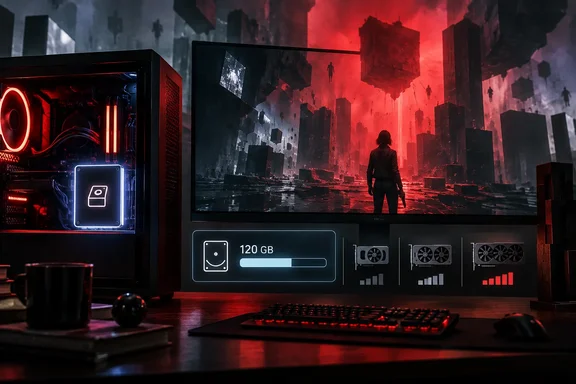
Control Resonant's 100 GB figure came from Remedy's early Steam FAQ
The lower storage number traces back to Remedy itself. The studio keeps a pinned FAQ on the game's Steam discussion board, last updated for the June 3 release-date announcement. Under the PC specs question it says "Full PC specifications and technical details with performance targets will be shared closer to launch." The initial minimum spec underneath listed 16 GB RAM, 100 GB SSD storage, 64-bit Windows 10/11, an NVIDIA GeForce GTX 1070 or AMD Radeon RX 5600 XT, and an Intel Core i5-8500 or AMD equivalent. The initial recommended spec named an NVIDIA GeForce RTX 3070 or AMD Radeon RX 6700 XT and an AMD Ryzen 7 3700X or Intel equivalent, again with 100 GB of SSD storage.
Remedy said plainly that these were provisional numbers. Hardware sites picked them up over the summer anyway. A Corsair buying guide dated July 21, for example, commented that "a 100GB install size is quite ludicrous for a single-player game, even by modern standards."
Then, on September 9, Remedy posted its final specs. PC Gamer reported that with Control Resonant now just a couple weeks out, Remedy has dropped the final PC system requirements. Players noticed the change on the day. In the FAQ thread, one commenter wrote that Remedy had tweaked the PC specs a little, in the Discord announcement post that went up today, and asked for the original post to be updated. As of the version captured for this article, the FAQ still showed the June figures. That explains why both numbers are still around: the old list remains on an official Remedy page, but the newer announcement replaces it.
The final requirements give every tier 120 GB and a performance target
The September 9 sheet is much more useful than the FAQ list. Each hardware tier comes with a resolution, a frame rate and the settings presets used to reach them. The shared baseline, per PC Gamer, is that across the board, you'll need 16GB RAM and 120GB of free space on your SSD—you can try rolling with an HDD but that's going to result in what you call a sub-optimal experience. TechPowerUp, working from the Steam listing, confirms that all of the hardware requirements call for a pedestrian 16 GB of RAM and a 120 GB SSD, as well as either Windows 10 or 11. TechSpot, Digit and OC3D report the same 120 GB figure.
Remedy split the sheet into standard rendering tiers and ray-tracing tiers. PC Gamer published the full breakdown:
| Tier (target) | Presets | CPU | GPU | VRAM |
|---|---|---|---|---|
| Minimum (1080p/30) | Quality upscaling, Low graphics, RT off | Core i5-8500 / Ryzen 5 3500 | GTX 1070 / RX 5600 XT / Arc A580 | 6 GB |
| Recommended (1440p/60) | Balanced upscaling, Medium graphics, RT off | Core i7-10700 / Ryzen 7 3700X | RTX 3060 Ti / RX 6700 XT / Arc B580 | 8 GB |
| Enthusiast (4K/60) | Performance upscaling, High graphics, RT off | Core i7-10700 / Ryzen 7 3700X | RTX 3080 / RX 6800 XT | 10 GB |
| RT Minimum (1080p/30) | Quality upscaling, Low graphics, Low RT | Core i7-8700K / Ryzen 5 3600X | RTX 2060 Super / RX 6600 / Arc A580 | 8 GB |
| RT Recommended (1440p/60) | Balanced upscaling, Medium graphics, Medium RT | Core i7-10700 / Ryzen 7 3700X | RTX 4070 Ti / RX 9070 | 10 GB |
| Path Tracing Enthusiast (4K/60) | Performance upscaling, High graphics, High RT | Core i7-10700 / Ryzen 7 3700X | RTX 5080 | 12 GB |
Put next to the June list, the changes are easy to see. Storage rose by 20 GB. The RTX 3070 in the recommended tier was replaced by the RTX 3060 Ti. The RX 6700 XT stayed. Intel Arc cards were added: the A580 at minimum and the B580 at recommended. The Ryzen 5 3500 was named as the AMD alternative to the i5-8500, and the vague "Intel equivalent" next to the Ryzen 7 3700X became a specific Core i7-10700. Remedy hasn't said why storage went up. Explanations floating around, such as a day-one patch or room reserved for DLC, are guesses.
Upscaling is built into every Control Resonant target
One pre-launch claim needs correcting. It holds that the only clue to the game's settings was an early PC Gamer "snapshot" showing a Balanced upscaler preset and Medium graphics, with no resolution or frame rate attached. Those two presets are in fact the published Recommended tier, and Remedy tied them to a clear 1440p/60 fps target with ray tracing off. The claim that no resolution targets exist for the minimum and recommended tiers is also wrong: they are 1080p/30 and 1440p/60.
The more important point is that all six tiers assume upscaling. TechSpot gave Remedy credit for this, saying the studio has bucked the trend of companies being less than forthcoming about whether their PC requirements only apply when upscaling is used – they do. In practice, a GTX 1070 reaches 1080p/30 only with the upscaler on Quality. An RTX 3060 Ti's 1440p/60 target assumes Balanced upscaling and Medium settings. Neither number describes native-resolution performance.
Frame generation isn't part of those numbers. OC3D notes that the framerate targets below are real framerates without Frame Generation enabled. According to TechPowerUp, the Steam page confirms support for NVIDIA DLSS 4.5 and AMD FSR 4.1 for both upscaling and frame generation, in addition to DLSS 4.5 Ray Reconstruction. The same listing says the game will also feature an uncapped framerate, and it will support HDR and ultra-wide aspect ratios at launch. Before those details were published, a Remedy developer had already said in the Steam FAQ thread that the game supports FSR 4 at launch, which matters to RX 9000-series owners.
Ray tracing is where Control Resonant's hardware bill jumps
Without ray tracing, the requirements are gentle. The 4K/60 Enthusiast tier asks for an RTX 3080 or RX 6800 XT, both about six years old now. Turn on ray tracing and the picture changes. At 1440p/60 the GPU requirement goes from an RTX 3060 Ti to an RTX 4070 Ti or RX 9070. Path tracing at 4K/60 requires an RTX 5080, and even that assumes Performance upscaling. Digit summed it up: "It is when you start chasing 4K and path tracing that things get serious."
CPU demands barely change. Every tier above minimum lists the same Core i7-10700 or Ryzen 7 3700X, the path-tracing tier included. The only CPU change is in the RT Minimum tier, which moves up to a Core i7-8700K or Ryzen 5 3600X. Our reading of the table is that the GPU sets your ceiling in Control Resonant, and an upgrade aimed specifically at this game will usually mean a graphics card, not a new platform.
VRAM rises steadily through the tiers: 6 GB at minimum, 8 GB at recommended and RT minimum, 10 GB for Enthusiast and RT Recommended, and 12 GB for path tracing. OC3D called the VRAM requirements fairly low for a modern game, which is good news for users of older graphics cards. The Arc A580 appears in both the standard minimum and the RT minimum tiers, so Intel's entry-level card is officially supported for low-setting ray tracing at 1080p/30.
The 120 GB SSD requirement is the one part of the spec sheet you can't dodge
Every other line in the sheet gives you choices: drop a preset, switch off ray tracing, change the upscaler mode. Storage doesn't. PC Gamer called the figure a bit of an eye-popper—that's triple what the original Control demanded—but three-digit storage requirements are increasingly the norm. For comparison, TechSpot says 120 GB puts the game in the top half of the list when it comes to storage requirements, but still well short of God of War Ragnarök's 190 GB.
The SSD part matters as much as the size. The official specs list SSD storage in both hardware tiers, and PC Gamer describes running from a hard drive as sub-optimal, not impossible. Remedy hasn't said exactly what goes wrong on an HDD, so don't count on a spinning drive being playable just because the game installs on one.
Download time is another cost. Steam users in the FAQ thread have been asking Remedy for preload details. One estimated about three hours to download the listed 120 GB on their connection and pointed out that a preload would let them start playing within minutes of launch. No preload schedule appears in the material reviewed for this article.
What this means for your PC before September 24
If you're deciding whether to upgrade or just making room for the install, work from the September 9 table and ignore the June FAQ numbers. Start by choosing the rendering target you actually want, then compare your GPU, VRAM and free SSD space against that row. "Recommended" means 1440p/60 at Medium with Balanced upscaling and no ray tracing. It doesn't cover ray tracing, and it doesn't mean native resolution.
If your card is at or above an RTX 3060 Ti, RX 6700 XT or Arc B580, you meet the standard recommended target and can wait for launch-day testing before spending more. If you want ray tracing at 1440p/60, Remedy's own target puts the bar at an RTX 4070 Ti or RX 9070, which is a far bigger purchase. On a GTX 1070-class card, plan for 1080p/30 at Low settings with Quality upscaling.
- Clear at least 120 GB on an SSD for the install. That figure applies to every tier, and the 100 GB figure was only a preliminary estimate.
- The RTX 3070 was the June recommendation. The final standard recommended GPU is the RTX 3060 Ti, RX 6700 XT or Arc B580.
- Every official target assumes upscaling and excludes frame generation. Use the matching upscaler preset when you compare your results with Remedy's targets.
- Ray tracing tiers raise GPU and VRAM requirements sharply, while the CPU requirement stays at a Core i7-10700 or Ryzen 7 3700X for everything above minimum.
- The game requires 64-bit Windows 10 or 11 and 16 GB of RAM across all tiers.
- The game launches worldwide on September 24, or September 25 in New Zealand. It's on Steam and the Epic Games Store at $59.99 (Standard) and $69.99 (Digital Deluxe) in the U.S., according to Remedy's FAQ.
Beyond Windows, the FAQ lists PlayStation 5, Xbox Series X|S and GeForce NOW as launch platforms, promises Steam Deck support at launch, and says a Mac version is coming later in 2026. Remedy notes that regional prices vary.
Once the June and September documents are read in order, there's no real conflict. Remedy published rough specs, said it would follow up with performance targets, and did so with a 120 GB SSD requirement and six clearly defined tiers. What's still missing is independent testing on retail hardware. Remedy's chart tells you which settings a GPU is expected to handle, not how smooth the game will feel in its busiest scenes. Reviews and benchmarks after the September 24 launch will show whether the RTX 3060 Ti really holds 1440p/60, and whether an RTX 5080 needs frame generation on top of Performance upscaling to keep path tracing playable.
Update: NVIDIA confirms launch availability and Dynamic Multi Frame Generation (September 30, 2026)
NVIDIA’s launch announcement confirms that Control Resonant is now available, with Dynamic Multi Frame Generation joining its DLSS 4.5 feature set. The live NVIDIA article is dated September 29, 2026—not September 22 as shown in the supplied source metadata—so its “available now” wording does not establish an earlier release than the September 24 launch previously reported.
For Windows players configuring path tracing, NVIDIA provides a new practical detail: selecting “Ray Tracing Preset: Ultra” automatically activates DLSS Ray Reconstruction on GeForce RTX GPUs. Dynamic Multi Frame Generation can use a fixed multiplier of up to 6X or adjust that multiplier dynamically toward a player-selected frame-rate target.
NVIDIA also publishes performance claims, including up to 220 FPS on an RTX 5080 at 4K with Ultra path tracing and fixed 6X frame generation. Those are vendor-reported results with generated frames, not independent confirmation of the earlier requirements chart’s frame-generation-free targets. They therefore do not settle the original article’s outstanding question about underlying rendering performance.
NVIDIA says a Control Resonant Game Ready Driver is available through its website and NVIDIA app. RTX users now have a launch-specific driver to install before evaluating the game on their own hardware.
References
- CONTROL Resonant Available Now With Path Tracing & DLSS 4.5: Get The Definitive PC Experience On GeForce RTX - NVIDIA NVIDIA · 2026-09-22T13:00:00+00:00
- Control Resonant PC Specs Clash: 120GB vs 100GB (2026) - shattered.io shattered.io · 2026-09-22T21:10:22+00:00
- Control Resonant PC requirements demand 120GB of SSD space and upscaling at every setting | TechSpot techspot.com