

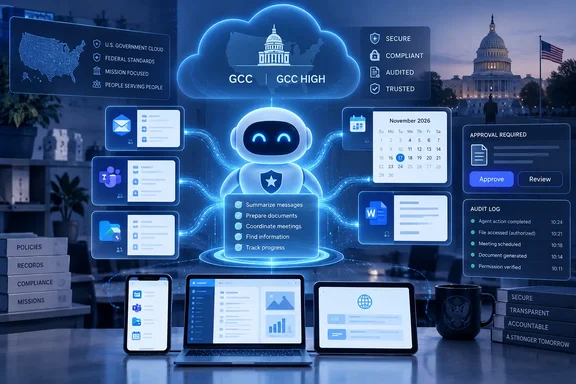
The practical change is larger than another Copilot chat feature. Cowork is Microsoft 365 Copilot’s long-running task-execution layer: an employee describes an intended outcome, and the service can draw on permitted emails, meetings, Teams messages, files, and organizational data while carrying out multiple steps. Microsoft’s roadmap description says the government version will span Android, iOS, Mac, Windows desktop, and the web.
Microsoft’s September 18 roadmap posting is the clearest timing commitment so far. A Microsoft Cloud Blog announcement three days earlier said Cowork was among the Copilot capabilities expected to reach U.S. Government clouds “in the months following” the launch of Microsoft 365 G7 in GCC. The roadmap now narrows that broad promise to November and, importantly, names GCC High alongside GCC.
For federal IT teams, the key planning point is that Cowork changes the risk profile from AI that suggests work to AI that can perform work across Microsoft 365 services. Existing Microsoft documentation for the commercial Cowork service says users must review and approve sensitive actions, but administrators should validate exactly which actions, approval prompts, auditing fields, billing controls, models, plugins, and browser capabilities are present when the government release arrives.
A November target, not a completed rollout
Roadmap ID 571637 lists general availability in November 2026 but gives no specific launch day, rollout cadence, or tenant-selection process. It also does not say whether GCC and GCC High will receive the feature simultaneously, whether rollout will be staged by geography or customer eligibility, or whether individual Cowork capabilities will arrive in separate waves.
That lack of detail is consequential in government clouds. Microsoft’s own documentation says feature availability and release timing can differ among GCC, GCC High, and Department of Defense tenants because of the operational isolation and compliance requirements behind those environments. A feature appearing in the commercial Microsoft 365 Copilot experience should therefore not be used as proof that every connected capability will be present in GCC or GCC High in November.
The omission most administrators should notice is DoD. Microsoft’s general government-cloud documentation recognizes GCC, GCC High, and DoD as distinct Copilot environments, but Roadmap ID 571637 names only GCC and GCC High. That means DoD tenants do not have a published Cowork availability commitment in this roadmap item. Agencies and contractors that operate across GCC High and DoD should not build a single deployment plan on the assumption that the service will arrive everywhere at once.
Microsoft has also not attached licensing, price, Copilot Credit rates, supported models, or an approved-plugin list to the government-cloud roadmap entry. Those questions are not administrative fine print: they determine whether Cowork can move from a small test group to routine operational use.
Cowork turns organizational permissions into task authority
Microsoft introduced Copilot Cowork to commercial Microsoft 365 Copilot customers earlier in 2026 and made it generally available on June 16. The service is designed to plan and work through multi-step tasks across organizational information, rather than simply return a single response in a chat window.
Microsoft’s current support documentation describes actions that can include drafting and sending email, scheduling meetings, creating and editing Word, Excel, PowerPoint, and PDF files, working with OneDrive and SharePoint content, researching across sources, and—when using a work or school account—posting in Teams and searching organizational files and people. The company says Cowork operates through the user’s Microsoft 365 identity and accesses data the user is already permitted to reach.
That permissions model provides a boundary, but it is not a substitute for access hygiene. Cowork can only be as narrowly scoped as the SharePoint sites, Teams channels, mailboxes, labels, and user permissions already in place. A broadly shared project site, an improperly permissioned mailbox, or outdated group membership can become part of the task context when an employee asks Cowork to assemble a briefing, prepare stakeholder communications, or research a topic across internal materials.
For government organizations, this makes pre-deployment cleanup more valuable than a generic AI acceptable-use memo. Teams should identify the workspaces likely to be used as Cowork sources, review oversharing in SharePoint and Teams, and confirm that sensitivity labels and data loss prevention policies reflect current handling rules. Cowork will inherit the governance posture of the tenant; it does not repair weak governance on its own.
Microsoft’s documentation says Copilot in government tenants keeps prompts, responses, and generated content inside the customer’s U.S. Government cloud tenant and applies the underlying environment’s security and compliance controls. That is an important boundary for GCC and GCC High customers, but it does not answer every operational question about task execution—especially where a task reaches into connected services or takes an action on a user’s behalf.
Billing and access control need a government-specific answer
Commercial Cowork documentation makes clear that the service’s operating model is consumption-based. Microsoft says Cowork activities—including model responses, tool and skill calls, image generation, and browser tasks—consume Copilot Credits. Its current administrative guidance says organizations enable access through usage-based billing and apply spending policies to users or groups.
The significant administrative wrinkle is that a spending policy can be an access control as well as a budget control. Microsoft warns that assigning a user to a policy that includes Cowork grants the user access even if the associated credit limit is tiny. For commercial tenants, setting a low cap is therefore not the same thing as blocking the service; excluding the user from an applicable Cowork spending policy is the relevant control.
Microsoft has not said in Roadmap ID 571637 whether government-cloud Cowork will use the same policy mechanics, the same credit model, or the same set of billing integrations at launch. It also has not published government-specific prices or consumption estimates with the roadmap announcement. Until it does, agencies should avoid treating commercial cost calculators or published workload assumptions as a procurement commitment for GCC or GCC High.
The broader lesson is straightforward: do not assign Cowork access through an all-users policy merely to make the feature visible. Start with a defined pilot population, a separate cost center or charging model where possible, named owners for the sources Cowork will use, and a measurable task set. A long-running agent that performs valuable recurring work can also produce recurring consumption, which makes per-user licensing alone an incomplete forecast.
Existing controls offer a starting checklist
Microsoft’s commercial administrative material describes several controls that should be familiar to Microsoft 365 security teams. It says Microsoft Purview data loss prevention policies apply to Cowork interactions, that sensitive information matched by DLP rules or sensitivity labels can be blocked from processing, and that Purview audit logs record Cowork activity with the agent name, ID, and version.
Those are useful foundations, but they should be verified in the government release rather than assumed. Before enabling Cowork for a GCC or GCC High pilot, administrators should establish what evidence they need when a user asks the service to collect material, draft a document, message a Teams channel, or act on a scheduled task. Audit retention, eDiscovery treatment, data-label enforcement, user-action approvals, and incident-response ownership should be documented before an employee begins delegating work that may affect external communications or mission processes.
Microsoft also says Cowork can run automated tasks on a schedule or in response to a matching email or Teams message. Automated execution deserves its own approval standard. A scheduled status digest that drafts an internal summary has a different risk level from a workflow that can send messages, interact with a connected business system, or collect data from a changing source.
Government organizations should distinguish between assistance, drafting, and execution in their pilot rules. Cowork’s value comes from reducing the repeated manual steps around information gathering and document preparation. Its governance burden grows when the tool moves from preparing a proposed action to initiating one.
What government tenants can do before November
The roadmap applies to users across mobile, desktop, and web surfaces, but the listed platforms should not be read as a guarantee that all interfaces will expose every action at launch. Microsoft has published no government-specific capability matrix for Cowork’s November release. That leaves agencies time to prepare the controls that will matter regardless of the final client experience.
A useful readiness plan should include the following:
- Review SharePoint, OneDrive, Teams, and group permissions for the pilot population, with special attention to sites used as broad knowledge repositories.
- Confirm that Purview sensitivity labels and DLP policies cover the data categories Cowork must not process or redistribute.
- Define which tasks may remain draft-only and which, if any, can proceed after an employee approval prompt.
- Establish a budget policy and monitoring owner before granting access, rather than after the first month of consumption.
- Require pilot users to record cases where Cowork used incomplete context, selected an inappropriate source, produced a faulty draft, or attempted an action requiring human correction.
Microsoft’s November milestone is meaningful because it extends a commercially available agentic workflow tool into the two government environments used by civilian agencies, state and local organizations, and contractors handling more demanding compliance workloads. It is also incomplete: the roadmap does not yet commit Cowork to DoD, define the government billing model, or describe the final feature set.
For GCC and GCC High administrators, the work now is less about waiting for another Copilot icon and more about deciding which users should receive an AI service that can act across the information and permissions they already hold.
References
- Microsoft Copilot (Microsoft 365): Copilot Cowork for Government Clouds Microsoft 365 Roadmap · 2026-09-18T22:00:04.2303666Z