

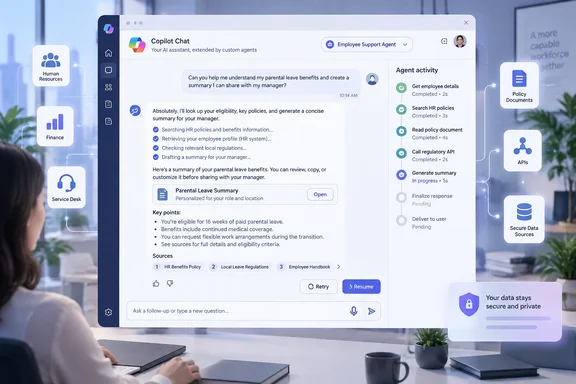
The practical value is less about cosmetic consistency than trust and usability. An employee asking a specialized HR, finance, service desk, or policy agent a question inside Copilot Chat should no longer be dropped into a visibly different conversational product with different response behavior and weaker evidence links. Microsoft’s roadmap entry says Copilot Studio agent answers will receive formatting comparable to Copilot Chat and a compressed explanation of the work performed, alongside the ability to resume or retry a response.
There is an important timing caveat: as of September 16, 2026, the roadmap item remains marked In development despite its September general-availability target. Microsoft’s roadmap explicitly treats dates as estimates, and the company has not published a rollout start date, tenant eligibility criteria, licensing change, or list of client surfaces beyond the Web platform designation. Administrators should treat this as an imminent but unshipped capability rather than something to announce as available to users.
Copilot Studio agents are being brought into the Copilot Chat harness
Microsoft’s own Copilot Studio documentation describes two related paths into Microsoft 365 Copilot: a custom Copilot Studio agent can be published through the Teams and Microsoft 365 channel, while an agent designed specifically for Microsoft 365 Copilot can be created as a more focused extension with its own instructions, knowledge, and tools. Both are meant to let organizations bring line-of-business data and processes into the Microsoft 365 Copilot interface.
In practice, however, publishing an agent into the same destination has not guaranteed a fully uniform experience. Microsoft cautions makers that an agent’s behavior at runtime in Microsoft 365 Copilot can differ from what they see in the Copilot Studio test panel or in Teams. The coming change is therefore best read as an effort to narrow the gap between the authoring environment, the custom-agent runtime, and the chat interface employees already use.
That matters for adoption. A user should not need to understand whether a response came from the default Copilot, a declarative agent, or a custom Copilot Studio agent before they can tell whether it is still generating, whether it failed, or where its information came from. Microsoft is standardizing the interaction layer around the agent rather than changing the basic permissions and tool model underneath it.
The roadmap language about a “compressed chain of thought” should also be interpreted carefully. Microsoft has not said it will expose hidden model reasoning. What the company appears to be promising is a concise, user-facing account of response progress or actions, closer to the status information already familiar from Copilot Chat. That is useful operationally, but it is not a substitute for logs, audit data, or an explanation that proves an answer is correct.
Clickable citations depend on the agent’s data, not only the new chat UI
The most consequential item in the roadmap is clickable citations. A visible source link turns an agent answer from an unsupported assertion into something a user can inspect, and that is especially important when an agent draws from a policy portal, customer system, knowledge base, or custom API.
But the new interface cannot manufacture a trustworthy citation when the underlying tool has not supplied one. Microsoft’s current extensibility guidance says Copilot can render clickable citations for API and Model Context Protocol tools when their responses include usable URL metadata. When that metadata is absent, Copilot may still show a citation-like pill or icon, but the user may not be able to open the actual source record.
For Copilot Studio makers, the implication is straightforward: do not wait for Roadmap ID 570435 before fixing tool responses. Custom connectors, REST APIs, and MCP servers should return stable canonical links, recognizable titles, and source descriptions wherever possible. A tool that only returns free-form text may produce a fluent answer, but it gives the UI little to connect to.
Microsoft’s guidance also favors the default citation experience over building elaborate Adaptive Card replacements for ordinary source links. That is sensible. Native citations are easier for users to recognize and are less likely to break when the chat client changes. Reserve custom cards for cases where users genuinely need richer controls or a dedicated workflow, rather than using them to compensate for missing source data.
This is one area where administrators should insist on testing in the actual Microsoft 365 Copilot client. A citation can be technically present yet useless if it resolves to a generic application homepage, an inaccessible internal location, or a noncanonical API endpoint. The standard to use is not “the agent showed a citation”; it is “the intended employee can open the cited record and independently verify the claim.”
Tool traces will improve visibility, but they are not governance records
Microsoft also says the updated experience will deliver tool-execution traces. For users, that could answer the basic question that agents routinely leave unexplained: did the agent search a knowledge source, retrieve a record, invoke a connector, or attempt to perform an action?
This is a welcome addition for agents that do more than summarize SharePoint files. Copilot Studio tools can retrieve data or carry out work through connectors, prompts, agent flows, computer use, custom connectors, MCP, and REST APIs. When an agent has access to a system that can create, update, approve, or transact on records, a user-facing indication that a tool was used is far better than a response that silently presents the result.
Still, a tool trace is not an audit trail. Microsoft’s development guidance already provides makers with an activity map in testing that shows the sequence of topics and actions selected by the orchestration layer. It advises makers to inspect whether the right tool was selected, in the right order, and to review production transcripts or logs for inaccuracies. Those diagnostics serve a different audience and purpose from a simplified trace shown in a conversation.
IT teams should not treat this UI change as evidence that their controls are complete. They still need to assess which tools are available, what identity each tool uses, whether it acts with the user’s credentials or a maker-owned connection, and how activity is retained for investigation. Microsoft’s own security guidance warns that agents can retrieve untrusted material from sources such as email and support tickets, where hostile instructions could influence answers or custom-tool invocation.
A visible trace may help users spot an unexpected tool call. It does not stop a poorly scoped connector, excessive permissions, prompt injection, or a tool whose description encourages the agent to select it inappropriately. The work for makers remains the same: use precise tool descriptions, least-privilege authentication, constrained data sources, and testing that includes adversarial or ambiguous prompts.
Voice dictation does not make these voice agents
The roadmap’s reference to voice dictation should not be confused with full speech interaction or a Copilot Studio voice-agent rollout. Microsoft’s current documentation for agents published to the Microsoft 365 Copilot channel still lists speech operations and speech messages among unsupported capabilities.
The more defensible reading is that users will be able to dictate their request into the Copilot Chat interface while interacting with a Copilot Studio agent, just as they would with Copilot Chat itself. That removes one interaction inconsistency, but it does not mean the agent can conduct a bidirectional spoken conversation, generate a spoken reply, or use the real-time voice-agent features Microsoft has been developing for customer-service scenarios.
Organizations that require telephone, contact-center, or speech-to-speech automation should keep those projects separate from this Microsoft 365 Copilot update. Roadmap ID 570435 concerns how a Copilot Studio agent appears inside a knowledge-work chat surface, not a new voice channel for every existing agent.
What admins and makers should do before rollout
There is no tenant switch or migration described in the roadmap entry, and Microsoft has not said whether existing agents will receive the new experience automatically, in waves, or only after republication. That leaves a short list of sensible preparation work:
- Verify that production tools return a source title and a direct, authorized URL whenever users need to validate a result.
- Test the agent in Microsoft 365 Copilot itself, because Microsoft says runtime behavior can differ from Copilot Studio’s test pane and Teams.
- Review which tool calls can change records or access sensitive systems, and make approval, authentication, and monitoring decisions independently of the new trace display.
- Prepare user guidance that explains what a cited source and a tool trace mean, and what they do not guarantee.
Microsoft is solving a real friction point: custom agents should feel like part of Copilot Chat rather than an embedded exception to it. But the upgrade will make existing weaknesses more visible as well. An agent with vague sources, inaccessible citations, or overly broad tools will gain a more polished shell without becoming more reliable.
References
- Microsoft Copilot Studio: Streamlining experiences from Copilot Studio Agents in Microsoft 365 Copilot Microsoft 365 Roadmap · 2026-09-01T22:59:38.0107578Z