

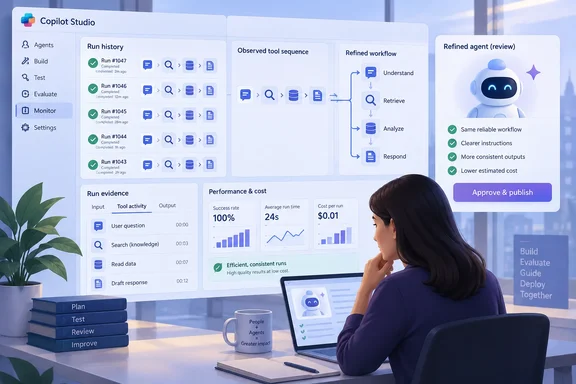
The name "self-learning" makes it sound like the agent rewrites itself. The roadmap describes something tamer. The system finds patterns and makes suggestions. A person still reviews, tests and publishes every change.
What the roadmap entry actually says
Here is what Microsoft lists for item 570432:
| Field | Listed value |
|---|---|
| Status | In development |
| Product | Microsoft Copilot Studio |
| Platform | Web |
| Release rings | Preview, General Availability |
| Cloud | Worldwide (Standard Multi-Tenant) |
| Preview target | September 2026 |
| GA target | October 2026 |
Microsoft describes the process in steps:
- The system reviews completed agent runs.
- It finds repeated tool sequences that a workflow could handle.
- Makers get recommendations with supporting evidence, the expected impact, and the related instruction and tool changes.
- Makers accept a recommendation, configure it, test it, and publish a refined copy of the agent.
Microsoft lists four goals: better output quality, cost control, keeping "work that requires model judgment" with the model, and "keeping makers in control."
Section summary: This is a maker-reviewed recommendation engine for turning repeated agent behavior into workflows. The roadmap does not say it retrains the model, and it does not describe any unsupervised change to a production agent.
Timing: estimates, not a release
It is October 1, 2026. The listed preview month is over, the listed GA month has started, and the item still says "In development." Microsoft's roadmap page says its dates and descriptions are estimates and subject to change. It also says entries are removed once a feature becomes generally available, or is cancelled or postponed.
So don't promise this to stakeholders for a specific date. Check the roadmap and your own Copilot Studio tenant before you plan around it. The entry gives no exact launch day, rollout percentage, licensing condition or tenant setting.
Why replace agent steps with workflows?
Generative orchestration is flexible, but it costs something on every run. Each time an agent reasons its way to the same chain of tool calls it has used many times before, you pay for that reasoning. It also takes time, and the run can go wrong in a slightly different way from last time. If a sequence never changes, a fixed workflow is usually cheaper, faster and easier to audit.
Microsoft has been pushing this split between agents and workflows for months. In a Copilot Studio blog post about combining the two, Microsoft said that in this pattern the workflow provides the structure for the business process—the defined steps, branching logic, handoffs, and an audit trail, while the agent handles the parts of the process that require judgement. The same post introduced agent nodes, so you can build a deterministic, reliable automation, and at the exact moment you need AI reasoning, the flow simply hands it off to an agent.
Microsoft's April 2026 Copilot Studio update covered the same idea and cited a customer example. It said Unifi used Copilot Studio and Power Platform to automate legal contract review by combining agents with deterministic workflows, and that instead of relying on a single agent, they broke the process into coordinated steps that extract, classify, and validate key terms across documents.
Item 570432 appears to automate the analysis behind that design choice: finding which parts of an agent's behavior should become fixed workflow steps. That is my reading of where the product is heading. Microsoft has not said the roadmap feature uses the agent-node architecture.
Section summary: Microsoft already recommends workflows for structure and agents for judgment. The planned feature would find candidates for that split in each agent's run history.
What makers can already do today
You don't have to wait for the feature to do some of this analysis yourself. Microsoft Learn documents two current tools for agents and agent flows on the "standard harness." Microsoft has not said either one powers item 570432.
The Monitor page, for autonomous agents:
- Groups analytics into four areas: run outcomes, trigger use, tool use and knowledge source use.
- Shows sessions from the last 360 days.
- Tracks how often each tool is used and how often it succeeds, with trend indicators. The details panel can separate the main agent from child agents.
- Lets you download run outcome data as CSV.
Evaluations:
- Run test sets, then rerun the same set to compare results before and after a change. Test cases that went from fail to pass, or pass to fail, are marked.
- Each test case gets Pass, Fail, Invalid or Error.
- Response time is measured from start to finish, including reasoning, tool calls, connector calls, queries and workflow steps.
- Results stay in Copilot Studio for 89 days unless you export them to CSV.
- Only one evaluation test set can run at a time.
A manual version you can run now
Based on the documented features above, here is a rough way to approximate the planned feature:
- Open Monitor and use the Tool use details panel to find tools that run often.
- Download the run outcome CSV and look for failures or long runs that cluster around particular triggers.
- Write down any tool chains the agent seems to repeat every time. Treat this as your own judgment call. Monitor does not label sequences for you.
- Move one stable chain into a workflow on a copy of the agent.
- Run the same evaluation test set on both versions. Use Compare with to catch regressions, and check response times.
That is roughly the loop Microsoft says the feature will handle, minus the automatic pattern detection.
What's still unknown
The roadmap entry leaves out several things administrators and makers will want to know:
- Which agent types or harnesses qualify.
- Whether an agent needs a minimum number of runs before it gets recommendations.
- How a "repeated tool sequence" is detected, and what thresholds apply.
- Where recommendations appear: in analytics, in authoring, or somewhere else.
- How "expected impact" is calculated, and whether the cost figures are estimates or measurements.
- What testing and rollback options come with the "refined copy."
- Licensing, admin controls, and availability outside Worldwide multi-tenant. Only that cloud is listed.
The goals of fewer errors and lower costs are intentions. The roadmap entry includes no measured results.
Don't confuse it with Power Apps closed-loop learning
In June 2026, Microsoft's Power Platform blog announced "closed-loop learning" for agents connected to the Power Apps MCP server, starting with its data entry tool. In that feature, corrections users make through the agent feed are saved as structured memory and applied on later runs. Microsoft said that loop runs automatically in production with nothing to configure.
That is a different feature. The Power Apps version learns from user corrections without anyone approving each change. Item 570432 analyzes tool sequences and waits for a maker to approve, test and publish changes. The June announcement does not show that item 570432 has shipped or works the same way.
Analysis: the cost angle and the governance angle
Microsoft listing cost control as the top benefit is revealing. As companies move from a few pilot agents to dozens of production agents, the bill for repeated model reasoning becomes a budget line someone has to defend. A tool that says "this sequence runs constantly, make it a workflow" gives makers the evidence to defend those choices.
Two cautions:
- Workflows trade flexibility for predictability. If a "repeated" sequence was repeated only because recent inputs happened to look alike, locking it into a workflow could break the agent when an unusual case arrives. The evidence and testing steps Microsoft describes are where that risk should get caught. Makers should treat them as a real check, not a click-through.
- A refined copy needs change management. Publishing a refined copy means another version to track, test and possibly roll back. Teams with ALM processes for Power Platform solutions should decide now where these copies fit in their pipeline.
Bottom line: This is a reasonable, maker-controlled feature aimed at a real cost problem. The dates on the roadmap are estimates and should be treated that way.
References
- Microsoft Copilot Studio: Self-learning for Copilot Studio Agents Microsoft 365 Roadmap · 2026-09-30T23:31:03.389585Z
- Monitor autonomous agents - Microsoft Copilot Studio | Microsoft Learn learn.microsoft.com
- Run evaluations and view results - Microsoft Copilot Studio | Microsoft Learn learn.microsoft.com