

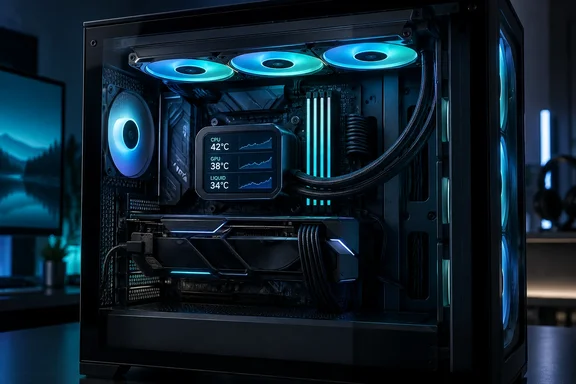
Corsair announced the Nautilus II AIOs and RS II fan family on September 17, with immediate availability. The company positions the range as its simpler, motherboard-controlled cooling line: standard PWM and ARGB connections are used instead of requiring an iCUE LINK hub or a proprietary controller. Independent coverage from ComputerBase confirms the pricing structure and points to the actual division in Corsair’s AIO catalog: Nautilus II targets the lower-cost end, while the more expensive Titan II line retains the larger premium display and iCUE LINK-first design.
For builders, this is a practical refresh rather than evidence of a major cooling breakthrough. Corsair has supplied no third-party thermal or acoustics testing with the launch, so claims that the FlowDrive 2S pump and revised cold plate produce better temperatures or lower noise remain vendor claims until reviewers test the hardware against the original Nautilus RS and competing 240 mm and 360 mm AIOs.
The LCD upgrade changes the installation requirements
The Nautilus II RS LCD moves from the previous generation’s round 2.1-inch, 480×480, 30 FPS IPS panel to a rectangular 3.5-inch, 480×640, 60 Hz IPS display. Corsair says the screen can show sensor data, iCUE widgets, GIFs, and content placed on its Windows desktop. ComputerBase reports that a DisplayPort passthrough bracket is included to route the connection from the graphics card out of the case.
That detail is the important qualification behind the “secondary display” feature. The LCD needs a spare DisplayPort output on the discrete GPU, not just an available internal USB header. A system already using every video output for monitors or a VR headset may need to rearrange its display cabling, use a different output arrangement, or forgo the LCD function. It also means the screen will appear in Windows display settings and must be positioned sensibly in the virtual desktop to prevent the cursor from disappearing onto a tiny panel inside the case.
This is a fundamentally different approach from the first Nautilus RS LCD. Corsair’s August 2025 announcement for that model described its display as an internal USB-connected component, and the company’s own comparison page confirms the earlier 2.1-inch, 30 FPS display used an internal USB 2.0 header. The new panel should offer smoother animation and more usable space for metrics, but its DisplayPort requirement trades internal-header simplicity for the flexibility of being a Windows-recognized display.
Corsair and ComputerBase also say the 3.5-inch LCD module will be sold separately for Nautilus II owners. The launch materials do not establish a U.S. price or a date for that standalone module, however. Existing first-generation Nautilus RS owners should therefore not assume the new screen is a drop-in upgrade for their coolers; the documented upgrade promise is for the new generation.
Nautilus II keeps motherboard control at the center
Corsair is selling six basic AIO configurations, each in 240 mm or 360 mm radiator sizes. The plain Nautilus II RS is black-only and has no RGB lighting. Nautilus II RS ARGB models are available in black or white, while the LCD models are also offered in both colors but use non-RGB radiator fans.
The U.S. list prices give the segmentation more clarity than the marketing language does:
- The Nautilus II 240 RS costs $89.99, while the 360 RS costs $109.99.
- The Nautilus II 240 RS ARGB costs $99.99, while the 360 RS ARGB costs $129.99.
- The Nautilus II 240 RS LCD costs $129.99, while the 360 RS LCD costs $159.99.
A 360 mm radiator is therefore a $20 upgrade in the black non-RGB line, $30 in the ARGB line, and $30 in the LCD line. The LCD adds $40 above the matching 240 mm ARGB model and $30 above the matching 360 mm ARGB model. In other words, buyers are paying primarily for the display hardware and its DisplayPort-based flexibility, not for a higher-spec cooling platform.
Corsair lists the 360 mm black Nautilus II RS at $109.99 in its U.S. store, a figure consistent with the launch price table. By comparison, ComputerBase places the 360 mm Titan II RX RGB at €169.90 and the 360 mm Titan II RX LCD at €229.90 in Europe. Regional prices cannot be directly converted into U.S. street pricing, but the structure makes Corsair’s intent clear: Nautilus II is meant to leave room below Titan II rather than replace it.
The trade-off is control architecture. Nautilus II connects through ordinary four-pin PWM and, where appropriate, standard ARGB motherboard headers. That is an advantage for builders who prefer BIOS fan curves, Fan Control, or motherboard utilities from ASUS, ASRock, Gigabyte, or MSI, and who do not want a USB controller consuming space, SATA power, and cable-routing effort.
Corsair’s iCUE software remains involved on the LCD model, but iCUE LINK integration is optional rather than included. A builder who wants to combine the Nautilus II or RS II fans with iCUE LINK gear needs Corsair’s separately sold Commander Duo controller and, for LINK devices, an iCUE LINK System Hub. The launch announcement calls this integration “easy,” but it is an add-on path, not a feature supplied in the box.
RS II’s biggest advance is mechanical, not a new fan class
The redesigned RS II and RS II ARGB fans are sold as individual 120 mm and 140 mm fans, plus 360 mm frames containing three 120 mm fans. The standalone price ladder begins at $14.99 for an RS120 II and $19.99 for an RS140 II. The three-fan RS360 II Unified Frame costs $39.99. ARGB versions list at $19.99, $24.99, and $54.99, respectively.
The 360 mm Unified Frame is the part most likely to matter during a build or later maintenance. Instead of installing three separate fans with four screws each, the whole assembly uses four screws. It also removes the cluster of fan-to-fan cables that usually runs along the radiator edge. Corsair says both 240 mm and 360 mm Nautilus II units receive this Unified Frame treatment, though the 240 mm version is naturally a two-fan assembly rather than a 360 mm frame.
Corsair’s comparison between the original Nautilus and Nautilus II shows why this should not be confused with a dramatic airflow redesign. The original 360 RS ARGB was rated for 13.3 to 72.8 CFM per fan and 0.20 to 4.15 mm-H2O static pressure. The Nautilus II 360 RS ARGB is rated for 10.8 to 73 CFM and 0.15 to 4.2 mm-H2O. The rated ceilings are extremely close, while the published noise range remains 10 to 36 dBA for both generations.
Corsair says revised AirGuide stator vanes improve acoustics and that the new fans retain Magnetic Dome bearings. Those may be worthwhile refinements, especially on a radiator where static pressure and turbulence matter, but the specification sheet alone does not demonstrate a clear performance lead. Builders replacing an operational first-generation Nautilus should wait for comparable noise-normalized testing rather than treating the “II” badge as a reason to swap coolers.
Socket support adds one notable Intel platform
The Nautilus II retains support for AMD AM4 and AM5, plus Intel LGA 1700 and LGA 1851. Corsair’s own comparison table adds Intel LGA 1954 to the new generation’s supported sockets, which is the only compatibility expansion listed over the older 360 RS ARGB. The radiator itself remains a conventional 27 mm thick aluminum unit with a copper cold plate, and 360 mm models retain 450 mm tubing.
Corsair says its thinner cold plate is optimized for AMD AM5 and designed to reduce thermal resistance. That does not mean the hardware is exclusive to AMD: the company continues to include Intel mounting hardware and explicitly lists the Intel sockets above. The most defensible reading is that Corsair has altered the contact and cold-plate design with current AMD processors in mind while preserving broad platform support.
The five-year warranty carries over across the Nautilus II AIOs and RS II fans. That is a useful baseline for a sealed liquid cooler, but it does not resolve the practical questions that matter more than the warranty length: pump behavior under sustained load, fan tonal character at midrange RPM, and whether the new mounting and unified-frame design are as serviceable in cramped cases as they appear in product renders.
Corsair has made the Nautilus II family easier to classify. Choose the base RS for a low-cost black build, RS ARGB for motherboard-controlled lighting, or RS LCD only when a spare DisplayPort output and a visible in-case display are worth the premium. The real test will come when independent benchmarks establish whether the FlowDrive 2S pump and RS II fans improve cooling or noise enough to make this more than a cleaner, better-connected refresh.
References
- (PR) CORSAIR Launches Updated Nautilus II AIO CPU Coolers and Upgraded RS II Fans TechPowerUp · 2026-09-17T19:42:07+00:00