

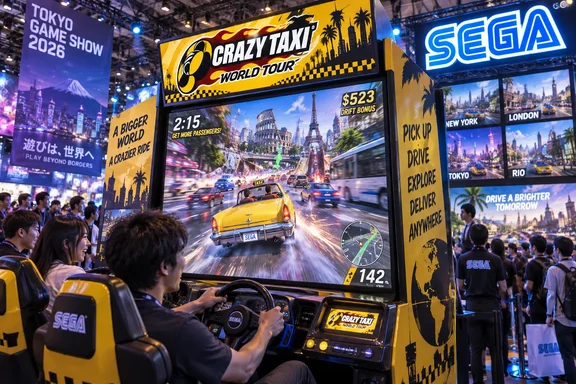
Notebookcheck reported that the game will be playable at the SEGA/Atlus booth in Hall 4-N01 at Makuhari Messe, Chiba. SEGA’s own Tokyo Game Show lineup confirms the demo, lists Xbox on PC and Steam alongside Xbox Series X|S, PlayStation 5, and Nintendo Switch 2, and says the booth will offer a wheel-equipped cabinet for players who request it in the standard demo line.
The important correction is timing: the playable Tokyo Game Show presence is not a brand-new September 16 reveal. Gematsu reported SEGA’s TGS lineup on August 27, including Crazy Taxi: World Tour as a demo title, while SEGA published its dedicated event product page earlier this month. What is newly useful is the clearer description of the demo format and the fact that the show opens immediately after SEGA’s closed multiplayer test ended on September 14.
That sequence makes Tokyo Game Show a meaningful checkpoint. SEGA has already tested its online modes with invited players; now it is putting the core driving experience in front of press, industry visitors, and the public before the game’s 2027 launch window.
The Tokyo Game Show demo is designed around driving feel
SEGA describes the booth version as an “arcade-style demo” played with a racing wheel. That is a more revealing setup than a trailer or a short stage presentation, because the franchise has always depended on immediate steering response, traffic readability, drift control, and the ability to recover from a near-miss without losing the flow of a run.
The company says World Tour builds on the series’ high-speed action and open-city driving, with Axel traveling around the world. The broader official game page promises stunts, missions, varied city terrain, a story mode, online multiplayer, and an option intended to recapture the original game’s arcade energy.
SEGA has not said whether the wheel setup at TGS uses a PC, console, or a custom arcade build. It also has not published supported wheel models, force-feedback details, steering-range options, controller-remapping information, or accessibility settings for the Windows version. Those omissions matter more than the existence of a show-floor cabinet: a polished event configuration does not establish what USB-wheel support will look like for Steam and Xbox on PC players at home.
The show demo can still answer several basic questions. Early footage and impressions should make clear whether the game’s driving is structured around compact score-chasing routes, longer open-world travel, scripted mission design, or some mixture of all three. That distinction will determine whether World Tour is a direct evolution of the original arcade formula or a larger action-driving game carrying the Crazy Taxi name.
The multiplayer test already exposed SEGA’s PC performance target
SEGA’s closed network test ran from September 12 through September 14 and included Xbox on PC and Steam, alongside console platforms. It focused only on online multiplayer, offering two maps, six vehicles, four playable drivers, and limited vehicle customization—not the full story campaign.
The test contained two multiplayer modes: Pickup Race, in which players compete to deliver passengers, and Cops ’N’ Cabbies, a taxis-versus-police mode. Both use Ranked Match and Custom Match options. SEGA characterized the test as an evaluation of multiplayer stability before launch and warned participants that the development build could contain bugs and performance issues.
More useful for Windows users were the provisional PC specifications attached to that test. SEGA listed Windows 10 as the minimum operating system and Windows 11 as recommended, with an SSD required at both levels. The minimum target was 1080p at low settings and 30 frames per second using hardware such as a Core i7-8700K or Ryzen 5 2600, 12GB of RAM, and a GeForce GTX 1060 6GB or Radeon RX 580 4GB. The recommended target was 1080p at high settings and 60 fps with a Core i7-12700K or Ryzen 7 5700X, 16GB of RAM, and a GeForce RTX 4060 8GB or Radeon RX 6700 XT 12GB.
Those requirements should be treated as a test-build baseline, not final retail requirements. SEGA explicitly says they may change before release. Still, the gap between its 30 fps minimum target and its 60 fps recommendation is worth noting: this does not appear to be a lightweight retro throwback that will run comfortably on every aging office PC with an entry-level graphics card.
The 12GB memory minimum is also unusual enough to deserve attention. PCs with 8GB of RAM remain common among people keeping older systems alive for less demanding games, and an SSD-only requirement reinforces that World Tour is being designed around modern asset streaming rather than the small, self-contained levels of the Dreamcast-era titles.
What TGS can—and cannot—tell PC players
Tokyo Game Show runs from September 17 through September 21. The first two days are business days; the public can attend from Saturday, September 19 through Monday, September 21. SEGA’s schedule includes a Crazy Taxi: World Tour “Mission Challenge” on September 17 and a demo playthrough stage presentation on September 19.
Those events may produce gameplay footage and direct observations of the game’s mission structure, driving camera, interface, traffic density, and stunt systems. They may also show whether Axel’s global journey is divided into distinct city maps or joined through a more continuous world structure. Notebookcheck’s report describes five global cities and a plot involving a masked crew that stole Axel’s taxi, but SEGA’s current English TGS page is less specific, saying only that Axel journeys across the world.
That is not a contradiction, but it is a reminder to separate announced marketing language from demonstrated content. SEGA has confirmed that the game has a story and online modes. It has not yet detailed the complete campaign structure, the number of cities on the official event page, the final multiplayer progression model, matchmaking regions, cross-play limitations, anti-cheat measures, or whether ranked play will support input-based matchmaking.
Those unanswered questions are especially relevant for the PC release. Cross-platform multiplayer can keep a racing game’s population healthy after launch, but only if the matchmaking and networking implementation is stable enough to avoid turning speed-sensitive races into a latency contest. The closed test was designed to gather data on that problem, yet SEGA has not published results, player counts, known issues, or planned fixes from the September test.
The public demo follows a different kind of validation
The closed network test and the Tokyo Game Show demo are testing different risks. The network test targeted server stability and multiplayer behavior under real player load. The show-floor demo is more likely to test the first impression: whether a player can step up, understand the objective, make aggressive turns through traffic, and leave wanting another run.
For a series that began in arcades in 1999, that second test is not trivial. Crazy Taxi succeeded because its rule set could be understood almost immediately, while high-level play rewarded route knowledge and risky driving. A modern campaign, global settings, multiplayer races, customization, and ranked matchmaking all add scope. They also create opportunities to bury the simple feedback loop that made the original game memorable.
SEGA’s decision to make the TGS demo playable with a racing wheel signals that it understands the value of a tactile, cabinet-like first impression. But PC players should resist treating a good booth demo as confirmation of a complete PC feature set. Windows performance, graphics scaling, ultrawide support, Steam Deck compatibility, wheel compatibility, input latency, and online service reliability remain unannounced.
For now, the firm facts are narrower: Crazy Taxi: World Tour is coming to Xbox on PC and Steam in 2027; it has already held a limited cross-platform multiplayer test; and Tokyo Game Show visitors will be able to try a wheel-based demo before the public days begin on September 19. The impressions from that demo should provide the first real indication of whether SEGA has preserved the driving game beneath the expanded world-tour pitch.
References
- Crazy Taxi: World Tour confirmed playable at Tokyo Game Show 2026 Notebookcheck · 2026-09-16T10:22:00+00:00