

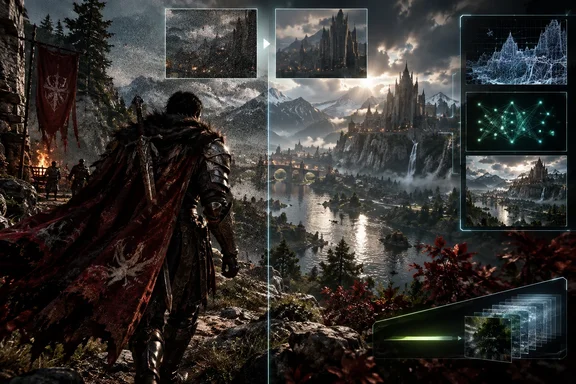
Wccftech first highlighted the graphics change alongside the patch’s quest, combat, Photo Mode, and new-game fixes. Pearl Abyss’s own September 18 patch notes confirm it, and also clarify the rollout position that matters to players choosing a platform: the update is available now on Steam, Epic Games Store, PlayStation, and Xbox, while the Mac App Store edition remains listed as in progress.
For PC users, this is a real visual-quality update, but it is also a narrower change than the version number suggests. Ray Reconstruction remains an optional NVIDIA RTX feature, and Pearl Abyss has not published comparative images, performance data, a driver requirement, or a list of presets where the new model makes the largest difference.
What the new Ray Reconstruction model changes
DLSS Ray Reconstruction replaces conventional hand-tuned denoisers in a ray-traced rendering pipeline with an AI model. Ray tracing in a game cannot generally afford to trace every possible light path for every pixel in real time, so the raw result needs reconstruction and denoising before it becomes the image on screen. The quality of that reconstruction affects reflections, shadows, indirect lighting, fine surface detail, and how reliably those elements hold together while the camera moves.
NVIDIA has described its Transformer-based DLSS models as improvements to temporal stability, moving detail, and lighting quality. In practice, the most useful improvement is often not a frame that looks sharper when paused. It is a reduction in the artifacts players notice while playing: flickering around reflective surfaces, unstable fine geometry, smeared lighting detail, or a noisy image in motion.
Pearl Abyss specifically says Crimson Desert’s update applies the latest Transformer model to DLSS Ray Reconstruction, rather than to DLSS Super Resolution or Frame Generation. Those are separate features with different jobs. Super Resolution renders at a lower internal resolution and reconstructs an output image; Frame Generation inserts AI-generated frames to raise displayed frame rates; Ray Reconstruction handles the cleanup and reconstruction of ray-traced effects.
That distinction rules out an easy but incorrect conclusion: patch 2.03.00 does not, on its own, mean Crimson Desert has received new Frame Generation modes, a broader RTX GPU support range, or better performance. The game may look better with its existing ray-tracing setup, but Pearl Abyss has not claimed that the patch lowers the substantial GPU cost of running it.
Streamline 2.14.1 is not a blanket DLSS feature update
NVIDIA Streamline is the integration layer developers use to connect a game engine to features such as DLSS, Reflex, and image-scaling technologies. Updating it can bring new libraries, fixes, or feature support into a shipped game, but the version number alone does not describe the player-visible result.
NVIDIA’s public release record for Streamline 2.14.1 lists support for V-Sync and frame-rate limiters in Dynamic mode for DLSS Multi Frame Generation, support for the Vulkan low-latency extension, plus bug fixes and stability work. It does not separately call out a new Ray Reconstruction model in its short release summary. Pearl Abyss’s patch notes are therefore the operative record for what changed in Crimson Desert: the studio explicitly says its build is using the latest Transformer model for Ray Reconstruction.
That is not necessarily a contradiction. SDK release summaries often emphasize framework-level changes while a shipped game’s bundled components and enabled configurations determine what players receive. But it does mean players should avoid assuming that every feature mentioned in NVIDIA’s 2.14.1 release applies to Crimson Desert. Pearl Abyss did not announce Dynamic Multi Frame Generation changes, Vulkan changes, or new graphics-menu options with this patch.
The practical takeaway is straightforward: if you already play Crimson Desert with ray tracing and Ray Reconstruction enabled, patch 2.03.00 is worth installing and retesting in scenes where image instability was most visible. If Ray Reconstruction was disabled because the performance hit was too steep, this patch gives no evidence that enabling it will now be practical on the same hardware.
The patch also fixes visible rendering and control issues
The Ray Reconstruction refresh is the headline for PC graphics enthusiasts, but the surrounding fixes are more useful than the patch’s “various bug fixes and stability improvements” label implies. Pearl Abyss says it corrected a case where visual noise on armor was particularly noticeable indoors, an issue that could be confused with a ray-tracing or denoising artifact even though the studio lists it separately from the graphics SDK update.
Patch 2.03.00 also fixes abnormal horse appearance after certain bardings are equipped, UI text jitter during scrolling, and incorrectly displayed UI text. Those are small repairs, but together they make this a broader presentation cleanup rather than a single NVIDIA middleware update.
Photo Mode receives a new “Precise Movement” option for finer camera positioning. That feature gives screenshot-focused players more control over composition, and it may make the Ray Reconstruction comparison easier to inspect in static captures. Still, screenshots alone are not the best test for the Transformer update: ray reconstruction is meant to improve the consistency of a moving ray-traced image, so a repeatable camera pan or gameplay sequence is more useful than a single frozen frame.
The game’s Water Stride ability now permits jumping, and it permits sliding when Vaporwalker is equipped. Pearl Abyss also addressed a failed combat behavior in which enemies knocked back in certain situations would not fall from cliffs, plus excessive fall damage after dismounting from A.T.A.G. while in midair. These are conventional gameplay corrections, but they matter for anyone returning to an existing campaign to evaluate the graphics changes.
New-game compensation acknowledges a rougher restart path
Patch 2.03.00 changes what happens when players begin a new game from existing save data. Pearl Abyss says players will receive 1,000 or more Silver as stackable Silver Pouches, reducing the early money grind during a restarted playthrough. The wording does not say that equipment, collectibles, or overall progression are carried into that new game, and the patch notes should not be read as a general new-game-plus system.
This is a limited compensation rather than a solution to the broader restart friction identified by Wccftech. The game gives returning players a financial cushion, but there is no announced mechanism in the patch notes for restoring the full set of gear found in a prior run. Players preparing for the forthcoming Charting the Unknown expansion should therefore check exactly what their save path requires before wiping or replacing a completed file.
Pearl Abyss has scheduled Charting the Unknown for October 15, 2026, at 22:00 UTC, which is 6:00 p.m. Eastern and 3:00 p.m. Pacific. The company has also said the expansion will not be available on the Mac App Store at launch. Patch 2.03.00’s own delayed Mac availability means Mac players face two separate wait states: the base-game patch is still in progress there, and the DLC has no Mac launch commitment.
What PC players should test before the expansion
The absence of a benchmark, driver recommendation, or formal image-quality comparison leaves the testing burden with players. That is especially relevant for a game whose RT implementation can already demand a powerful GPU: a better model can improve image quality while still increasing or preserving the cost of the rendering path.
A sensible test is to use the same display resolution, DLSS mode, ray-tracing preset, and scene before and after the update, then watch for stability rather than chasing a single average frame-rate number. Reflections, foliage, hair, particle-heavy combat, interiors with complex lighting, and water tend to expose reconstruction quality more clearly than open, static daylight scenes.
Players should also leave DLSS options at the game’s supported settings rather than treating this patch as an invitation to swap graphics DLLs manually. Pearl Abyss has delivered a tested game build around Streamline 2.14.1; replacing bundled components can complicate troubleshooting and makes any visual or stability comparison meaningless.
Patch 2.03.00 is a modest release, but the DLSS Ray Reconstruction update gives it a specific PC purpose: it refreshes the image-quality path for players already willing to pay the performance cost of ray tracing. With Charting the Unknown due in less than a month, the concrete result is a better time to validate an RTX configuration now—before the expansion adds new environments and potentially raises the visual workload again.
References
- Pearl Abyss Sharpens Crimson Desert’s Ray Tracing, as Patch 2.03.00 Brings NVIDIA DLSS Ray Reconstruction Improvements Wccftech · 2026-09-18T09:23:13+00:00