

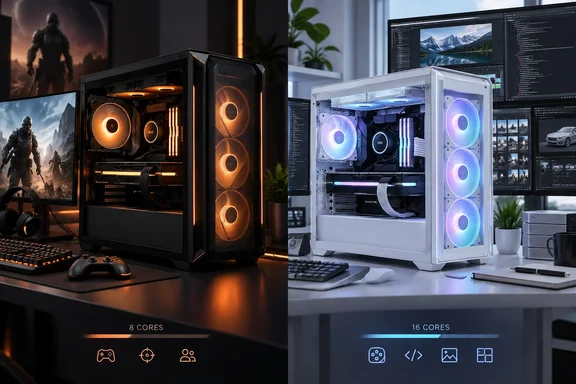
ThePCEnthusiast reported the pair on September 26, 2026. Here is what's in each box, what isn't specified, and who should buy which.
The Two Configurations
Both systems come with an AMD B850 motherboard, liquid CPU cooling, an RTX 5080 with 16GB of memory, and Windows 11 Home. Each also includes Wi-Fi 6, Bluetooth 5.3, a keyboard and mouse, a one-year parts-and-labor warranty and lifetime technical support.
| Specification | Ryzen 7 configuration | Ryzen 9 configuration |
|---|---|---|
| Model | SLC8800A6 | SLCAI21000A3 |
| Processor | Ryzen 7 9850X3D | Ryzen 9 9950X3D2 |
| Cores / threads | 8 / 16 | 16 / 32 |
| L3 cache | 96MB | 192MB |
| Graphics | RTX 5080 16GB | RTX 5080 16GB |
| Memory | 32GB DDR5 | 64GB DDR5 |
| Storage | 2TB PCIe 4.0 SSD | 4TB PCIe 4.0 SSD |
| Chipset | AMD B850 | AMD B850 |
| Chassis | Black | White panoramic, RGB |
| Reported U.S. price (Sept. 26, 2026) | $3,399.99 | $4,599.99 |
A retail listing for the Ryzen 9 model matches the headline specs. It shows "AMD Ryzen 9 9950X3D2 4.3GHz 16 Cores | AMD B850 Chipset | 64GB DDR5 | 4TB PCIe 4.0 NVMe SSD | Windows 11 Home". The same listing gives the video outputs as one HDMI port and three DisplayPort outputs. For other connections it lists two USB-C 3.2 ports, three USB-A 3.2 ports, three USB-A 2.0 ports, wired LAN and 7.1-channel audio.
Treat the prices as a snapshot from September 26, 2026. Prebuilt pricing on Amazon changes often, so check the listing before you buy.
Section summary: The only differences are the CPU, the amount of RAM and storage, and the case. The graphics card is exactly the same.
What CyberPowerPC Doesn't Tell You
Neither configuration names the exact motherboard, the graphics card maker, the power supply or the liquid cooler. Like most system builders, CyberPowerPC may swap in different brands or models depending on supply, unless a part is explicitly listed. You're buying the advertised core specs. The supporting parts aren't guaranteed.
For the Ryzen 9 model, this matters more than usual:
- Cooling: The 9950X3D2 has a TDP of 200W, which is 30W more than the 9950X3D, making it the most power-hungry desktop consumer chip from the company. According to Corsair, AMD has recommended a 360mm AIO for this CPU, whereas the 9950X3D called for just a 240mm. The listing only says "liquid cooling" and gives no radiator size, so you can't tell from the listing whether this system meets AMD's recommendation.
- Power headroom: Puget Systems notes that the chip's maximum socket power (PPT) increases even more, to 270 W: a full 70 W, or 35%, more than the 9950X3D's 200W. Combine that with an RTX 5080, and the PSU's wattage and quality become important. That's especially true if you plan to upgrade the GPU later.
Our advice: When the system arrives, check the cooler's radiator size and the PSU label. Then watch CPU temperatures in a monitoring tool during a long render or a heavy gaming session. If the chip hits its thermal limit and clocks drop, part of the $1,200 upgrade is being lost.
Ryzen 9 9950X3D2 vs. Ryzen 7 9850X3D
AMD announced the Ryzen 9 9950X3D2 Dual Edition as its newest flagship and the world's first desktop CPU that stacks 3D V-Cache across both CCDs. StorageReview explains the layout: each CCD combines 32MB of traditional 2D L3 cache with a 64MB 3D V-Cache stack, giving both CCDs an identical 96MB L3 pool. That adds up to 192MB. According to TechPowerUp, the chip runs at 4.30 GHz base with up to 5.60 GHz boost. Corsair lists the retail CPU on its own at $899.
The Ryzen 7 9850X3D also boosts to 5.6GHz. It has 8 cores, 16 threads, 96MB of L3 cache and a 120W TDP. AMD's own spec sheet lists 104MB of "total cache," which includes L2. That figure isn't a contradiction; it just counts more than L3.
The Ryzen 9 has twice the cores and twice the L3 cache. That does not mean twice the gaming performance. AMD's own claims for the chip are modest. Tom's Hardware reported AMD's figure as a touted 5~ 10% performance boost over the Ryzen 9 9950X3D, and that comparison is against its sibling chip, not the 9850X3D. Notebookcheck noted that AMD is positioning the Ryzen 9 9950X3D2 as an AI productivity chip, not a gaming beast.
There's also a Windows-specific wrinkle. Older dual-CCD X3D chips like the 9950X3D put stacked cache on only one chiplet, so Windows had to steer games to the right cores. The 9950X3D2 puts cache on both chiplets, which removes most of that problem. Even so, TechPowerUp found that AMD's chipset driver still uses Game Bar to park CCD1 cores during gaming. If you buy the Ryzen 9 model, keep AMD's chipset driver up to date. Don't strip out Xbox Game Bar in a Windows 11 debloat pass until you know what it does on your system.
Section summary: The 9950X3D2 is a better workstation chip that also games very well. For gaming alone, it isn't a big step up.
How Fast Is the RTX 5080?
In ThePCEnthusiast's earlier 13-game GPU test suite, the RTX 5080 averaged 193 FPS at 1440p and 115 FPS at 4K. The site's comparison averages were:
| GPU | 1440p avg. | 4K avg. |
|---|---|---|
| RTX 5090 | 233 FPS | 169 FPS |
| RTX 5080 | 193 FPS | 115 FPS |
| RTX 5070 Ti | 168 FPS | 98 FPS |
| RTX 5070 | 138 FPS | 78 FPS |
| RTX 5060 Ti 16GB | 102 FPS | 56 FPS |
Two caveats apply:
- These numbers come from the publication's earlier graphics card testing. Neither CyberPowerPC desktop was benchmarked.
- Averages alone don't show the game list, graphics presets, or whether ray tracing, upscaling or frame generation was on. Your results will depend on the whole system, your settings and cooling.
With those caveats, the conclusion is simple. In GPU-heavy games, especially at 4K, both desktops should perform about the same, because the RTX 5080 sets the limit. The Ryzen 9 may pull ahead in some CPU-heavy games, mostly at lower resolutions and high frame rates. How much depends on the game.
The Local AI Question
The Ryzen 9 model's product code includes "AI," and it's pitched partly at AI work. Its 64GB of system RAM and 16 cores do help with CPU-heavy tasks, large datasets and running many apps at once. But both machines have the same 16GB of VRAM on the RTX 5080. Extra system RAM does not add GPU memory.
How large a model fits entirely on the GPU depends on the model's architecture, its quantization, the runtime and whatever else is using VRAM. Doubling system RAM doesn't change that limit. Someone serious about running large local models might get more from a GPU with more VRAM than from a bigger CPU.
Which One Should You Buy?
Choose the $3,399.99 Ryzen 7 model (SLC8800A6) if:
- You mostly game, at 1440p high refresh rates or at 4K.
- You stream or do light content creation. The 32GB of RAM and eight-core chip handle that easily.
- You'd rather spend $1,200 on a better monitor, a larger second SSD or a faster GPU later.
Choose the $4,599.99 Ryzen 9 model (SLCAI21000A3) if:
- You regularly edit video, render in 3D, compile large codebases or run several heavy apps at once.
- You'll actually use 64GB of RAM and 4TB of storage.
- You want one Windows 11 machine for both gaming and serious work.
A rough value check: the Ryzen 9 model adds 32GB of DDR5, 2TB of storage and a pricier CPU. Retail prices for those parts cover some of the $1,200 gap. The rest pays for the processor upgrade, the white panoramic case and the RGB lighting. This is our reading of the spec sheet, not a measured price-to-performance result.
Bottom Line
These two desktops show a common problem with prebuilt PCs. The price goes up a lot while the part that matters most for gaming, the graphics card, stays the same. For most gamers, the Ryzen 7 9850X3D model is the better buy: same RTX 5080, $1,200 cheaper. The Ryzen 9 9950X3D2 model makes sense for buyers whose daily work needs 16 cores and 64GB of RAM. Those buyers should also check the cooler and power supply once the box arrives.
Neither system has been independently benchmarked as a complete build, and the key supporting parts aren't named. Reviews of the full systems would tell buyers more than the spec sheet does.
References
- CyberPowerPC's New RTX 5080 Gaming PCs Pack AMD's Flagship X3D - ThePCEnthusiast ThePCEnthusiast · 2026-09-26T15:24:49+00:00