

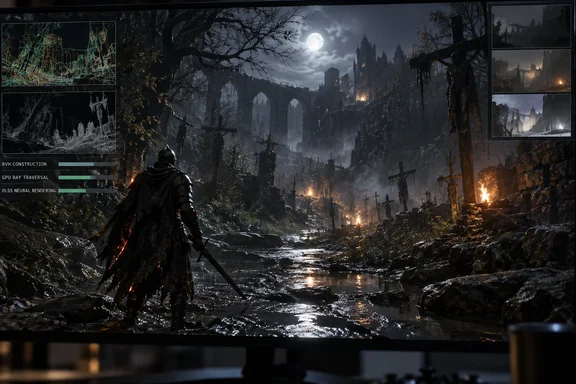
Wccftech’s September 18 report highlighted the new showcase and described it as running with NVIDIA DLSS 5 alongside path tracing. Ganaboy’s public project material, GitHub issue tracker, and recent posts for the Dark Souls Lighting Engine confirm that a Dark Souls III edition is being built. They also show that compatibility with the game’s online and Seamless Co-op modes remains untested, while the promised performance profile is based on comparisons with the older Dark Souls II Lighting Engine rather than a published Dark Souls III benchmark suite.
For Windows players deciding whether to revisit FromSoftware’s 2016 PC release, that changes the immediate conclusion. DS3LE-PT is not available yet, it does not have final requirements, and the preview should not be read as evidence that a midrange gaming PC will run the finished mod well.
A renderer conversion rather than a visual preset
The project is called Dark Souls III Lighting Engine, or DS3LE, and its path-traced mode seeks to replace much of the original game’s pre-authored lighting behavior with physically modeled light transport. Path tracing traces many possible paths for light through a scene, allowing indirect illumination, reflections, shadows, and emissive surfaces to affect each other in ways the original DirectX 11 renderer was never designed to calculate in real time.
That requires more than swapping in higher-resolution textures or applying a shader filter. Ganaboy says more than 80% of the game has been added to a bounding volume hierarchy, or BVH, the spatial data structure a ray tracer uses to determine what rays hit without testing every object in a level. The stated 3 GB to 4 GB installation estimate—roughly ten times the geometry footprint cited for the Dark Souls II version—illustrates why the mod is better understood as a substantial renderer-side conversion.
This is also why screenshots can mislead. A path-traced scene can gain convincing soft shadows, bounce light through foliage, and give stone, water, and fog different visual weight. Yet it can also expose compromises hidden by the original fixed lighting. The author says DS3LE will use artificial lights in “worst-case” areas and plans post-processing and lighting changes as testing continues. Those are not incidental tuning knobs; they are the mechanisms that prevent a technically accurate lighting pass from making a deliberately authored game unreadable or unpleasant to play.
The project’s stated approach to torches makes the tradeoff explicit. Dark Souls II’s Lighting Engine gave torch mechanics a higher priority, according to Ganaboy’s FAQ. Dark Souls III’s default path-traced setup will not require a torch for progression, even where its lighting otherwise might suggest darkness. In other words, the mod is optimizing for a workable modern lighting presentation, not attempting to restore every gameplay implication of real darkness.
The DLSS 5 claim needs a narrower reading
NVIDIA introduced DLSS 5 in March 2026 as a neural-rendering system that uses a game’s color and motion information to add AI-generated lighting and material detail. NVIDIA subsequently launched the feature with NBA 2K27 in early September on GeForce RTX 50-series hardware and GeForce NOW. That is a much more ambitious function than conventional DLSS Super Resolution, which primarily reconstructs a higher-resolution image from a lower-resolution render.
Wccftech says the Crucifixion Woods showcase uses DLSS 5 before upscaling to reduce the cost of the path-traced presentation. Ganaboy has separately described DLSS 5 neural-rendering integration as work in progress for the Dark Souls II project, saying its cost was roughly 4–5 milliseconds on an RTX 5080 at 960p in one configuration. Those figures should not be treated as a Dark Souls III performance promise: they are from a different game, a particular GPU, and an early integration path.
There is a more immediate complication. In a recent public reply, the Dark Souls Lighting Engine account said that images it had shown for DS3LE path tracing were without DLSS 5 and would continue to be shown that way. That does not necessarily disprove that the latest video contains an experimental DLSS 5 pass; it may reflect a distinction between the creator’s still-image posts and a separate video configuration. But neither Wccftech nor the available public project information identifies the exact build, GPU, render resolution, DLSS 5 settings, or comparison methodology used in the new footage.
The distinction is important because DLSS 5 can change what the player sees, rather than merely accelerate the original render. A scene presented with path tracing plus neural rendering is not a clean measure of the path tracer alone. Until Ganaboy publishes like-for-like captures—native path tracing, conventional DLSS Super Resolution, and DLSS 5 at the same output resolution—viewers cannot separate the contribution of the lighting-engine work from NVIDIA’s neural post-processing.
That is not a criticism of showing a technically ambitious configuration. It is a warning against calling the result a straightforward Dark Souls III “remaster” preview. The finished mod may offer multiple rendering choices, and its default mode has not been established.
RTX owners will have options, but not an easy hardware answer
Ganaboy says the project will support AMD cards capable of ray tracing as well as NVIDIA hardware. That is meaningful because the Lighting Engine’s core path-tracing work is not presented as an RTX-only feature. But “supported” and “comfortable to run” are separate questions, particularly for a game whose original recommended GPU was a GeForce GTX 970 or Radeon R9-class card.
The creator’s FAQ says Dark Souls III performance should resemble Dark Souls II Lighting Engine despite the large geometry increase. The practical comparison offered is revealing: a player who used DLSS Quality mode in the Dark Souls II mod should expect to use Balanced mode in Dark Souls III. Balanced renders from a lower internal resolution than Quality, improving frame rate at a greater risk of reduced image detail and instability.
That is a sensible expectation setter, but it is not enough to establish hardware tiers. There are no confirmed frame-rate targets, no 1080p, 1440p, or 4K results, no minimum VRAM figure, and no indication of how performance changes in notoriously dense or effects-heavy areas. The author recommends NRD-SH, an advanced denoiser, as the default because NVIDIA Ray Reconstruction carries a heavy penalty on RTX 20- and RTX 30-series cards. That makes the likely reality clear: older RTX owners may be able to run the mod, but the premium denoising path may be impractical.
Windows gamers should also distinguish DLSS Super Resolution from DLSS 5 when considering an upgrade. The former is widely useful across RTX generations. DLSS 5’s initial deployment has centered on RTX 50-series hardware, and Ganaboy has not committed to a final DS3LE feature matrix. Buying hardware specifically for an unreleased mod would be premature.
Mod-loader support does not settle the multiplayer risk
Ganaboy says DS3LE will work with UXM, Mod Engine 2, and Mod Engine 3. For experienced Dark Souls III modders, that is the most concrete installation news so far. UXM is used to unpack and modify game files, while Mod Engine routes mod content without directly replacing the base installation in the same way.
The project’s published installation instructions already list a current Steam copy of Dark Souls III and either Mod Engine 2 or UXM as prerequisites for its Dark Souls III Lighting Engine materials. Those instructions show that the author expects a conventional PC modding workflow, not a standalone installer that can be safely applied without preparation.
The unresolved part is multiplayer. The developer says online and Seamless compatibility are untested and offers no definitive answer. Dark Souls III remains sold with co-op and PvP features on Steam, so this is not a theoretical concern for players who regularly summon, invade, or use community multiplayer tools.
Until that testing is complete, the prudent assumption is that DS3LE path tracing belongs in an offline setup. Players should keep a clean game installation or a reversible mod profile, avoid assuming that graphical changes are invisible to online integrity systems, and watch for explicit compatibility guidance from the project rather than treating loader support as a green light for networked play.
The release target is useful, but it is not a launch date
The author’s current target is the end of the year, with a later public reply expressing confidence in an “actual Christmas” availability. That puts a potential release in late 2026, not on a confirmed day and not with a published download, pricing model, hardware table, or final feature list.
The independent value of the latest showcase is that it demonstrates the project is progressing beyond a one-off technical experiment: the lighting engine has a public issue repository, installation documentation, Dark Souls III loader support in its planning, and a stated geometry-conversion milestone. The limitation is equally clear. The polished video is a development showcase, not a release candidate.
For now, Dark Souls III players should treat DS3LE-PT as a major mod worth tracking rather than a graphics update ready to install. Its eventual appeal will depend less on whether Crucifixion Woods can look like a current-generation remake in a curated clip, and more on whether Ganaboy can publish stable presets, credible performance data, and safe guidance for the game’s still-active online audience before the year closes.
Update: Gameplay build details identify RTX 5080 and 1440p DLSS Quality testing (September 20, 2026)
According to ixbt.games, Ganaboy’s Crucifixion Woods gameplay capture was recorded on a PC with a Ryzen 5 3600, GeForce RTX 5080, and 16GB of RAM. The game reportedly ran at 1440p with DLSS Super Resolution set to Quality.
That fills in several technical gaps left by the earlier showcase, but it should not be read as a finished-mod benchmark. ixbt.games also reports that the DLSS 5 pipeline uses NRD denoising before neural rendering, then applies DLSS Super Resolution for upscaling. In practical terms, the footage represents a layered rendering configuration rather than path tracing performance in isolation.
The report reiterates the projected 3GB–4GB mod size and Ganaboy’s expectation that performance will be broadly comparable to DS2 Lighting Engine. It still does not provide frame-rate data, internal render resolution, GPU utilization, or results on other RTX generations or AMD hardware, leaving Windows players without a reliable hardware recommendation.
References
- FromSoftware’s Dark Souls 3 Gets Next-Gen Leap With Path Tracing and NVIDIA DLSS 5, As New Video Showcases Remake-Level Visuals Wccftech · 2026-09-18T14:45:30+00:00
- Modder Improves Dark Souls III Graphics - Shows Gameplay with Path Tracing and DLSS 5 - ixbt.games ixbt.games · 2026-09-19T19:50:31+00:00