

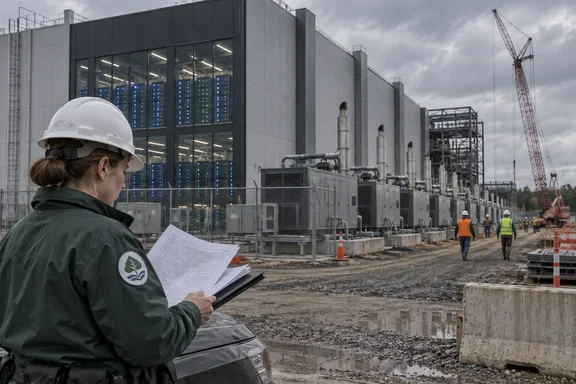
New Jersey DEP's $1.07 Million Order Against DataOne's Vineland Data Center
The basic facts are consistent across local and national coverage. The New Jersey Monitor reports that state inspectors visited DataOne's facility on July 29 and discovered 62 1,982-kilowatt generators that had not been there during their last inspection in December. The generators were not permitted, and the firm's failure to get needed permits — required of any generator with a capacity of 37 kilowatts or higher — violated the New Jersey Air Pollution Control Act, and the department levied a $1.07 million fine.
WHYY, the Philadelphia Inquirer and regional outlets confirm the same core findings. According to the Inquirer, state officials say DataOne, a French company that is building the Cumberland County facility, installed and operated 62 large natural-gas power generators without the required DEP permits. Headline figures vary between "$1 million," "$1.1 million" and "$1.07 million." All of them describe the same penalty, and $1.07 million is the exact amount.
DEP Commissioner Ed Potosnak described it as a record. He called it "by far the largest ever taken against a data center in New Jersey and possibly one of the largest such actions in the nation", and said it "sends a clear message that these facilities will not be constructed or operated with impunity in this state". His claim of a New Jersey record is firm. His claim about the rest of the country is more careful: "possibly."
62 Generators at 1,982 kW Each Dwarf New Jersey's 37 kW Permit Threshold
The size of the power installation explains why the state treated this as a serious matter. WHYY notes that the state's Air Pollution Control Act requires facilities installing generators with 37-kilowatt capacity or higher to obtain a preconstruction permit and valid operating certificate. Each DataOne unit is rated at 1,982 kW. As Ars Technica noted, that is more than 50 times higher than the state limit.
Multiplied across the fleet, 62 units at 1,982 kW comes to about 122.9 megawatts of nameplate on-site generation. That figure is our own calculation from the state's per-unit rating. It is not a measurement of how much power the site actually drew, and aerial evidence suggests not every unit ran at once.
The permitting requirement exists because of what these engines emit. According to the DEP, natural gas generators emit carbon dioxide, nitrogen oxides, carbon monoxide and other pollutants. No public source has published measured emissions or air-quality readings for the neighborhood around the Vineland site. Local advocates say the lack of permits is part of the problem. Matt Williams of Sustain South Jersey noted that the lack of permits leaves no paper trail to measure the generators' actual impact.
The 45-Day Deadline Is a Permit Clock, Not an Immediate Shutdown
"Shutdown deadline" headlines make this sound more drastic than it is. The New Jersey Monitor reports the state ordered the company to get the permits within 45 days or cease operations. The order is about the unpermitted generators. It does not shut down the data center, and it does not end DataOne's construction permits.
The generators also do not have to go quiet while the clock runs. Ars Technica reports that DataOne was given 45 days to apply for the permits or else cease operations, but they can continue operating the gas engines while seeking permits. Local critics object to exactly that. Nichole Gardner, co-chair of the local group Sustain SJ, told Ars that the site "should be made to discontinue operations during the 45-day period until the proper permits are issued."
The practical result depends on what happens with DataOne's permit applications, which the company says it will file. Counting from the September 22 announcement, 45 days ends in early November 2026. The exact trigger date depends on the wording of the administrative order, and that document has not been widely published.
How Microsoft's Copilot Capacity Ended Up on a Vineland Construction Site
The Microsoft connection comes through a contract chain, and each company plays a separate role. The Inquirer reports that while DataOne is the owner, operator, and builder, the Amsterdam-based Nebius Group will operate the center's internal equipment, which will fuel Microsoft's AI tools. Microsoft does not own or operate the site, and the DEP penalty names DataOne.
The workloads are specific. DataOne CEO Charles-Antoine Beyney told the Asbury Park Press last year that the facility will primarily run AI operations like Microsoft's Copilot software. The contract behind the site is large. The New Jersey Monitor reports that Nebius Group, which is based in Amsterdam, made a $17.4 billion deal with Microsoft last year to operate the 587,980-square-foot campus through 2031. A 2025 Seeking Alpha analysis gave the same figure, describing a $17.4B, five-year GPU infrastructure contract with Microsoft for its Vineland, NJ data center. Some outlets round it to $17 billion. Tom's Hardware used a larger $33 billion figure for the Microsoft–Nebius relationship, but the Vineland-specific contract is consistently reported at about $17.4 billion.
Descriptions of the campus's size vary by source and by build stage. According to the New Jersey Monitor, the "AI factory," which will include 14 "data halls" and have a maximum capacity of 350 megawatts, is expected to be done in late December. WHYY describes the 300-megawatt data center, with its initial phases already approved and under construction. The 300 MW figure matches the initial project announcement. The 350 MW figure is the planned maximum.
Microsoft has not said much. When Floodlight, a nonprofit climate newsroom, first reported the generators in August, it noted that Nebius did not respond to requests for comment by publication. Microsoft declined to comment.
Drone Footage and Resident Complaints Got There Before New Jersey Regulators
The DEP's July 29 inspection was the official finding. Journalists and residents had found the generators earlier. Floodlight, reporting with The Guardian, published thermal drone footage in late August showing the partly completed DataOne facility in Vineland was operating at least 45 of the site's 62 generators at the time. A DEP spokesperson told Floodlight that the agency "has issued no permits, nor are any permit applications under review for power generators at the DataOne facility in Vineland."
Floodlight's reporting also indicates the generators may have been running long before July. The outlet said the facility is relying on the unpermitted gas generators, the first of which appear to have been turned on in October, according to maintenance logs. It also cited thermal imagery from a data intelligence firm that appears to show 25 of the unpermitted gas generators operating in late June. These are Floodlight's findings. The state's penalty is based on its own July inspection.
The generators were also an interim fix after a failed permit attempt. Floodlight reported that DataOne originally submitted a permit application for more than 30 Bergen gas-burning engines, which are commonly used to propel cruise ships. Regulators found deficiencies, and DataOne withdrew the application in May and instead now plans to rely on an array of Bloom fuel cells capable of producing 300 megawatts.
Residents had raised concerns months before the enforcement action. According to Ars Technica's summary of New York Times reporting, Sustain SJ founder Zac Landicini spoke at a February town hall after a "farmer first spotted 'some type of unit' on satellite imagery" of the site. The generator fine also comes on top of other disputes. The New Jersey Monitor reports neighbors suing DataOne over noise, and SNJ Today notes that city officials in Vineland issued stop-work orders last month after crews began building a liquefied natural gas tank and fuel cell units before securing permits. Tom's Hardware reports residents describing a 1.5-million-gallon LNG tank and nighttime noise affecting homes within about half a mile. The DEP penalty does not settle those separate complaints.
DataOne's Fuel-Cell Plan and the Limits of a Million-Dollar Fine
DataOne disputes how the state categorized the generators but says it will apply for the permits. Spokesperson Naomi Race told the New Jersey Monitor that "we are transitioning to low-emission, quiet fuel cells as part of the site's permanent power solution and have the necessary approvals in place for this solution." She added: "While we disagree with the temporary generator determination, we will apply for the air permits for the temporary generators and are in communication with the Department of Environmental Protection regarding its findings and the fuel cell transition timeline."
Fuel cells would reduce some of the problems. Floodlight explains that although they run on gas, fuel cells use a combustion-free electrochemical process to generate electricity and result in far less health-harming air pollution than Bergen engines. They are not carbon-free, however. According to Floodlight, a Bloom official testified at a planning board meeting that if completed, they could emit more than 2 billion pounds of the climate-warming gas every year. The Vineland stop-work orders also show that the fuel-cell installation has run into its own permit disputes.
Residents are mainly angry that the fine seems small next to the project. "It's still kind of a drop in the bucket for a company that has several billion dollars of capital," Vineland resident Steve Brown told the Times, according to Ars. On the political side, Governor Mikie Sherrill used the fine to argue for data-center guardrails. Sherrill stressed to Politico this week that she opposes a statewide moratorium on data center construction, and environmental groups are criticizing her for that.
The site also fits a wider trend. Floodlight reports that DataOne is the first data center in New Jersey seeking to build its own power plant. It says the "bring your own power" approach was pioneered at Elon Musk's data centers near the Tennessee–Mississippi border, and that nationwide, nearly 60 data centers are planning to build their own gas plants, according to research by energy analytics firm Cleanview.
What this means for Microsoft customers and IT buyers
For most Windows and Microsoft 365 administrators, nothing needs to change today. No source reports any impact on Copilot or Azure services, and the site is still under construction. It matters more to organizations that check where their AI suppliers get their power or that report on supply-chain emissions. Microsoft's AI capacity increasingly comes from third-party campuses that it neither owns nor operates, and those sites follow their own local permitting and power practices.
- The New Jersey DEP fined DataOne $1.07 million on September 22, 2026, for 62 unpermitted 1,982 kW natural-gas generators at its Vineland data center.
- DataOne has 45 days to obtain air permits or stop using the generators, and Ars Technica reports the engines can keep running while the permits are pursued.
- DataOne owns the site, Nebius runs the compute under a roughly $17.4 billion Microsoft contract through 2031, and Microsoft itself was not fined.
- The facility is expected to primarily run Microsoft AI workloads such as Copilot, according to DataOne's CEO, and construction is expected to finish in late December 2026.
- DataOne says its permanent power will come from Bloom fuel cells, but that equipment has already drawn Vineland stop-work orders over its own permits.
- If your organization tracks the sustainability of its cloud suppliers, it is fair to ask Microsoft how third-party capacity partners are powered during construction.
The next milestone is the permit deadline in early November, when New Jersey will either permit the generators or require them to stop. Either way, DataOne's plan to finish by late December now depends on moving to fuel cells on time. This supplier is building capacity for Microsoft's Copilot, so the pace of that AI buildout is now tied to state regulators and a skeptical town in South Jersey.
References
- New Jersey hits Microsoft-linked AI data center with record fine for 62 unpermitted power generators, issues 45-day shutdown deadline Tom's Hardware · 2026-09-25T11:00:00+00:00