

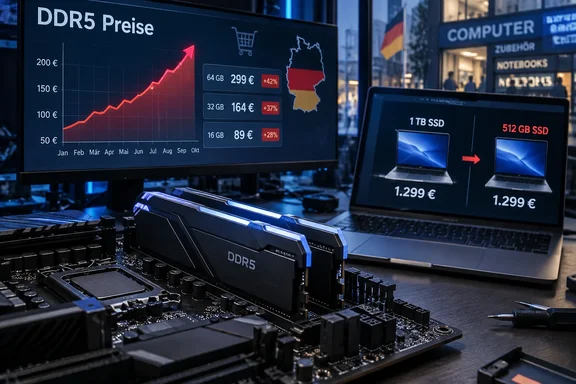
TechRadar first highlighted 3DCenter’s September figures and Mashable’s observation of the Dell configuration change. The underlying records support the broad direction of both reports, but the numbers need a correction: a DDR5 price index of 544% does not mean prices are “544% up.” It means prices are up 444% from the baseline — or cost 5.44 times as much. That distinction sounds academic until buyers use it to compare a €75 memory kit in 2025 with one now listed around €430.
3DCenter’s methodology makes the German result more useful than a single alarming listing. It tracks the lowest available prices for roughly 20 technically comparable, vendor-neutral DDR5 product categories on Geizhals, Germany’s major PC-component price comparison service. Its data was collected around September 13, 2026, and measures retail offers rather than DRAM contract prices paid by Dell, Lenovo, motherboard makers, or hyperscale data-center customers.
The takeaway is still severe: the September move was not caused by one premium kit disappearing from stock. Across the tracker’s average, DDR5 went from an index of 486% in August to 544% in September — an 11.9% month-over-month increase after prices had already surged far beyond their pre-crisis levels.
The 544% figure masks uneven pain between DDR5 kits
The average index tells only part of the story. 3DCenter’s individual entries show substantial differences depending on capacity, speed grade, and timing. A basic single 16GB DDR5-5600 module that cost €39 in July 2025 was listed at €219 in September, a 462% increase. A 32GB DDR5-5600 module moved from €77 to €453, while a mainstream 2x16GB DDR5-6000 kit rose from €75 to €430.
Those are the configurations that matter most to a conventional Windows desktop build. A two-stick 32GB kit has long been the uncomplicated choice for a new gaming PC, developer workstation, or general-purpose system expected to remain comfortable through several Windows feature-update cycles. At €430 in the German market, it is no longer a minor line item alongside a CPU cooler or power supply.
Some higher-end modules are moving even more violently. 3DCenter recorded a 2x16GB DDR5-6400 CL30 category rising from €141 to €1,215 between July 2025 and September 2026, a 762% increase, following a 103% jump in one month. That is an extreme result rather than a useful market-wide price, but it illustrates a problem buyers will recognize: when inventories thin out, specific performance bins can become effectively unavailable at sane prices before the broader memory category moves by the same amount.
The tracker also prevents an easy but misleading conclusion that all PC memory is rising identically. DDR4/DDR3 averaged 292% of its July 2025 baseline in September, meaning a 192% increase, and DDR4 alone was roughly 3.3 times its baseline. Laptop SODIMMs were at 390% of the baseline, or 290% higher. DDR5 is currently the sharper retail problem, but older platforms are not offering the bargain escape route they once did.
Contract-market pressure is reaching consumer shelves
The German retail figures line up with broader DRAM market reporting, even though the measurement methods differ. TrendForce said in July that conventional DRAM contract prices were expected to rise 13% to 18% in the third quarter of 2026, as AI server demand collided with constrained supply and consumer PC makers reached their affordability limit. In a separate September assessment, TrendForce said suppliers’ inventories remained historically low and that additional supply was being directed mainly toward servers.
This is why a retail tracker is worsening even after a long period of elevated prices. Consumer DIMMs are not simply being marked up in isolation. Server builders are buying high-capacity registered DIMMs, cloud providers are building inventory, and memory makers are directing production toward higher-value products including HBM, LPDDR5X, and server DRAM. Micron has likewise told investors that future demand is shifting toward higher-performance, higher-value memory whose complexity costs more per bit.
For a DIY buyer, “AI demand” can sound like a distant explanation for an immediate bill. The practical effect is that the consumer channel competes for production capacity without the purchasing commitments of the biggest cloud customers. TrendForce says some U.S. cloud service providers have signed multiyear supply agreements; buyers outside those agreements and incremental purchases are more exposed to revised quotations.
That does not establish that every €10 retail jump comes directly from a single supplier contract. Retail prices also reflect distributor inventory, exchange rates, local competition, product discontinuations, and seller margins. But the direction is consistent: PC DRAM contract costs are rising, and German street prices are reflecting that pressure with unusually little delay.
Dell’s XPS 13 change preserves the price point, not the value
The Dell example deserves separate treatment because it is a familiar manufacturer response to component inflation. Mashable reported that Dell changed the entry-level XPS 13 in the United States from an 8GB-memory, 512GB-SSD configuration at $699 to a 256GB-SSD model at the same $699 price. The former 512GB baseline reportedly moved to $799, and the 16GB/512GB model to $999.
Dell’s current U.S. XPS 13 listings do show a $699.99 configuration with a 256GB NVMe SSD, and Dell advertises a $599 eligible-student price. But Dell has not publicly said that the configuration change or the higher prices were caused by DRAM costs. The causal link is therefore an inference from the wider component market, not a fact Dell has confirmed.
The result for shoppers is clearer than the rationale. A $699 starting price survives in marketing material, but the amount of usable local storage at that price is cut in half. A 256GB SSD can work for a browser-and-cloud-files notebook, yet it becomes restrictive quickly once Windows 11, Office or Adobe applications, local OneDrive synchronization, game clients, virtual machines, developer tools, and recovery headroom are considered.
For IT departments, the Dell episode is a reminder to compare SKU-to-SKU, rather than using last year’s base-model price as a procurement benchmark. A purchase request that says “XPS 13, starting at $699” may conceal a material storage reduction. The same applies to 8GB versus 16GB system-memory options, soldered-memory configurations that cannot be upgraded later, and configurations that replace a larger SSD with a smaller one while retaining the same family name.
2027 looks tight, but the forecast is not a retail price target
There is credible evidence for continued DRAM tightness in 2027. TrendForce expects server DRAM contract prices to keep rising quarter by quarter from the second half of 2026 through the second half of 2027, although it expects the pace of increases to moderate. Its July outlook estimated that RDIMM bit supply would grow only 15% to 20% year over year in 2027, lagging expected server CPU shipment growth.
TrendForce also forecasts a split market: DRAM supply remains tight in 2027 while NAND flash moves toward a more balanced condition as capacity enters production. That is important for PC buyers because it means RAM and SSD pricing do not have to move together. A laptop or desktop could retain expensive DDR5 while its SSD pricing begins to stabilize, or vice versa depending on the configuration and channel inventory.
New fab construction will not quickly solve this year’s retail shortage. Micron says first wafer output at its first Idaho fab is expected in mid-2027, while its second Idaho fab is scheduled for late 2028. First wafers are not equivalent to immediate, high-volume availability of the exact DDR5 components that reach retail kits, and the company’s larger New York buildout is a longer-term project. Construction announcements are evidence of investment, not a near-term price-relief date.
The responsible conclusion is narrower than claims that DDR5 will become permanently unaffordable: there is no visible near-term supply event that guarantees a return to July 2025 pricing. But forecasts for 2027 are forecasts, not a schedule. A downturn in server demand, a production ramp that beats expectations, or a change in memory makers’ product mix could change the equation.
What Windows PC buyers should do now
Users who need more memory for an existing DDR5 desktop should first determine whether the workload actually requires it. Task Manager’s Performance tab and Resource Monitor can show sustained high memory use, hard faults, and paging pressure. If a system with 16GB rarely approaches its physical-memory ceiling, paying several hundred dollars for a speculative move to 32GB may deliver little day-to-day benefit.
If an upgrade is necessary, match the existing kit as closely as possible — capacity, speed, timings, voltage, and ideally the exact part number — and check the motherboard’s qualified-vendor list and BIOS version before mixing DIMMs. Two matched modules remain less troublesome than four mixed sticks on many DDR5 platforms, particularly when EXPO or XMP overclocking profiles are involved. A lower-speed matched kit that runs reliably is usually a better purchase than an exotic latency bin distorted by scarce inventory.
For new Windows PC purchases, insist on a written configuration comparison: installed RAM, whether it is upgradeable, SSD capacity, available M.2 slots, and the actual price of the model that meets the requirement. Dell’s $699 XPS 13 listing demonstrates why that comparison now matters more than the starting price. In a market where 32GB DDR5 can consume the budget once reserved for a midrange CPU, the cheapest advertised configuration increasingly tells buyers the least about what they are getting.
References
- DDR5 RAM pricing appears to be spiralling out of control even more — it's 5.5x pricier than before the memory crisis, and 2027 could get worse TechRadar · 2026-09-16T12:54:40+00:00