

What is actually known
Reports of the shutdown began circulating on September 27, after screenshots of a discussion with a DenuvOwO member were shared online. Asked whether the group had disbanded, the member reportedly said it had. The member also reportedly agreed when another user suggested that Denuvo's lawsuit against voices38 was behind the decision.
Several outlets repeated the story, but the sourcing is thin. GameRiv notes that the available reporting does not establish that Denuvo's legal action directly caused the shutdown. Tom's Hardware, on September 28, described the disbanding as based on reports circulating online. Its attribution of the cause was an unnamed piracy-scene source close to the matter, who said the lawsuit was the probable reason.
Two other points from the coverage:
- Game count: The figure of more than 60 games comes from media reports, including Notebookcheck and TweakTown. No court has verified it, and no complete list of titles has been established.
- No law-enforcement angle: None of the reporting reviewed describes arrests, raids or a criminal investigation. It describes a voluntary shutdown.
The lawsuit
The case is Denuvo GmbH v. Voices38, number 5:2026cv10423. The public Justia docket shows it was filed on September 14, 2026, in the U.S. District Court for the Northern District of California. That day's entries are a complaint, a certificate of interested entities naming Irdeto B.V. as Denuvo GmbH's corporate parent, and a proposed summons.
Some outlets say Irdeto sued. The docket names Denuvo GmbH as plaintiff, with Irdeto as its parent.
Allegations, not findings. Tom's Hardware, citing TorrentFreak, reports that the complaint accuses the defendant of bypassing Anti-Tamper in at least 26 PC games. Reported titles include Hogwarts Legacy, Black Myth: Wukong, Resident Evil Requiem and Doom: The Dark Ages. The complaint reportedly seeks damages and a court order to stop further tampering. Tom's Hardware stresses that the case is early and that Denuvo's claims have yet to be tested in court. I could only confirm that wording from the 26-game article, so treat it as that outlet's characterization.
Copyright or DMCA? Reports describe the claims as DMCA anti-circumvention claims rather than copyright infringement. Tom's Hardware points out that Denuvo doesn't own the copyrights to the games. The Justia docket summary, however, lists the nature of suit as "Copyright". I haven't seen the complaint itself. The most defensible reading is that the press describes DMCA anti-circumvention claims while the docket's automated label says otherwise.
Who is the defendant? Denuvo apparently doesn't know voices38's identity. The complaint reportedly refers to an unknown individual or entity plus ten unnamed defendants, and it cites Reddit, Discord and Steam accounts Denuvo believes are linked. Seeking information from those platforms would be a logical next step. Nothing I reviewed shows it has already succeeded.
Does the suit involve DenuvOwO? No. As TweakTown puts it, the lawsuit does not mention or connect voices38 to the group. The link comes from the group member's reported remarks and from scene commentary.
Why Windows users should care
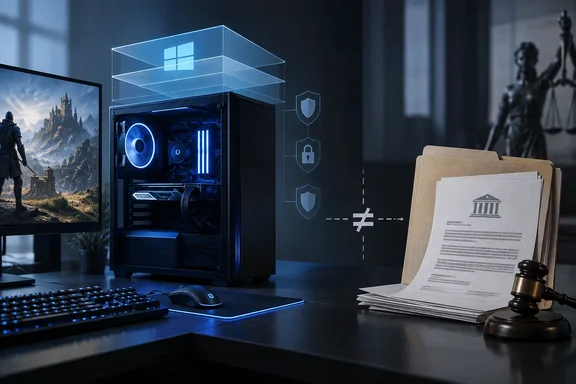
Denuvo is a PC DRM and anti-tamper layer. The hypervisor technique matters to Windows users because of how it works and what it costs the user's machine.
Traditional cracks directly patch or modify Denuvo's checks inside the game executable. The hypervisor technique instead tries to bypass the protection by manipulating the environment Denuvo sees while the game runs. That is why it was reportedly easier to apply across many titles. The drawbacks include the need to alter or turn off some Windows security features. Notebookcheck's German report makes the same point, adding that the method required changes to Windows security settings.
None of the sources I reviewed lists exactly which settings are affected, and they don't say that every package changes the same ones. Telling users to switch protections off would be irresponsible, so this article doesn't give instructions.
The general risk applies regardless of how any individual release behaves. Notebookcheck cautions about trusting releases from unknown sources. It says malicious code in tampered games could exploit Windows vulnerabilities, steal data or cause crashes. That is a stated risk of running untrusted software. It is not a documented incident involving DenuvOwO packages.
For admins and security-minded gamers, the takeaway is simple:
- Software that requires you to weaken OS-level protections, such as virtualization-based or kernel-level defenses, is a bad bargain on a machine you care about.
- Anyone running such software on a work or shared machine should expect it to look like a security problem to endpoint protection.
- Anything that operates at hypervisor level is inherently powerful. That is exactly why unknown sources deserve zero trust.
Does the scene stop here?
Probably not entirely, though that is judgment based on reporting from September 28. Tom's Hardware says DenuvOwO's work was built on common open-source tools, so others should find it relatively easy to replicate. Notebookcheck likewise says the group didn't invent the bypass and relied on existing open-source projects.
Other reported developments:
- voices38: Tom's Hardware reports that voices38 has said work will continue as normal and keeps releasing cracks.
- RUNE: The same outlet says the long-running group RUNE recently released a proof-of-concept crack for Assassin's Creed: Mirage. It reportedly removed Denuvo Anti-Tamper and VMProtect from the executable, with a 15% average FPS gain and a 76% minimum-FPS gain on an Intel Core i7-13700K and RTX 5080 system. These are the outlet's reported figures, not independently tested here.
- CS.Rin: Tom's Hardware says the forum removed links to DenuvOwO-bypassed titles and banned some of the group's members. The outlet speculates that the site wants to limit its exposure to laws like the DMCA. That motive is the outlet's inference, not a confirmed fact.
Notebookcheck adds that the hypervisor method had lost some ground recently. It says voices38 was cracking games faster by altering checks in the executables. The hypervisor route was easier to use but required Windows security changes.
The bottom line
The reportedly confirmed facts are narrow. A group tied to hypervisor-based Denuvo bypasses is said to have stopped operating, and a lawsuit against a different cracker is on the public docket. Anything beyond that is inference. That includes the claim that the suit caused the breakup, the idea that legal pressure will deter others, and any forecast of who takes over.
Game publishers should be cautious about reading too much into one group's exit. The technique is public and other cracking activity continues. For everyone else, the practical advice hasn't changed: don't run tools that ask you to lower your system's defenses.
Update: Denuvo reportedly seeks subpoenas as voices38 releases Atomfall crack (October 8, 2026)
Denuvo has reportedly moved beyond identifying accounts it believes belong to voices38 and is now seeking subpoenas for information from Discord, Reddit and Steam, according to Notebookcheck’s new report. That is a substantive change from the earlier coverage, which described platform requests only as a possible next step. The report does not establish that a judge has granted the requests, that any platform has disclosed identifying information, or that voices38 has been identified.
Meanwhile, Rebellion’s Atomfall has reportedly appeared on piracy networks with its Denuvo protection removed by voices38, according to Notebookcheck. The report, published late on October 7 UTC, describes a concrete release following the cracker’s earlier promise to continue despite the lawsuit. It does not indicate that DenuvOwO has resumed operations.
For Windows users, the reported Atomfall release should not be confused with an official DRM-removal update from Rebellion. Notebookcheck describes an unauthorized crack, not a change to the publisher’s distributed game. Nor does the report provide a security assessment of that release: its appearance alone establishes neither that it is safe to run nor that it requires the Windows security changes associated with hypervisor-based bypasses.
References
- Voices38 cracks another AAA Denuvo game despite piracy lawsuit from DRM maker Notebookcheck · 2026-10-07T22:29:00+00:00
- DenuvOwO announces disbanding after 60 games cracked with Denuvo - Pasquale Pillitteri Pasquale Pillitteri · 2026-10-03T07:20:00+00:00
- Piracy group behind hypervisor-based Denuvo bypasses disbands following Denuvo's lawsuit against voices38 tweaktown.com