

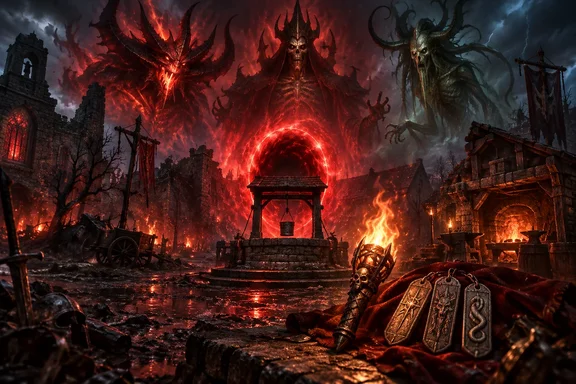
PC Gamer highlighted the discovery after Reddit user JT99-FirstBallot found the recreated Diablo town, while Blizzard’s own Season of Hell’s Legacy announcement had already signaled that players should expect secrets among its remade locations. Blizzard did not publicly spell out the Tristram-to-Uber-Tristram chain in its main season overview, however, leaving the community to map the requirements after the season launched on September 15.
The result is one of the more substantial anniversary callbacks in Diablo IV, but it also exposes a divide between Blizzard’s carefully marketed seasonal systems and the parts of the patch players are expected to uncover themselves. Tristram is a destination worth seeing for series veterans. The Hellfire Torch is why endgame players will be running it more than once.
Tristram Is a Destination, Not Just a Dungeon Backdrop
Blizzard’s official material describes the Season of Hell’s Legacy as the centerpiece of Diablo’s 30th-anniversary celebration, built around “Waking Nightmares” that recreate notable moments from earlier games. The developer explicitly confirmed remade versions of the Tristram Cathedral, Arreat Summit, and Durance of Hate, where players confront echoes of Diablo, Baal, and Mephisto during the seasonal questline.
GamesRadar, which attended Blizzard’s BlizzCon 2026 presentation, reported that the Diablo I-inspired activity runs from Tristram Cathedral through the Catacombs and Caves into Hell. That is a much bigger undertaking than a single familiar town hub: Blizzard has adapted much of the original game’s journey into Diablo IV’s modern dungeon structure and combat model.
The newly uncovered Tristram village sits alongside that official framework. PC Gamer’s report focuses on the fidelity of the town layout and its returning inhabitants, including Griswold, Ogden, Pepin, and Wirt. For players who know the first game, the recreation lands because it retains the geography that made Tristram memorable: the well at the center, the clustered buildings, the blacksmith, and the uneasy sense that the village is only temporarily safe.
There is one factual correction worth making to the anniversary framing. The original Diablo did not debut in 1997, as the submitted report states; it launched on December 31, 1996. Blizzard is therefore marking 30 years of the franchise during 2026, even though many players first encountered the game widely in 1997.
The music may be the most effective part of the exercise. Blizzard’s season announcement talks broadly about recreating old settings and encounters, but it is the return of Matt Uelmen’s Tristram guitar motif — together with familiar character performances — that supplies the recognition factor. Visual assets age quickly; a few notes of that soundtrack communicate the original game’s identity immediately.
The Hidden Route Appears to Require Ten Deckard Cain Journals
The official Season of Hell’s Legacy overview tells players to finish the seasonal questline, choose a Prime Evil Soul Splinter, and replay Waking Nightmares for rewards. It does not provide a formal checklist for accessing the old Tristram village or the Uber Tristram encounter.
Vitablo, a Diablo-focused guide site that credits creator MacroBioBoi and community mapping work, reports that players must first complete Deckard Cain’s seasonal questline and then find 10 hidden Deckard’s Journal entries across Sanctuary. Returning those journals to Cain opens a portal to Tristram.
That distinction is important for anyone treating the seasonal campaign completion as the finish line. The campaign unlocks the broader activity loop, but the village itself appears to be a second-layer secret. Players who complete the questline and leave without hunting the journals will miss the town, its NPC callbacks, and the next stage of the chain.
The discovery also fits Blizzard’s language more closely than its patch notes initially suggested. Its season announcement tells players that memories contain “forgotten secrets” and specifically encourages them to search for hidden discoveries. Yet there is a difference between an intentional secret and documentation that leaves players unable to tell whether a missing objective is a puzzle, a bug, or unfinished content. Season 15 arrived following a brief server-related delay, according to GamesRadar, so unclear unlock conditions were particularly likely to be mistaken for launch instability.
For practical purposes, players should treat old Tristram as post-campaign seasonal content. Finish the seasonal story, return to Deckard Cain in the Imperial Library, and look for the journal hunt rather than assuming all Tristram-related content is contained in the cathedral encounter from the main quest.
Uber Tristram Reuses Diablo II’s Logic — With Diablo IV Systems
The village’s well is reportedly the trigger for the next portal, but it requires Wirt’s Lucky Coin. According to Vitablo’s current guide, the coin is crafted in the Horadric Cube by transmuting one consumable shard tied to each Prime Evil: Hatred for Mephisto, Destruction for Baal, and Terror for Diablo.
Those shards are said to drop throughout the game but more reliably from the three seasonal capstone encounters at Torment 10 and above. The guide cautions that these versions carry a Torment 12-level challenge, putting the final portal firmly in endgame territory rather than making it a straightforward sentimental tour.
That construction is deliberate fan-service, but it is also a mechanical echo of Diablo II’s Pandemonium Event. In Lord of Destruction, players farmed keys, opened portals to lesser Ubers, collected Mephisto’s Brain, Diablo’s Horn, and Baal’s Eye, then transmuted those organs to access Uber Tristram. Defeating Uber Mephisto, Uber Diablo, and Uber Baal rewarded a Hellfire Torch.
Diablo IV does not copy that procedure item for item. Instead, it uses the game’s current seasonal capstone loop, consumable drops, and Horadric Cube to create an equivalent escalation: farm the three Prime Evil-linked pieces, craft an access item, enter the well portal, and fight all three bosses at once. The older event’s structure survives, even though Diablo IV’s gear and progression systems are very different.
Players should not mistake the three boss echoes encountered during the campaign for this encounter. Blizzard has confirmed that Diablo, Baal, and Mephisto each appear in their own large Waking Nightmares as part of the seasonal quest. Uber Tristram combines them in a single arena and appears to require the separate Tristram and coin sequence.
Hellfire Torch Has Real Build Consequences
The Hellfire Torch is not simply a transmog or collector’s trophy. D4Guides, which examined Season 15 client data, identifies it as the season’s first Mythic Talisman Charm. Its listed rolls include 10% to 20% All Stats, 10% to 20% resistance to all elements, and +1 to +4 to all skills; more consequentially, it permits one additional Unique Charm in the Talisman.
Vitablo’s guide shows a top-end Torch with 20% All Stats, 20% all-resistance, +4 to all skills, an extra Unique Charm slot, and an effect that allows the five-piece bonus from a particular set to activate with four pieces. The site also reports that the final set-related effect can vary, meaning players may need repeat clears to get the Torch variant that benefits the equipment set they actually use.
Even before exact drop rates and variant distributions are independently established, the extra charm slot makes the item strategically different from a standard stat reward. Season 15 adds 24 Talisman Charms, according to D4Guides, including powers adapted from legacy uniques. Adding another Unique Charm changes the number of effects a build can carry rather than merely raising a familiar damage multiplier.
That makes Uber Tristram relevant to players who otherwise would skip a hidden homage after seeing it once. A strong Torch can alter Talisman choices across an entire endgame build, while a mismatched set effect creates an incentive to farm the fight again. In Diablo II, the difficulty of Uber Tristram made the Hellfire Torch a coveted reward. Diablo IV preserves that relationship between the three-boss challenge and a prize that affects character planning.
Blizzard Left the Best Part for Players to Unearth
Blizzard has confirmed that Season of Hell’s Legacy contains a broad tour through Diablo I, Hellfire, Diablo II, Diablo III, and Diablo Immortal, with Waking Nightmares split among replayable capstones, fixed-location dungeons, and sudden one-room events. Inven Global’s hands-on overview similarly described the season as a series-wide retrospective rather than a narrowly Diablo I-themed event.
But Tristram’s well portal, the Wirt’s Lucky Coin crafting path, and the Hellfire Torch reward were not laid out in Blizzard’s central season announcement or its published 3.2.1 notes for build 73552. That omission is the story here. The seasonal quest and its Prime Evil powers are the advertised feature; the hidden Uber Tristram path is the layer that gives the anniversary event replay value after the first completion.
There are also signs that the community has not exhausted the season’s hidden content. PC Gamer noted that the Uber Tristram bosses drop another item whose use was still being investigated, while earlier Season 15 data-mining had surfaced references to both Hellfire Torch and Annihilus-style rewards before their acquisition methods were clear. Until Blizzard documents those systems, players should be cautious about treating every rumored recipe or item interaction as settled.
For now, the concrete payoff is clear: complete the seasonal story, locate the ten Cain journals, open the village portal, gather the three Prime Evil-linked crafting materials, and use Wirt’s Lucky Coin at Tristram’s well. The anniversary event has turned Diablo’s most recognizable town into a real endgame destination — and made one of Diablo II’s most desirable rewards matter again in Diablo IV.