

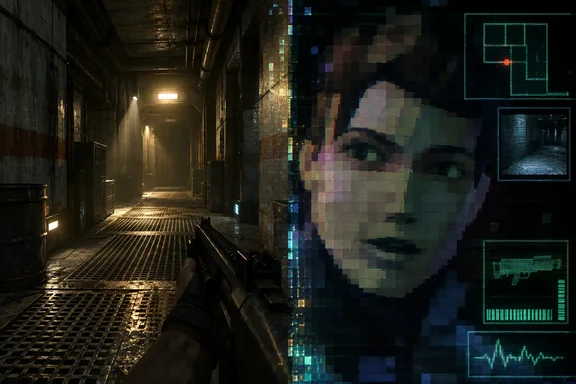
DLSS 5 Neural Rendering Was Built for Engines That Talk Back
Earlier DLSS versions mainly rebuilt a sharper image from fewer pixels. NVIDIA describes DLSS 5 as something new. The company says it is the first DLSS technology to generate the final displayed appearance rather than reconstruct a higher-cost reference output from the conventional renderer. In practice, a model trained on real-world imagery changes how lighting and materials look in each frame.
NVIDIA's research page says the model depends on game engine data. At inference, the model is conditioned on the current rendered frame, engine motion vectors, carried temporal state, and artistic-direction values. Motion vectors are per-pixel records of how things move between frames. NVIDIA's developer blog, dated September 22, 2026, adds that the system works on a strict one-frame-in, one-frame-out model with game-engine motion vectors, which is meant to keep the output stable as the player moves.
Developers also get controls that a modded game doesn't have. According to NVIDIA, studios can pick among several models, adjust Structure Intensity and Tone Intensity, and use semantic AI masking and engine-level masks to isolate props or asset groups such as glassware, water droplets, and foliage. The blog also says input quality matters. giving the model richer source data, like ray-traced or path-traced lighting, yields dramatically more-accurate results.
Official support is very limited. NVIDIA says DLSS 5 is available now in NBA 2K27, developed by Visual Concepts and published by 2K, for all GeForce RTX 50 Series desktop and laptop GPUs, and GeForce NOW Ultimate members can stream it. The How-To Geek piece says native use requires a DirectX 12 game that already supports DLSS Frame Generation and DLSS Upscaling. A game from 2003 or 2004 has none of that.
How DLSS 5 Swapper Fakes the Missing Inputs
The workaround is DLSS 5 Swapper, an unofficial Windows app. According to How-To Geek, it installs ReShade, RenoDX add-ons, the DLSS 5 neural-rendering DLLs and any graphics-API bridges a game needs, and it works with DirectX 9, DirectX 11, Vulkan and OpenGL games. The steps described are short: download the app from its GitHub page, let it find your installed games, choose one, and click Install DLSS 5.
Games without DLSS use a route called DLSS5-Feeder. TweakTown describes Feeder as a community mod that injects or makes the necessary DLSS calls so DLSS 5 can be triggered inside games that lack native support, working with ReShade, which supplies a depth buffer and optical-flow motion, two required inputs for DLSS to function properly. One public GitHub repository for the tool says Feeder builds a synthetic DLAA contract from ReShade depth and estimated motion vectors, so it does not need the game to create a native DLSS feature.
The same README explains how older 32-bit games are handled. For 32-bit games, the app automatically installs the matching 32-bit ReShade add-on and sends frames to a bundled 64-bit helper, because NVIDIA's NGX runtime is 64-bit only. DirectX 9 is translated to DirectX 11 with dgVoodoo2 before it enters that route. This explains How-To Geek's warning that Windows Security may flag dgVoodoo2 when you patch a DirectX 8 or 9 game. The outlet calls this a false positive. That judgment belongs to the outlet. You should check the specific file you downloaded before trusting it.
There isn't just one DLSS 5 Swapper. At least two GitHub projects use the name. The one maintained by Rakan Alkhaldi is described as a separate project that installs DLSS 5 Neural Rendering into games, including games and emulators without native DLSS, through routes such as DLSS5-Feeder, RenoDX and OptiScaler. Its site offers version 2.2.7. Another repository documents a 2.1.1 build. How-To Geek doesn't say which project or version it used, so the exact install path in its test can't be matched to one release.
Half-Life 2 Environments Got the Biggest DLSS 5 Lift
The writer chose the original Half-Life 2 because of its facial animation, reflections and detailed environments, which stood out in 2004. They deliberately avoided remasters so that DLSS 5 would be working with the original assets. The everyday-looking comparison games were Jedi Academy and Mount & Blade. The report gives specific observations for the first two.
Environments were the biggest surprise. Half-Life 2 is mostly concrete, stone and metal rather than foliage. The writer says the 2004-era textures still look low-resolution, but light moving across those hard surfaces looked much better. In one scene, light coming in from the side looked more diffuse and more realistic. In the stock game, a background character holding a broom is lit brightly even though almost all the light is behind him. With DLSS 5 on, his shadows matched the scene better.
The writer also says DLSS 5 rarely made anything worse than a realistic-looking low-poly object. Even Jedi Academy, which the writer never thought of as a looker, had noticeably better environments with the effect on.
This fits NVIDIA's own description of the technology. The model is trained to add lighting and material detail on top of the geometry the engine draws. Hard surfaces with simple shapes give it a lot to improve and few chances to go wrong. This is an inference from NVIDIA's design notes. It is not a measured finding.
Faces Were Where the DLSS 5 Mod Broke Down
Faces gave mixed results. Half-Life 2's opening puts the G-Man's face right in front of the player. The writer thought DLSS 5 improved the shadows and lines on his face, his stubble and his eyes. They say nearly every NPC gained at least a small lighting improvement. One example is a train passenger with a briefcase who looks oddly bright in the original game. DLSS 5 darkened his hands, clothes and face to match the actual light in the scene.
The problems come from mismatched detail. The writer's point is that a photorealistic surface on a low-poly barrel is fine, but the same treatment on a low-poly human face can look jarring. In their view, Jedi Academy faces look acceptable in screenshots and bad in motion. Some Half-Life 2 characters also came out looking generic, which the writer calls a recurring DLSS 5 problem even in modern games. Critics made the same complaint about art direction when DLSS 5 first appeared.
NVIDIA's native pipeline is designed to address exactly this. In NBA 2K27, according to NVIDIA, Visual Concepts uses overall tone and style controls plus a per-pixel uplift control mask to fine-tune character detail while respecting player likenesses. A modded 2004 game has no such masks and no developer tuning. This helps explain why faces were the weak point in the test.
Ghosting and a Garbled HUD Show What Estimated Motion Vectors Cost
Two artifacts come straight from the workaround. The writer saw clear ghosting during fast movement and blames the motion vectors that the tool estimates, since the game never provides them. NVIDIA's temporal-stability claims rely on engine-supplied vectors. ReShade estimates motion from the finished image, which can't be as accurate.
The HUD had its own problem. The writer says the model doesn't recognize a HUD, so it tries to "redraw" interface elements. The result was often messy, especially with text. Native integrations can use engine masks to keep effects off specific elements, while a post-process injection sees the HUD as more pixels in the frame. The broader Swapper project also treats UI handling as unfinished. Alkhaldi's repository notes that Xenia HUD correction remains experimental.
The writer puts the results in context: this is an AI feature built for DX12 games with DLSS, running on a roughly 20-year-old OpenGL game through a framework the writer says was assembled by motivated amateurs with help from AI. The piece also contains some dating slips. It calls the OpenGL title "23 years old", and elsewhere it mentions a game "from 2009". Half-Life 2 came out in 2004, which makes it about 22 years old. In our reading, the 23-year OpenGL description fits Jedi Academy better, since it was a 2003 release on the OpenGL-based id Tech 3 engine.
Performance and Provenance Are the Hidden Costs of DLSS 5 Swapper
The How-To Geek test gives no GPU model, driver version, resolution or frame rates. Other hands-on reports say the cost can be high. King of Computer Media, a Taiwanese outlet, tested the tool and reported that it does work, but the frame rate takes a massive hit (at least cut in half), and the game can crash at any moment. GameGPU blames much of the slowdown on older cards, saying the lack of hardware support for the ultra-low-precision NVFP4 format results in a 50% drop in frame rate on older GPUs.
Card support is also unofficial. NVIDIA's native path runs on RTX 50 Series hardware. One Swapper README lists RTX 20 through RTX 50 as supported and says the bundled nvngx_dlssnr.dll is a patched build whose author states it adds RTX 20/30/40 support and runs identically on RTX 50. Alkhaldi's repository takes a narrower approach. It says the bundled neural model runs on Blackwell (RTX 50 / RTX PRO Blackwell); an older card needs a modded nvngx_dlssnr.dll you supply, and it recommends driver 616.56.
The model's origin matters as well. Before NVIDIA's official NBA 2K27 launch, DSOGaming noted that this DLSS 5 version is based on a leaked build and warned that the workaround does not show the same quality that a native DLSS 5 implementation may offer. King of Computer Media said the same and added that whether NVIDIA will act against such tools remains unknown. Neither outlet has said whether current Swapper builds have moved to shipping NVIDIA files.
What this means for you
Only try this on a GeForce RTX system you're comfortable modifying, in single-player games you can easily restore. TweakTown points out that the tool is not affiliated with NVIDIA in any way. The Coolaid003 repository says its executable is not code-signed, so SmartScreen shows a "Windows protected your PC" warning on first launch. Take that as a reason to confirm which project you're downloading, not as a warning to click past automatically.
Both projects include rollback features. Alkhaldi's site says original files are backed up automatically, and the Coolaid003 README describes a Restore originals function that keeps the first backup even after repeated installs. For games with anti-cheat, King of Computer Media warns that modified files may trigger warnings or lead to account issues. Alkhaldi's build shows a red warning in that case but doesn't block you.
- Expect environments and lighting on hard surfaces to improve the most in older games, based on How-To Geek's Half-Life 2 and Jedi Academy results.
- Expect low-poly faces, fast camera movement and HUD text to show artifacts, because the tool estimates motion vectors and can't mask out the interface.
- Plan for a large frame-rate drop, since independent testers report the frame rate falling by roughly half, especially on pre-RTX 50 cards.
- Confirm which "DLSS 5 Swapper" project and version you're installing, because at least two unrelated GitHub projects use the name and document different requirements.
- Check any Windows Security or SmartScreen alert against the specific file you downloaded before assuming it's a false positive.
- Keep modded installs out of online games with anti-cheat, and use the tool's Restore originals function to undo changes.
How-To Geek's experiment supports a limited but real conclusion. Even with estimated motion vectors and no developer tuning, DLSS 5 can make the lighting in a 2004 game look more convincing, while exposing every low-poly face and HUD element it doesn't understand. Official support is still just NBA 2K27 on RTX 50 Series hardware, so for now these community-built injectors are the only way to try DLSS 5 on older games. That's likely to stay true unless NVIDIA adds an official override path or takes action against the tools.
References
- I ran DLSS 5 on one of the "most realistic" games of the 2000s, and the results weren't as horrifying as I expected How-To Geek · 2026-09-25T19:00:16+00:00
- What’s New for Game Developers: DLSS 5 with 3D-Guided Neural Rendering, NVIDIA ACE Updates, and New RTX Kit Capabilities | NVIDIA Technical Blog developer.nvidia.com
- DLSS 5: Generative Neural Rendering - NVIDIA ADLR research.nvidia.com