

Dynamics 365 Field Service targets the subcontractor closeout gap
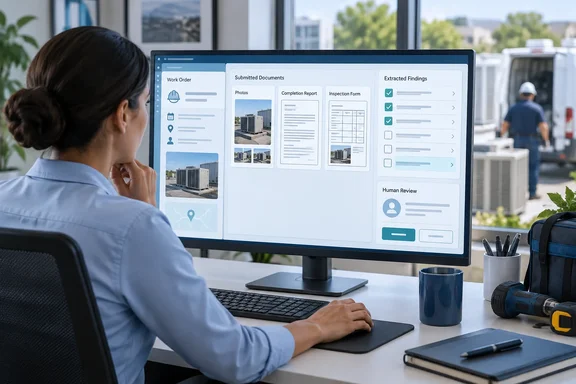
A subcontractor may finish a job by sending photos, a service report, an inspection form, or a certificate. According to the roadmap description for ID 571674, those files often arrive in a shared mailbox, leaving an internal service team to download them, interpret them, and reconnect them to the Field Service work they support.
The proposed Subcontractor Agent would process supported attachments received with a subcontractor submission and associate them with the relevant work. Authorized users could then find the evidence from the operational record. This is a change in how incoming evidence is handled, not the introduction of attachments to Field Service: Microsoft’s existing work-order experience already has a Timeline that can contain photos and other documents. Today, a user can add a work-order attachment by selecting the Attachment icon, choosing a file, and selecting Add note and close.
That existing manual option remains the useful baseline while the agent is in development. The roadmap description does not specify whether the agent will store its files as Timeline notes, inspection attachments, or another kind of related record. Teams should therefore avoid designing retention or access procedures around an assumed storage location.
Inspection results would remain proposals until a reviewer checks them
The planned capability goes beyond filing attachments. For supported inspection or task-completion documents, the agent could use their contents to prepare a closeout proposal containing findings, outcomes, observations, deficiencies, or task results. The described review experience keeps the original document beside the proposed structured information so a dispatcher, service coordinator, or other authorized reviewer can compare them before validating and applying them to the appropriate Field Service record.
That proposed workflow has a different starting point from an existing Field Service inspection. In Microsoft’s documented inspection process, an administrator publishes a digital-form template, a dispatcher adds the associated service task type to a work order, a technician enters responses, and a dispatcher views the results. Those inspection answers are stored in Dataverse. The Subcontractor Agent proposal instead starts with evidence submitted by a subcontractor and asks an internal reviewer to assess what the agent has drawn from it.
There is another distinction for teams already experimenting with document-based inspections. Field Service’s separate Create inspections with Copilot preview converts uploaded images or PDFs into draft inspection templates that people edit and publish for later use. It is aimed at building a form; the proposed Subcontractor Agent is aimed at handling a completed-work submission. Neither feature should be mistaken for automatic acceptance of an incoming inspection result.
The distinction affects closeout decisions. A proposed “pass” or deficiency extracted from a document would be a prompt for comparison with the source, not a substitute for that comparison. The roadmap gives no extraction-accuracy figure or rule for resolving contradictory findings, so organizations evaluating the preview should retain their existing reviewer judgment and approval criteria.
File exceptions and financial records set firm boundaries
The roadmap description names photos, PDFs, service reports, inspection documents, and other supported completion files as examples of material the agent would handle. It also says unsupported, unreadable, encrypted, oversized, or potentially unsafe files would be surfaced for appropriate handling instead of being shown as successfully processed.
That is useful exception behavior to assess, but the description supplies no complete format list, size limit, security mechanism, or step-by-step exception workflow. An evaluation should check both sides of the experience: whether a typical readable submission produces evidence a reviewer can find, and whether a file the agent cannot process remains visibly unresolved. The roadmap does not establish that every attachment in a submission will yield extracted findings.
Document processing is not financial posting. The roadmap explicitly says that processing an invoice, parts list, or other financial or consumption document does not by itself create, match, approve, or post a financial transaction or product-consumption record unless that behavior is separately supported. That boundary is consequential in Field Service, where existing work orders also track products, services, and financial information. A team considering the agent for closeout should keep its invoice and materials controls separate from the proposed document-review workflow.
The October 2026 preview is a planning date, not a deployment step
As of September 25, 2026, the listing places the feature in development and estimates preview availability in October 2026, followed by general availability in February 2027. Its scope fields name Desktop and Web, the Preview release ring, and Worldwide Standard Multi-Tenant cloud instances. Those fields describe the planned rollout; they do not say that an organization can enable the feature today.
The desktop-and-web scope also matters to field teams. Existing Field Service inspections can be completed on mobile devices while offline and synchronized later, according to Microsoft Learn. That established inspection capability does not extend the roadmap’s Subcontractor Agent scope to mobile or offline use.
Microsoft’s AI at Work roadmap describes its release dates as estimates subject to change. For this particular entry, licensing, tenant prerequisites, preview enrollment steps, attachment limits, and the exact reviewer controls have not been established in the available material. Those details will matter before an administrator can turn the proposed workflow into an implementation plan.
What this means for you
Keep the current closeout process in place, and treat the preview as an opportunity to test whether assisted intake actually makes subcontractor evidence easier to review. The most useful preparation is to identify the submissions and decisions your team already handles, without assuming an enablement procedure or an automated approval path.
- Retain a way to connect subcontractor files to the correct work order; the existing work-order attachment action remains a documented manual option.
- Select representative photos, service reports, and inspection forms for a future preview evaluation, including documents whose findings need careful interpretation.
- Include unreadable, encrypted, oversized, and unsupported files in that evaluation, and check how reviewers are told that processing did not succeed.
- Have reviewers compare each proposed inspection or task result with its original document before applying it.
- Keep invoice approval and product-consumption recording in their established workflows; the described document intake does not perform those transactions on its own.
The Subcontractor Agent’s strongest supported promise is a closer link between subcontractor evidence and the Field Service work it closes out, with a human checking proposed findings against the source. October’s estimated preview is the first stated point at which teams may be able to assess the actual experience; until then, the roadmap is a basis for planning a careful evaluation, not for replacing closeout controls.