

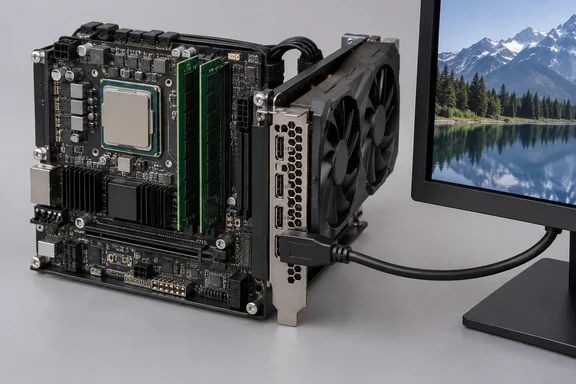
What ERYING launched
ERYING posted the launch on its official Chinese site on September 23, 2026, focusing on the i7 model, called the i7-13798HRE-D4. English coverage followed on September 26 and added the i5 version. VideoCardz notes that the HRE family is aimed at embedded and industrial systems, and ERYING is reusing the chip for a consumer MoDT platform. The company is pitching the boards mainly as a cheaper way into a modern Intel system that still uses DDR4 memory.
MoDT means "Mobile on Desktop." The term describes boards that put a mobile processor on a desktop-style motherboard, a form factor that has grown as mobile chips gained cores and efficiency. The CPU is permanently attached to the board, and ERYING has built this kind of product for years. You can't swap the CPU later. When you buy the board, you've picked your processor for good.
The chips: what's behind the HRE names?
ERYING says the Core i7-13798HRE can be treated as a Core i7-13800HRE without integrated graphics. According to ERYING's own write-up, the 13800HRE is an Intel industrial-control part derived from the i7-13700H, with ECC memory support added. TweakTown says the i5-13598HRE seems to follow the same pattern, based on its specs: an i5-13600HRE-class chip with the integrated graphics turned off.
| Spec | Core i7-13798HRE | Core i5-13598HRE |
|---|---|---|
| Core layout | 6P + 8E | 4P + 8E |
| Cores / threads | 14 / 20 | 12 / 16 |
| Max boost | 5.0 GHz | 4.8 GHz |
| L3 cache | 24 MB | 18 MB |
| Base TDP | 55 W | 55 W |
| Integrated graphics | None | None |
TweakTown's figures match the table: 14 cores and 20 threads, a 5.0GHz boost and 24MB of L3 for the i7, and 12 cores, 16 threads, 18MB of L3 and a 4.8GHz boost for the i5.
One caveat matters here. TweakTown reported that when it published, neither the 13798HRE/13598HRE pair nor the related 13799HRE/13599HRE pair appeared in Intel's public ARK database. Technetbook adds that retail sites in China have listings for Core i7 13799HRE and i5 13599HRE variants with similar core layouts. Until Intel publishes a spec page, treat the family positioning as something ERYING and the press have reported, not something Intel has documented.
Section summary: These are 13th-gen Raptor Lake chips from Intel's embedded line with graphics disabled. The core counts are well reported, but Intel has no public listing for them yet.
The board: small footprint, CPU-direct lanes
Both versions use the same board design:
- Size: 175 x 215mm, with two DDR4 UDIMM slots running in dual channel
- Expansion: a PCIe Gen5 x8 slot and a PCIe Gen3 x4 slot
- Storage: two M.2 slots, one PCIe Gen4 x4 and one PCIe Gen3 x4, plus two SATA ports
- Power and wireless: one 8-pin EPS CPU power connector and a reserved M.2 slot for a wireless module
- Rear I/O: two 10Gbps USB-A ports, six 480Mbps USB-A ports and a 1GbE RJ-45 jack
- Internal headers: one 5Gbps USB header and one 480Mbps USB header
ERYING says every PCIe and storage lane connects straight to the CPU rather than through a chipset, because the chip is a mobile H-class part. No lane diagram or independent check has been published. Also, a reserved Wi-Fi slot doesn't mean a Wi-Fi card is included. Nothing published so far says whether a card or antennas come in the box.
Section summary: For a board this small, the expansion is generous. The 2.5GbE-free, USB 2.0-heavy rear panel shows where ERYING cut costs.
The GPU requirement is not optional
These processors have no integrated graphics, so you need a dedicated graphics card to get a video signal. ERYING's announcement confirms the board has no video outputs at all: no HDMI, no DisplayPort.
For Windows builders, that has some practical consequences:
- Budget for a GPU from the start. A cheap low-profile card is enough for office work or a Windows install. Gaming needs something that fits the PCIe 5.0 x8 slot's bandwidth.
- Troubleshooting is harder without a backup display. On most Intel desktops, the onboard video output lets you check whether a dead graphics card is the problem. Here you'll need a spare card. (That's general bench experience, not something ERYING has said.)
- Media workloads lose Intel's iGPU features. Intel's Quick Sync encoding lives in the integrated graphics, so Plex-style transcoding servers would have to rely on the discrete card. (This is general industry knowledge about Intel's platform, not a claim from ERYING.)
- Headless use is possible, but you'll probably need a GPU temporarily to set up the BIOS and install the OS.
ERYING's performance claims
ERYING runs the i7 board at a 115W PL2 limit that drops to a 95W PL1 limit, far above the chip's 55W base rating. ERYING says the i7 scores about 800 single-core and nearly 8,000 multi-core in CPU-Z, and around 16,000 in Cinebench R23 multi-core. The company also claims that a -50mV BIOS undervolt pushed R23 to about 16,500 and cut temperatures by roughly two degrees. For thermals, ERYING says the chip ran at about 72°C at 115W and about 62°C after dropping to 95W.
For gaming, ERYING paired the board with an RTX 4070. It claims an average above 500fps in CS2, against 319.7fps for a Core Ultra 9 285H system. In PUBG, it reports 156fps versus 133fps. ERYING's own comparison is also frank about the limits: its tests put the i7 behind the company's much stronger i9-13980HX and Ryzen 9 8945HX MoDT platforms. ERYING blames two things. The first is DDR4-3200 memory at roughly 47 GB/s, versus DDR5-6000 on the HX systems. The second is the 13798HRE's lower 5.0GHz peak clock.
Keep in mind that every number here comes from the vendor. ERYING doesn't say which power limit applied to each benchmark, and no independent review exists yet.
Pricing: one yuan figure, several dollar figures
The prices in yuan are fixed. The Core i7-13798HRE-D4 costs 1,399 yuan and the Core i5-13598HRE-D4 costs 1,199 yuan. VideoCardz converts those to about $197 and $169. XiaomiToday says $196 and $168, while TweakTown uses about $210 and $180. The dollar figures differ only because each outlet used a different exchange rate.
Past launches suggest those conversions are the most optimistic you'll see outside China. When ERYING launched its HX boards, VideoCardz pointed out that prices on ERYING's official AliExpress store were much higher than the company's announced prices. Shipping, taxes and reseller markups will likely add to the cost.
Who should care, and who shouldn't
ERYING's reasoning is openly about memory prices. With DDR5 expensive, a board that takes the DDR4 sticks you already own has real appeal. For comparison, ERYING's HX platform launched at 2,599 RMB for the i9-13980HX and 1,899 RMB for the i7-13700HX. The new boards are well below that.
Good fits:
- Budget Windows 11 gaming builds that reuse DDR4 and a spare GPU
- Compact home servers or NAS builds that can use two NVMe drives and two SATA ports
- Upgrades for tinkerers who already have a GPU and DDR4 kit sitting around
Think twice if:
- You want a CPU upgrade path later, since the chip is soldered
- You need Intel iGPU features or a GPU-free desktop
- You need documented Intel support, clear warranty terms or confirmed international availability, none of which the published material covers
- Memory bandwidth matters for your workload, since DDR4 is a clear bottleneck by ERYING's own figures
The bottom line
ERYING has put Intel industrial chips on a small, inexpensive DDR4 board with a PCIe 5.0 x8 slot and CPU-direct storage. On paper it's a clever answer to high DDR5 prices. But the published performance numbers all come from ERYING, Intel hasn't listed the chips publicly, and the lack of video output makes a graphics card mandatory. It's worth a look, but wait for independent reviews before you buy.
References
- ERYING Launches MoDT Motherboards with Intel Core i7 13798HRE - technetbooks.com technetbooks.com · 2026-09-26T21:52:00+00:00
- ERYING puts Intel's unusual Raptor Lake embedded CPUs on desktop motherboards, starting at $180 tweaktown.com
- Intel Core i7-13798HRE and i5-13598HRE "Raptor Lake Embedded" CPUs launch on desktop motherboards from ERYING - VideoCardz.com videocardz.com