

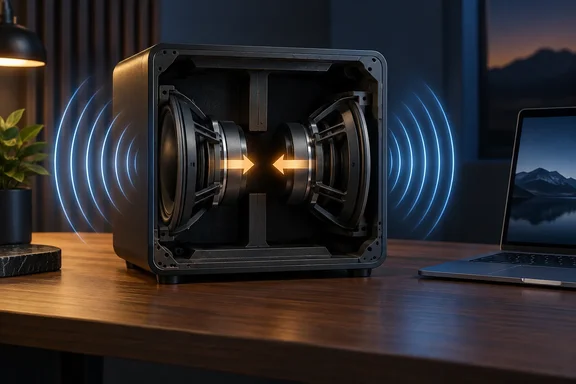
As How-To Geek explains, the design turns up in products as different as compact laptops and high-end home-theater subwoofers. The principle is real, not simply a premium-audio label—but it addresses one particular problem: unwanted movement of the speaker enclosure. It does not, by itself, guarantee deeper bass, higher maximum volume, or better sound than every conventional subwoofer.
What is being cancelled?
When a speaker cone moves forward to make sound, the driver motor and the cabinet experience an equal reaction force in the opposite direction. In a sufficiently heavy and rigid cabinet, that motion may be small. In a thin laptop chassis, a compact soundbar, or a powerful but relatively light subwoofer enclosure, it can be noticeable.
A single woofer can make its enclosure vibrate in several ways:
- The entire cabinet can rock slightly in response to the moving cone.
- Cabinet panels can flex and radiate sound of their own.
- The enclosure can pass vibration into a desk, TV stand, shelf, or floor.
- Components in a small device can buzz when the chassis resonates at particular frequencies.
A force-cancelling design places a second driver so the reaction force from one driver counteracts the reaction force from the other. The drivers must be closely matched, mounted in a mechanically opposed arrangement, and driven so their cone motion is synchronized correctly.
For example, one driver may face left and the other right. When both cones move outward at the same time, their acoustic output adds in the room, while the push on the cabinet from one driver is opposed by the push from the other. Some designs mount one driver inverted, which can change how the drivers must be wired to maintain the intended cone motion.
The important distinction is that the cabinet forces are being cancelled. At subwoofer frequencies, the driver spacing is generally tiny relative to the sound wavelength, so the bass output from the two drivers combines rather than disappearing.
Why it can make a meaningful difference
The most obvious result is a cabinet that remains comparatively still when it is producing bass. Manufacturers such as KEF, MartinLogan, and Arendal Sound use opposed-driver designs in dedicated subwoofers for this reason: reducing enclosure motion can reduce unwanted cabinet radiation and structural vibration.
That can be valuable in two very different product categories.
Thin PCs and all-in-one devices
A laptop, tablet, monitor, or all-in-one PC has very little room for a heavy, well-braced speaker cabinet. Its metal or plastic chassis can act like an unwanted resonator when small speakers attempt to reproduce lower frequencies.
Apple lists force-cancelling woofers in the six-speaker system of current MacBook Pro models. In that context, the design is less about delivering room-shaking sub-bass and more about producing fuller low-end sound without making the notebook’s chassis buzz under the user’s hands.
For PC buyers, this is one of the better places to regard force cancellation as a meaningful specification. It can help a compact device sound cleaner at moderately high volumes, especially with music, games, video, and dialogue-heavy content that includes bass effects. It will not turn laptop speakers into a replacement for a desktop speaker system or headphones, but it can reduce a common weakness of thin-device audio.
Compact, powerful standalone subwoofers
At the other end of the scale, a high-output home-theater subwoofer must move a substantial amount of air. A conventional cabinet can be made very rigid and heavy to control the reaction forces, but that adds size, mass, and cost.
Using two opposed drivers offers an alternative path: cancel much of the cabinet’s rocking force at the source. This can be particularly useful for a compact sealed subwoofer that is expected to play loudly without wandering across a hard floor or vibrating furniture as much as a lighter single-driver design.
It is also relevant for desktop audio. A small subwoofer placed under a PC desk can couple vibration into the desk frame, which may make keyboards, monitors, or loose objects buzz. A force-cancelling model may reduce that mechanical nuisance, although it cannot eliminate bass transferred through the air or through poorly isolated furniture.
What force cancellation does not solve
The feature is often described too broadly. A low-vibration enclosure is useful, but it is only one part of subwoofer performance.
A force-cancelling design does not automatically fix:
- Room modes, which can make bass boomy or nearly disappear at particular listening positions.
- Poor placement, including putting a subwoofer where its output strongly excites a room resonance.
- Weak amplification, excessive driver excursion, port noise, or poor DSP tuning.
- Distortion generated by the drivers themselves when pushed beyond their limits.
- Vibrations caused by a loose shelf, desk panel, window, or object in the room.
It also does not create free output. Two drivers provide more cone area than one, and that can support higher output, but they also add cost, complexity, amplifier demands, and thermal considerations. A well-engineered single-driver subwoofer with a rigid, properly braced cabinet can still be excellent.
The claim that force cancellation makes placement broadly irrelevant goes too far. It may make the enclosure less likely to shake nearby objects directly, but bass response in a room remains highly dependent on placement and the listening position. Moving a subwoofer by a short distance can substantially change perceived bass because of reflections and standing waves.
Is it worth paying extra for?
For a laptop, compact all-in-one PC, premium monitor with integrated speakers, soundbar, or portable speaker, the answer is often yes—provided the product is otherwise strong. In these space-constrained devices, force-cancelling woofers can reduce chassis buzz and make modest bass sound more controlled. It is a useful engineering choice because the alternatives are limited by size and weight.
For a dedicated home-theater or music subwoofer, it depends on the goal.
A force-cancelling model is worth serious consideration if you want:
- A compact enclosure with substantial bass output.
- Less physical vibration through furniture or a lightweight floor.
- Cleaner performance from a subwoofer placed near a desk, rack, or media cabinet.
- A design intended for music listening where enclosure coloration is an important concern.
It is less compelling if your budget is tight and the choice is between a smaller dual-driver model and a larger, better-performing conventional subwoofer. In many rooms, spending the difference on better placement, room correction, multiple subwoofers, or a sturdier cabinet design can produce a larger audible improvement.
The buying takeaway
Treat “force-cancelling” as a legitimate design feature rather than a promise of universally superior bass. It tells you that the manufacturer has used an opposed-driver arrangement to reduce mechanical vibration of the enclosure.
For compact PCs and other thin devices, that can be a practical sign of more careful audio engineering. For a separate subwoofer, it is most valuable when cabinet vibration, compact size, or vibration transfer to furniture matters to you. Compare the complete product—measured output, low-frequency extension, controls, size, placement needs, and price—rather than buying on the label alone.