

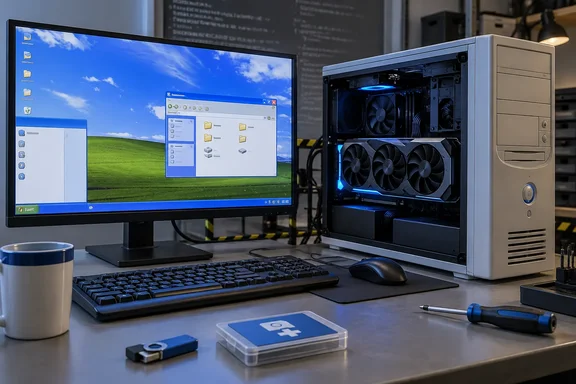
What the driver is
The project is a custom Nvidia 368.81-based driver for Windows XP 32-bit, released as Forceware 382.69. VideoCardz describes the base as Nvidia's old 368.81 Windows XP driver from July 2016. Nvidia's official XP package stopped at Maxwell GPUs.
The project's build guide says it applies binary patches, selected firmware resources and installer changes to that older driver. It says XP 368.81 already contained substantial Pascal hardware and graphics-class code. The patches connect and correct that code rather than writing a driver from scratch.
Firmware pieces come from two Windows 7-era packages: Quadro 376.84 and GeForce 378.78. The guide says these donors are the expanded nvlddmkm.sys files only, not whole driver stacks.
Which cards are covered
The repository lists these desktop cards:
- Maxwell: GeForce GTX 970, 980, 980 Ti and TITAN X (Maxwell). Quadro M4000, M5000, M6000 and M6000 24GB.
- Pascal: GeForce GTX 1060 (3, 5 and 6 GB), 1070, 1070 Ti, 1080 and 1080 Ti. TITAN X (Pascal) and TITAN Xp. Quadro P2000, P2200, P4000, P5000 and P6000.
- Experimental GP107: GTX 1050, GTX 1050 Ti, and Quadro P400, P600, P620 and P1000.
- Extras: additional desktop OEM variants of the GTX 950 and GTX 960.
Mobile GPUs, GP100 and GP108 are excluded. GP108 is the chip behind the GT 1030, which is why that card is missing. The README says the entries are INF additions, not validation of every model.
The release timeline
The project has moved quickly. The first release, dated 27 September, was described by ggmania as a modified 32-bit build of Nvidia's old 368.81 XP driver. A 3 October build removed GP100 and GP107 entries from the INF. The 4 October release fixed OpenGL initialization crashes on Pascal, verified with GTX 1080 Ti rendering tests, and restored GP107 desktop entries with experimental initialization.
If you read an earlier write-up, the GP100 and GP107 details may differ from what the repository says now. Check the current README before relying on any card list.
What changed in display handling
Much of the work targets modern monitors. The README describes these fixes:
- DisplayPort: HBR2 and HBR3 link training and extended receiver-capability detection. Mode selection is based on a link that trained successfully, with automatic 8-bit fallback when a higher colour depth does not fit.
- HDMI: HDMI 2.0 identification and SCDC scrambling and high-clock-ratio handling. Setup retries are bounded, with a safe-mode recovery if they fail.
- HDMI/DVI: handling that accounts for the GPU and monitor, with a 594 MHz HDMI ceiling. The build guide calls that ceiling an implementation choice, not HDMI 2.0's universal maximum.
- NVIDIA Control Panel: the Customize button is restored, DisplayPort identification is corrected and scaling and fixed-aspect settings are improved. System topology viewing and EDID loading are unlocked.
HBR3 support does not mean full DisplayPort 1.4. The README says DSC, HDR and MST are not implied.
What has actually been tested
The author's claims are narrow and worth reading carefully. These results come from the project's own documentation, not independent review:
- The 4 October build passed Direct3D 9 and five OpenGL rendering checks on a GTX 1080 Ti. The build guide adds that the card was installed through Windows PnP and rebooted. It reports 64 D3D9 draw and readback checks passing.
- The guide says the full Nvidia installer UI and other GPU models were not retested.
- GP107 hardware startup and rendering remain unverified. The guide says only offline execution checks have passed for that chip.
- DisplayPort tests on a GTX 980 Ti covered 3440×1440 at 100 Hz on HBR2 ×4 with RGB10. They also covered 60 Hz on a restricted HBR link with automatic RGB8 fallback, and 1080p on a restricted RBR link. Over-budget timings were rejected.
- For HDMI, the guide reports a normal picture at 3440×1440 and about 100 Hz. It also says a 594 MHz custom timing produced no visible picture.
- The guide lists areas it has not validated: DSC, HDR and MST, HDMI deep colour and YCbCr, suspend and resume, and full access to 8 GB and 11 GB of VRAM.
Third-party reports add some context. VideoCardz and Aroged both relay a user report of a GTX 1080 Ti on a Threadripper 7970X system, with working 3D acceleration, Control Panel support and 3840×1080 at 144 Hz. Aroged also says the community has noticed some issues with PhysX, OpenGL and OpenCL. These are anecdotal and they overlap with the project's own known gaps.
About the "vibe-coded" claim
Some social posts call the driver vibe-coded. One post on X says someone "vibe coded" the driver. Tom's Hardware notes that the repository doesn't say this and that it saw no obvious sign of it in the build instructions. I found no primary evidence either way, so treat the label as unproven. The more useful question is whether the work can be checked. The repository ships a Python patcher, C and assembly sources, patch manifests and hash-verified inputs.
Rebuilding and trust
The guide says a verified rebuild matched 584 outer-package files and all 469 Control Panel files byte for byte against its output. Compressed archives can still differ in hash because of compression, timestamps and tool versions. This shows the project is reproducible. It is not a security audit.
The project code is GPL-3.0-only with a narrow Nvidia integration exception. Nvidia's binaries and firmware keep their own terms. Rebuilders need the exact Nvidia packages, with matching SHA-256 hashes.
Windows XP 64-bit
Requests for 64-bit support have already appeared. One GitHub issue says "Your modded driver seems insane (pascal on xp) but I would really like a 64 bit version, for NT 5.2". A fork claiming a 64-bit build exists on GitHub, but Tom's Hardware reports the original fork was deleted and its binaries are now on Mega. I haven't verified either build. Third-party binaries with no inspectable source deserve extra suspicion.
Practical advice
- Use a test or retro machine, not one that holds data you care about.
- Confirm your card is on the list, and treat 1050 and 1050 Ti (GP107) as experimental.
- The modified display files no longer match Nvidia's original catalog signatures, as the build guide states. Keep a recovery path, such as an older driver or a second GPU.
- Start at low resolution, then try high refresh rates in bounded steps. The guide advises checking the actual link and depth and confirming the picture on screen.
- Expect gaps. Don't count on DSC, HDR or MST, and test your own games, audio and sleep behaviour.
Why it matters
Nobody should run XP on a machine that touches the internet. For retro gaming, though, a GTX 1080 Ti is far more capable than anything from the XP era, and this driver removes the need to match old cards to old operating systems. The display work also helps with modern ultrawide and high-refresh monitors, which XP-era drivers handle poorly.
The caveats matter as much as the headline. The tested hardware is small (a GTX 1080 Ti and a GTX 980 Ti plus user reports), the driver is unsigned and GP107 is unproven. The project is promising and clearly documented. It should still be treated as a hobbyist build.
References
- Modder brings Nvidia Pascal GPU support to Windows XP 32-bit Tom's Hardware · 2026-10-04T14:25:00+00:00
- GitHub - SupraGSX/Forceware-382.69: Custom NVIDIA 368.81-based XP 32-bit driver with Maxwell/Pascal desktop additions, OpenGL fixes, experimental GP107 support, improved DP/HDMI handling, restored Customize/DP scaling and topology unlock. Excludes GP100/GP108 and mobile GPUs. · GitHub github.com
- REBUILDING.md github.com