

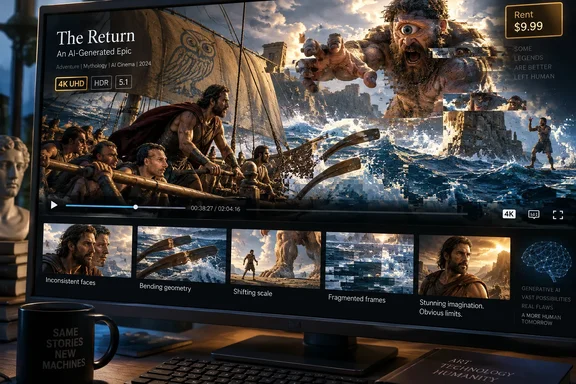
For Windows and PC users interested in generative-video tools, the significance is less whether this particular retelling of Homer succeeds as cinema. It is that Fountain 0 has turned the current AI-video stack into a consumer product with a feature-length running time, a direct web storefront, rented access, and a “4K UHD” label. The release shows that getting hundreds of generated clips into a sellable package is now possible. It also exposes how far that is from delivering the kind of shot-to-shot control, editorial continuity, and reliable performance expected of a conventional production.
Fountain 0’s own listing says the rental gives viewers 30 days to begin watching and 72 hours after playback starts. It does not advertise apps for Windows, Xbox, Roku, Apple TV, Fire TV, or other living-room platforms. The Verge reports that its reviewer had to mirror a phone screen to a television, an awkward delivery method for a release promoted partly through its visual quality.
The runtime is clear; the public metadata is not
There is a basic documentation problem around the release before the movie itself even begins. Fountain 0’s store and its September 16 announcement both list Odysseus: The Fall at 150 minutes — two and a half hours — which matches The Verge’s account. Rotten Tomatoes, however, lists a 2-hour-15-minute runtime.
That 15-minute discrepancy is not a trivial typo for a digital-only film asking audiences to rent it sight unseen. It raises an obvious question: are there multiple cuts, has one listing not been updated, or is a third-party database carrying incorrect information? Fountain 0’s release materials do not explain the difference. For a new distribution system that asks viewers to transact directly with the producer, accurate runtime, supported playback devices, captioning, audio options, and video specifications are part of the product — not background details.
The company’s storefront also labels the stream “4K UHD,” while its announcement says its internal Fountain 0 engine operated on top of Kling and credits the Kling 3.0 series with native 4K output. Those statements establish a claimed delivery format and describe the source technology, but they do not answer practical questions viewers would normally expect a video service to disclose: bitrate, codec, HDR availability, browser DRM requirements, bandwidth recommendations, or whether a 4K display will receive 4K rather than a lower-resolution stream.
The gap matters because 4K is a resolution claim, not a continuity guarantee. More pixels can make an image sharper. They do not ensure that an actor’s face, prop, body position, lighting, geometry, or spoken dialogue remains stable from one generated shot to the next.
A feature-length stress test for generated video
Fountain 0 says writer-director Ash Koosha created the film himself over four months of part-time work, with every scene and image generated by AI. The company says its proprietary software handles pre-production, image generation, and post-production, while Kling supplied the underlying video-model capability. It also says 13 real people licensed their images for use as characters, including Koosha as Odysseus.
That is a more ambitious claim than using AI to make trailers, title sequences, visual effects plates, or isolated short films. A 150-minute feature has to carry identities, geography, time, action, dialogue, costume, and cause-and-effect across thousands of editorial decisions. That is exactly where the distinction between a compelling demo and a usable production pipeline becomes visible.
According to The Verge, the film repeatedly breaks down on those basics: the cyclops changes height between shots; waves move contrary to the apparent wind; oars bend and twist; mouths fail to line up with dialogue; and a boat in a larger fleet moves sideways. The review also reports names being pronounced incorrectly and scene elements transforming unexpectedly, including a sword becoming a dagger.
Each example on its own could be filed as a generation artifact. In aggregate, the report describes the technical limitation that current generative-video systems still struggle to solve: persistence. Models can generate an impressive individual frame or several seconds of motion, but a feature requires the system — and its human editor — to preserve the rules established by earlier shots.
A conventional set solves many of these problems before post-production begins. The same actor, costume, prop, lens, location, lighting plan, and physical laws remain available for the next setup. Script supervisors and continuity departments track what was said, held, worn, damaged, and moved. The fact that an AI production replaces those constraints with generation and selection does not remove the work. It shifts it into prompt design, reference management, iteration, compositing, editing, and quality control.
Fountain 0 presents its software as the layer that makes that process manageable. The Verge’s review suggests that, at least in this release, the layer did not keep the model’s errors out of the final cut.
The company’s comparison makes the flaws harder to ignore
Fountain 0 explicitly positioned its film alongside Christopher Nolan’s The Odyssey, arguing that AI makes it possible for vastly more low-cost productions to be created. That comparison is the company’s marketing choice, not a standard imposed by critics. It creates a test the company’s own materials do not meet: not whether a one-person team can generate a feature, but whether the result merits the “Hollywood blockbuster” framing used in its announcement.
The defensible technical accomplishment here is scale. A single creator assembled and released a long-form narrative from generated material, and Fountain 0 put it behind a rental transaction rather than merely publishing a proof-of-concept reel. The company also previously brought Dreams of Violets, another fully AI-generated project, to the 2026 Tribeca Festival; Forbes reported that the festival confirmed the earlier film was in its official program.
But “feature length” and “blockbuster level” are different claims. The former can be measured in minutes. The latter depends on the repeatability of characters and environments, intelligible vocal performances, coherent action, pacing, and a finished viewing experience that holds together away from a developer’s demo environment.
The Verge’s review argues that the film’s AI errors became its most watchable element because the surrounding narrative was so difficult to follow. That is an artistic judgment from one outlet, and no broad critical consensus exists yet: Rotten Tomatoes currently lists no critic reviews and no audience ratings for the film. Still, the absence of an established review record makes the first complete hands-on assessment more important for prospective renters, particularly when the official marketing makes unusually large quality claims.
The real product is the workflow, and it needs disclosure
The most consequential part of Odysseus: The Fall may be Fountain 0’s claim that it can lower token costs and let small teams create films cheaply and quickly. That proposition will attract independent filmmakers, PC enthusiasts experimenting with local and cloud AI tooling, and companies looking to reduce production costs.
Cost alone, though, is not a useful measure if it excludes the labor required to fix or accept model failures. Fountain 0’s earlier claims around low-budget AI filmmaking deserved scrutiny for the same reason: a cash figure may omit subscriptions, cloud generation, failed iterations, storage, editing, legal review, marketing, rights management, and the creator’s unpaid labor. The company has not published an itemized production cost for Odysseus: The Fall, nor has it disclosed how many generations, rejected clips, human edits, or third-party tools were required to complete it.
The release also makes clear that likeness licensing will be central to Fountain 0’s business model. The company says it intends to recruit public figures and other partners to license their images for future productions. That is more concrete than generic talk about AI “democratizing” filmmaking: it points toward a production system where the rights to recognizable identities may become as important as access to models and compute.
For viewers, the immediate consequence is simpler. Odysseus: The Fall is a $9.99, 150-minute test of whether today’s AI-video workflows can sustain a story after the novelty of individual shots wears off. Fountain 0 has made the test available; its incomplete technical disclosure and The Verge’s account of the finished film suggest the technology has not yet earned the blockbuster comparison the company chose to make.
References
- The 2.5-hour AI-generated Odyssey movie is 2.5 hours too long The Verge · 2026-09-16T20:59:13+00:00