

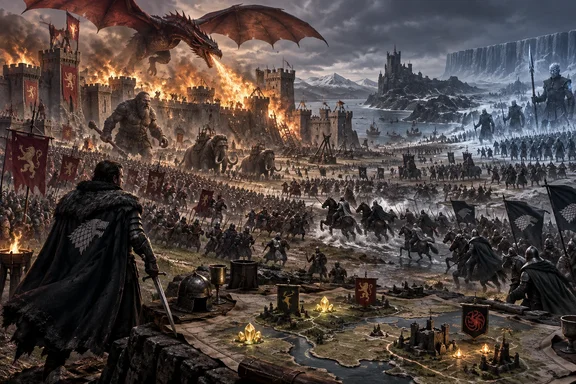
That approach emerged in a gamescom interview with Wccftech, following the game’s August gameplay reveal and the subsequent addition of Arya Stark and Gregor “The Mountain” Clegane to its hero lineup. PlaySide has confirmed the core facts elsewhere: the Melbourne studio is developing and publishing a PC strategy game for Steam, built around House Stark, House Lannister, House Targaryen and the White Walkers, with both a solo conquest campaign and multiplayer skirmishes.
For PC players, the news is less that another licensed Game of Thrones game exists than that PlaySide is making a specific trade. War for Westeros wants the accessible, hero-driven drama of a game such as Marvel Rivals or Super Smash Bros. while retaining the map control, resource collection and counter-unit decisions of a conventional RTS. Whether that hybrid can sustain a multiplayer audience will depend on the parts of the game the studio has not shown in detail: networking performance, unit responsiveness under load, map design, match pacing, and the counterplay available once a player has reached their faction’s most destructive options.
The late game is where PlaySide wants the television fantasy
Game Director Ryan McMahon told Wccftech that balance remains important, but “the rule of cool comes first.” In context, that does not mean every unit is intended to be equally strong. It means PlaySide plans to balance the route to high-impact units and abilities rather than flatten their effects after players finally unlock them.
The model is familiar to RTS players, but the emphasis is different. A Lannister player who reaches wildfire, a Targaryen player who earns access to dragons, or a faction that brings giants and mammoths onto the field should be able to change the complexion of a match quickly. McMahon’s comparison to hero-focused action games is revealing: PlaySide is pursuing high-visibility moments that can be understood immediately, including by Game of Thrones fans who may have little experience with build orders or unit compositions.
That can work, especially for a license whose most recognizable imagery is built around decisive events: a dragon burning an army, cavalry breaking a line, a hero surviving impossible odds, or an alliance changing the outcome of a war. But it also creates a hard design problem. Spectacle does not become strategic merely because it arrives late in a match. If the required buildup is too safe or too predictable, players will regard the decisive unit as an inevitable timer rather than an earned advantage. If the answer to a dragon or wildfire is too narrow, the game risks becoming a race toward the same few finishing moves.
The publicly shown material gives some reason to think PlaySide understands that pressure. Its earlier development update, covered by PC Gamer, stressed physical impact and composition-based counters. Cavalry is supposed to be able to run through vulnerable infantry formations, while spear-equipped anti-cavalry units can halt a charge and punish the attacker. Wccftech’s interview adds more detail: units have a broad type — infantry, cavalry or ranged — alongside weight classes and roles such as anti-cavalry or anti-infantry.
That system is potentially more important than the named heroes. If charge interactions, knockdowns, pathfinding and formation counters remain legible when dozens or hundreds of units are moving, War for Westeros could give casual players a readable reason why their army won or lost. If those interactions are buried beneath visual clutter and hero effects, the “rule of cool” will make losses feel arbitrary.
Asymmetry is doing more work than the two-resource economy
PlaySide is reducing some of the traditional RTS workload. Instead of asking players to direct workers across several resource types, War for Westeros uses gold as its primary currency and influence as a secondary resource for heroes, advanced research and late-game units. McMahon characterized construction and income as comparatively hands-off once the appropriate gathering structures are built.
That is a meaningful concession to the audience PlaySide is pursuing. RTS newcomers often struggle not because they cannot understand unit counters, but because they are simultaneously expected to manage workers, construction queues, scouting, army positioning, upgrades, control groups and several scarce materials. Reducing the macro burden can leave more attention for the battlefield, where the Game of Thrones license has its strongest appeal.
The risk is that fewer resources can also reduce the number of meaningful tradeoffs. PlaySide’s answer appears to be stronger faction mechanics rather than a universal economic model with cosmetic faction skins.
The Lannisters are the clearest example. Wccftech reports that they can go into debt, repay it later, and exchange gold for influence — a mechanical interpretation of the family’s wealth and political leverage. They can also sign a single mercenary contract at a time, making the contracted force available for production. The Golden Company has been named as one such option.
That gives Lannister players an identifiable choice: accept future economic pain to assemble power now, or preserve stability and arrive later. It is also the sort of asymmetric mechanic that will be difficult to tune in multiplayer. Debt systems are exciting precisely because they enable a player to break normal limits. If they are too forgiving, every Lannister match risks becoming an early all-in attack backed by mercenaries; if they are too punitive, the faction’s signature tool becomes a trap that only experts can use.
The other factions have not yet received equivalent mechanical detail. PlaySide has said each house and the White Walkers will have distinct armies, buildings and strategies, while official material has shown the Targaryens fielding forces such as the Dothraki and Unsullied. But the studio has not published a full faction breakdown, fixed hero roster, tech-tree outline or multiplayer balance plan. The promise of asymmetry is credible; the scope of it is still largely marketing language until the beta gives players access to more than selected demonstrations.
The campaign is a sandbox, not a retelling of season eight
War for Westeros is avoiding a single canonical point in the HBO timeline. McMahon told Wccftech that PlaySide is pulling characters, factions and elements from across the series and handing the player a sandbox conquest of the Seven Kingdoms. Players can decide alliances, betrayals, the heroes they use, which faction prevails and who takes the Iron Throne.
That framing is the game’s sensible answer to an awkward licensing problem. A direct strategy-game adaptation of the show would either force players through outcomes they already know or spend much of its campaign trying to preserve continuity across a story where major characters repeatedly die, disappear or change sides. A sandbox instead lets the studio use Jon Snow, Daenerys Targaryen, Tywin Lannister, Jaime Lannister, Arya and the Night King without committing to a single version of events.
Official gameplay materials and the Steam listing corroborate the broader premise: solo conquest and online PvP skirmishes are planned, and the game’s central promise is to rewrite the fate of the realm. The newly announced Arya and Gregor reinforce the direction. Arya’s revealed ability set centers on assassination and face-changing deception, while Gregor is positioned as a brutal Lannister front-line presence. Those are strong fantasy roles, but they also raise a familiar RTS concern: powerful heroes need to complement the army game rather than replace it.
PlaySide’s stated campaign structure could help. McMahon said territorial decisions on the strategic map will influence the skirmish battle that follows. A battle for the Neck, for example, may be affected by nearby holdings, while the maps themselves draw on named Westerosi locations including the swampy Neck and Ashemark. The useful question for the beta is whether those territory bonuses create distinct tactical situations or merely provide statistical advantages before a battle begins.
A campaign where geography, alliances and territory meaningfully alter how battles play would give the game replay value beyond alternate endings. A campaign where the map layer only feeds passive buffs into standard skirmishes would make “rewrite the show” a thinner proposition than it sounds.
PC is confirmed; consoles and Steam Deck support are not
The clearest release information remains narrower than some coverage has suggested. Steam lists War for Westeros for release in 2027, while PlaySide’s gamescom announcement specified early 2027 for PC via Steam. The store page confirms single-player, online PvP, co-op, Steam Cloud, achievements and Family Sharing, but its minimum and recommended system-requirements fields still say only “Coming Soon.”
That absence matters more than usual for a game selling large-scale simulated battles. PlaySide says it is using Unreal Engine but has built a deterministic simulation layer underneath it to manage pathfinding, unit movement and other battlefield behavior. Determinism is important in multiplayer strategy games because every client must resolve the same match state consistently. The studio has not yet explained its netcode model, supported player counts, hardware targets, frame-rate expectations, or how the simulation scales during the largest advertised fights.
A closed beta is planned, and PlaySide has said it wants feedback as well as technical data on larger-scale play. That beta should be treated as a test of the game’s most consequential claim: can its cinematic combat remain responsive and intelligible when the spectacle is no longer a curated trailer sequence?
Console plans are also unsettled. Wccftech reports that McMahon described controller support and a console port as possibilities to consider after the PC launch, and said Steam Deck support was desired but not guaranteed at release. That account conflicts with a September Factornews interview that described the game as arriving on PC and consoles. The official Steam page currently lists no console platform, and PlaySide’s own announcements describe the release as PC-built and Steam-bound. Until PlaySide announces otherwise, PC is the only confirmed launch platform.
The game is also delayed from its original 2026 target. PC Gamer reported in July that PlaySide moved it to early 2027, with the studio saying its original schedule had been too ambitious. That makes the forthcoming beta more than a promotional milestone. It is where players should finally learn whether War for Westeros can marry its two ambitions: approachable, television-scale drama for newcomers and enough counterplay, performance and strategic depth to keep dedicated PC RTS players interested after the dragons arrive.