

Launch dates and where you can play
NVIDIA says E-Day launches with DLSS 4.5, RTX Mega Geometry and ray tracing on GeForce RTX. The dates need care.
- October 1: Premium Edition early access began. That is the date on NVIDIA's first post.
- October 6: worldwide launch. Xbox Wire says the game is on Xbox Series X|S, Xbox on PC, Game Pass and Steam. It adds that the game can be played on console and PC at no extra cost with Xbox Play Anywhere.
Treat October 1 as early access, not the general release. The October 6 NVIDIA post is the "available now" update.
RTX Mega Geometry: the technical story
E-Day is built on Unreal Engine 5 and DirectX 12 by The Coalition, and it leans heavily on Nanite. Nanite is Unreal's virtualized geometry system, which scales detail automatically.
NVIDIA says ray tracing causes a problem. Nanite objects fall back to a single static, low-detail mesh for ray tracing, because building acceleration structures for the full geometry is too expensive with existing DXR 1.2 and Vulkan APIs. The object looks full-detail on screen. Its ray-traced shadow or reflection comes from the simplified stand-in, which causes discontinuities and artifacts.
NVIDIA says RTX Mega Geometry fixes this after six years of research. It says the feature debuts in E-Day and will be adopted by DirectX Raytracing 2.0. That would make ray-traced Nanite possible in any Unreal Engine 5 game. The DXR 2.0 adoption is NVIDIA's claim about future plans. It is not a shipped feature.
What NVIDIA shows
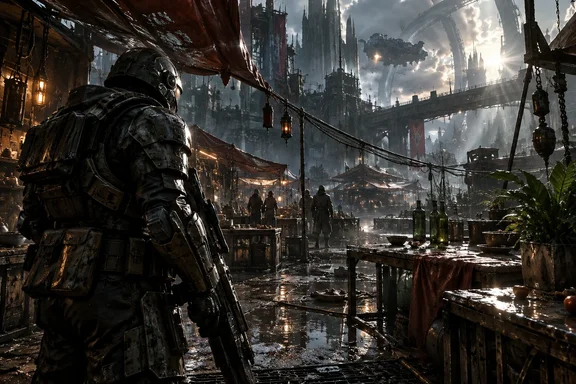
NVIDIA's examples come from the "Market" multiplayer map. It says:
- More objects enter the ray-traced scene, and each has more geometry. It names fish, lobsters, freezer bins, a weight scale and floor mats.
- Ropes on the back wall are now complete in the ray-traced scene.
- Plants, glass bottles and planter shelves that were missing now appear.
- Missing or incomplete shadows are corrected, and glossy reflections on metal tables improve.
- Shadows and reflections flicker or artifact less when the player or camera moves.
These are NVIDIA's own visualizations, not independent measurements. Independent coverage is more measured. A Gizbot review of an RTX 5070 said ray-traced shadows and reflections add plenty to the atmosphere, while RTX Mega Geometry brings smaller improvements. In a hands-on piece, Tom's Guide was more enthusiastic. It said that after cranking up settings to Ultra and bumping up frame rates with DLSS 4.5, it was easy to take the game beyond its console roots. In short, the feature is visible and measurable, but how much you will notice it depends on the scene.
The VRAM threshold
NVIDIA states that you need a GeForce RTX GPU with at least 12GB of VRAM to enable RTX Mega Geometry. This is a requirement for that one feature, not the game's minimum spec. If you have an 8GB card, you can still use the game's other RTX features, but you shouldn't expect this setting to be available.
DLSS 4.5, Frame Generation and Reflex
NVIDIA says E-Day supports DLSS 4.5 Super Resolution, Frame Generation and Dynamic Multi Frame Generation. All GeForce RTX players can use the first two. Dynamic Multi Frame Generation is for the RTX 50 Series. It allows up to 6X frame generation, or adjusts the multiplier on the fly to hit a frame-rate target you pick.
Reflex can be switched on in the graphics settings. NVIDIA says it works in single-player, co-op and competitive modes, and cut PC latency by up to 50% in its own campaign benchmark.
NVIDIA's benchmark claims
All of these figures are NVIDIA's. They use a fixed 6X multiplier, Ultra preset ray tracing and RTX Mega Geometry.
| Resolution | NVIDIA's average multiplier vs native | Reported frame rates |
|---|---|---|
| 4K | 7.5X | Up to 410 FPS (RTX 5090), over 290 (RTX 5080), 250 (RTX 5070 Ti) |
| 2560x1440 | 5.8X | Up to 500 (5090), 380 (5080), 330 (5070 Ti), 275 (5070) |
| 1920x1080 | 5.8X | 300 FPS on all benchmarked RTX 50 Series GPUs, up to 600 on the 5090 |
These numbers show how high the displayed frame rate gets with generated frames. They do not show how fast the game renders natively. Generated frames raise smoothness, but your inputs are still sampled at the rendered rate, which is why Reflex matters. NVIDIA doesn't publish the full test-system details in the post, and I found no independent reproduction of these specific figures.
A more sober independent data point comes from DSOGaming. At native 4K on its "Ludicrous" settings with RTX Mega Geometry, an RTX 5090 hit a minimum of 28FPS and an average of 34FPS. With DLSS 4.5 Quality mode, it reached 49/56FPS. That is a very different picture from 410 FPS. The gap comes from the generated frames and from different settings, so it is not necessarily a contradiction. Still, it shows how much the headline number depends on the multiplier.
Other pieces and caveats
- Drivers: NVIDIA recommends its E-Day Game Ready driver, available through its website or the NVIDIA app. It gives no driver version in the post, so check the app for the current one.
- Other upscalers: an Xbox Wire spotlight from August, as summarized by the gamers.wiki site, lists AMD FSR, Unreal TSR and Intel XeSS alongside DLSS. It also lists Advanced Shader Delivery for supported storefronts. These come from a secondary summary, so confirm them in the in-game menu.
- GeForce NOW: NVIDIA's page says the game can be streamed, but I can't confirm that the cloud version has DLSS 4.5, ray tracing and RTX Mega Geometry from day one. NVIDIA's own wording elsewhere ties those cloud features to "soon".
- Xbox's own claims: Xbox lists the game at $69.99 and states 4K and up to 60FPS across campaign and multiplayer on a compatible display. It doesn't give PC minimum specs in the launch guide.
- Promotion: NVIDIA's "definitive PC experience" is marketing language, and the GPU giveaways on its page add nothing technical.
What to do on your PC
- Install the E-Day Game Ready driver from the NVIDIA app or website.
- Open the graphics settings and enable Reflex.
- Choose a DLSS 4.5 Super Resolution mode that fits your GPU.
- Add Frame Generation if your base frame rate is already playable. On an RTX 50 Series card, try Dynamic Multi Frame Generation with a target frame rate.
- If your card has 12GB or more of VRAM, try RTX Mega Geometry and compare the shadows and reflections yourself.
Bottom line
E-Day is a showcase for ray-traced Nanite. NVIDIA's real claim is technical: Mega Geometry makes ray tracing use the detail you actually see. The strongest evidence for that is NVIDIA's own comparison images, with mixed but mostly positive independent impressions. The big FPS figures are best read as best-case results on RTX 50 Series cards. Whether DXR 2.0 adopts the approach is something to watch, because that is what would make this more than one game's feature.
References
- Gears of War - NVIDIA - NVIDIA NVIDIA · 2026-10-01T15:00:00+00:00
- Gears of War: E-Day Out Now With DLSS 4.5 - NVIDIA NVIDIA · 2026-10-01T15:00:00+00:00
- Gears of War: E-Day PC Performance Review: RTX 5070 Tested at 4K - Gizbot News gizbot.com